June 6, 2026
What Is British Folklore? A Gentle Introduction to the Stories Beneath the Landscape
British folklore is easiest to misunderstand when it is treated as a single book of old beliefs. It is not. There is no authorised list of British legends, no national handbook of fairies, no agreed catalogue of lucky objects and unlucky days that every village once followed.
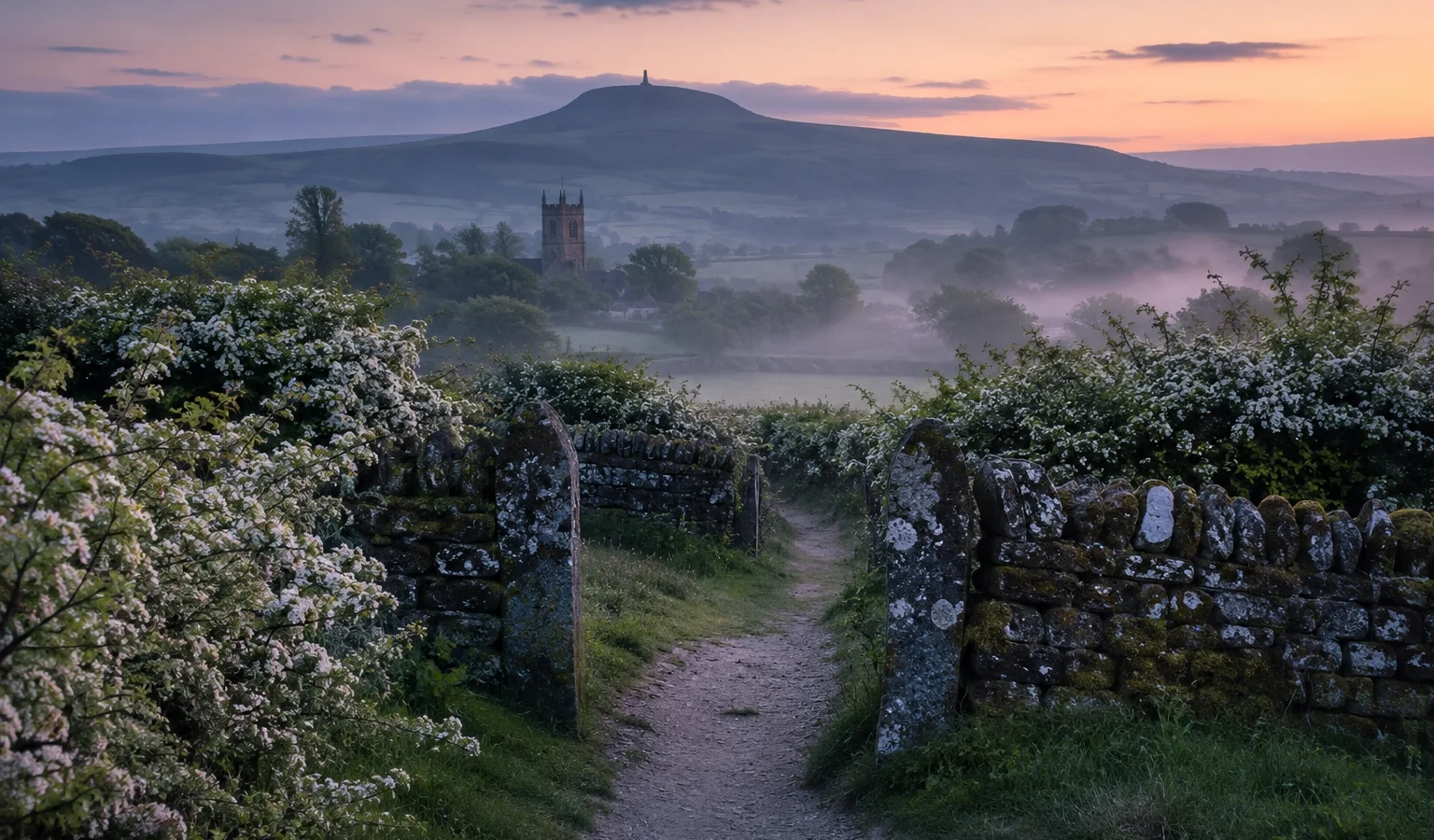
British folklore is better understood as a living body of traditional culture: stories, sayings, customs, beliefs, songs, games, seasonal practices, charms, warnings, jokes and explanations that people pass between one another. Some are centuries old. Some are surprisingly recent. Many change as they travel.
That is why the British landscape can feel so crowded with stories. A ruined castle may collect a ghost. A standing stone becomes a petrified king. A spring acquires a saint, a cure or a wishing custom. A dangerous bend in a road develops a black dog. A tree beside a well gathers ribbons, coins or scraps of cloth. The place remains real; the stories gather around it.
The most useful way to enter British folklore is therefore not to ask, “Which of these stories is true?” as if every tradition were making the same kind of claim. A better question is: what sort of tradition is this, who recorded it, where was it told, when does it first appear, and what did people do with it?
Folklore is not a shortcut around evidence. It is a way of seeing how stories, customs and places carry meaning through time.
British folklore is larger than folktales
The word folklore often makes people think first of stories: fairies, dragons, ghosts, giants, witches and wandering kings. Stories are certainly part of it, but the field is much wider.
A local saying about the weather can be folklore. So can a children’s game, a wedding custom, a rhyme attached to a place-name, a belief about rowan above a doorway, a tradition of tying cloth at a well, or the warning that a particular road should not be travelled after dark.
Some folklore is verbal. Some is practical. Some survives in objects and places. A charm may be worn rather than recited. A seasonal custom may be performed without anyone being able to explain its origin. A legend may exist in several contradictory versions because neighbouring communities remember it differently.
This breadth matters because it prevents British folklore from being reduced to “old supernatural stories”. It includes belief, but it also includes habit, humour, memory and social practice.
Myth, legend and folktale are not quite the same thing
In ordinary conversation the words myth, legend and folktale are often used interchangeably. Folklorists and historians usually find it more useful to distinguish them, even though the boundaries are not perfect.
Myths often concern gods, origins or the structure of the world. They may explain how a people, place or custom came to be.
Legends are usually tied more closely to named people and identifiable places. A legend may claim that a king slept beneath a hill, that a saint struck a spring from the ground, or that a particular ghost walks a particular lane. A legend can contain historical elements without being a reliable historical record.
Folktales tend to travel more freely. Their characters may be less attached to one documented person or location, and their plots often appear in many countries in recognisably related forms.
These categories help us ask better questions, but real traditions do not always remain politely inside them. King Arthur can be approached as a legendary ruler, a literary character, a national symbol and a figure of local folklore at the same time. Robin Hood belongs to ballad, legend, local tradition and later popular literature. The categories overlap because traditions grow by borrowing.
| Term | Usually points towards | A careful question to ask |
|---|---|---|
| Myth | Origins, gods, sacred order or the structure of the world | What larger explanation or worldview is the story serving? |
| Legend | Named people, places, events or local landmarks | What historical evidence exists, and what belongs to later retelling? |
| Folktale | Travelling story patterns, repeated plots and recognisable motifs | How does this version compare with similar tales elsewhere? |
| Custom | Repeated action, seasonal practice, household habit or public performance | Who performed it, when, where and why? |
| Belief | Ideas about luck, danger, healing, omens or unseen forces | Who recorded the belief, and what evidence does the source actually provide? |
Why British folklore is so local
British folklore often becomes most interesting when the map gets smaller.
A national summary can tell us about dragons, black dogs, holy wells or fairy beliefs, but local traditions frequently refuse to behave like neat categories. The black dog of one county may warn travellers. Another may terrify them. A third may be attached to a churchyard, bridge or stretch of coast. The shared motif matters, but so does the local version.
This is why phrases such as “the British believed” should be used carefully. Britain contains several nations, many historical languages, different religious traditions, distinct regional identities and enormous variation between counties, islands, towns and villages. A custom recorded in Cornwall should not automatically be treated as evidence for Yorkshire. A nineteenth-century Suffolk story is not necessarily an ancient pan-British belief.
British folklore becomes clearer when we keep its geography attached: a legend should be read with its county, collector and earliest trace, not lifted out of place and turned into a national rule.
Stories cling to real places
One of the strongest features of British folklore is its attachment to landscape.
English Heritage has pointed out how myths, legends and folktales become connected with castles, hills, forests, wells and ancient monuments. The place can give a story authority: you can stand beside the stone, walk the road or see the ruined wall for yourself.
But the relationship works in both directions. Stories also change the way places are understood.
Tintagel is a good example. The site has genuine early medieval archaeology, but its fame as the place of Arthur’s conception comes from Geoffrey of Monmouth’s twelfth-century writing. Later generations built, visited and interpreted the place through that Arthurian association. The legend did not prove the archaeology; the archaeology did not prove the legend. Together they created a cultural landscape with several layers of meaning.
This process repeats across Britain. Prehistoric monuments become the work of giants or the Devil. Hills hide sleeping heroes. Caves contain secret courts. Bells are heard beneath drowned villages. A tree is remembered because someone once made a promise beside it.
This is one reason British folklore often feels rooted rather than abstract: landscape and narrative reinforce one another until a place becomes difficult to separate from the story told about it.
For a closer look at this pattern, see our guide to why folklore clings to real places.
British folklore is not the same thing as history
A folkloric tradition can be historically important without being historically accurate.
Suppose a nineteenth-century collector records that villagers believed a particular stone had once been a dancing woman turned to rock. The record may be excellent evidence that the story was being told in that place at that time. It is not evidence that the transformation happened, nor does it automatically prove that the story was already ancient when it was collected.
This distinction is simple but essential.
Folklore sources tell us about people, memory, imagination and belief. Archaeology tells us about material remains. Documentary history works with written evidence produced in particular contexts. Literature may preserve older traditions, reshape them or invent new ones. These forms of evidence can illuminate one another, but they are not interchangeable.
A grounded approach does not weaken folklore by saying this. It makes the surviving tradition more interesting. We can ask why a community wanted a king beneath the hill, why a churchyard needed a black dog, or why a spring collected healing stories without pretending that the legend is an archaeological report.
Old does not always mean ancient
Folklore has a habit of becoming older in the retelling.
A custom described as “ancient” online may turn out to have been first recorded in the nineteenth century. A supposedly Celtic belief may be based on a Victorian antiquarian’s interpretation. A modern ritual may borrow genuine historical symbols but arrange them in a form no earlier source describes.
That does not make modern folklore worthless. New folklore is still folklore.
The stories surrounding the Beast of Bodmin Moor or the Hairy Hands of Dartmoor show that modern places can produce modern legends. Contemporary rumours, newspapers, tourism, television and the internet all participate in folklore-making just as older communities used oral storytelling, chapbooks, sermons, ballads and local gossip.
The useful question is not always “Is this ancient?” Sometimes it is “When did this version emerge, and why did people keep repeating it?”
British folklore changes when people repeat it
Variation is not a defect in folklore. It is one of its defining qualities.
A story told by one family may differ from the version printed by a local historian. A newspaper can simplify a legend. A tourist leaflet may choose the most dramatic variant. A novelist can add an episode that later readers assume was traditional. Social media can compress several regional beliefs into a single neat list.
This makes source-tracing especially important. If three websites repeat the same sentence, they may not represent three independent traditions. They may all be copying one modern source.
Folklore research often means moving backwards: from a modern claim to an older local history, from that history to a collector’s note, and from the note to the earliest surviving source that can actually be identified.
Sometimes the trail ends quickly. That is useful information too.
What counts as evidence in British folklore?
Different sources answer different questions.
A medieval manuscript can show that a story existed in written form by a certain period. A parish record may establish that a person or event was real. A museum object can show that people carried, wore or deposited particular things. A nineteenth-century folklore journal may preserve a local belief. An oral-history recording can show how a tradition was remembered in the twentieth century.
None of these should be made to say more than it can.
Museums provide a good example. The British Museum holds amulets and charms that demonstrate the real use of protective or healing objects in particular periods and contexts. That is evidence of practice and belief. It is not evidence that the charm produced the promised supernatural effect.
This distinction — belief is real even when efficacy is unproven — is one of the most useful habits a British folklore reader can develop.
A source can prove that a belief was held, repeated or recorded without proving that the belief worked in the way people hoped.
Folklore and religion
Folklore is sometimes presented as if it were a separate pagan layer hiding beneath organised religion. British material is rarely that tidy.
Christian saints, church bells, holy wells, pilgrimage, charms, prayers, seasonal customs and local supernatural beliefs have interacted for centuries. Some practices were accepted by clergy in one period and condemned in another. Some combined devotional and protective meanings. Some customs changed after the Reformation. Others were reinvented by antiquarians, folklorists or revival movements.
It is therefore better to describe a documented religious or folk practice in its own context than to force everything into a simple “pagan versus Christian” story.
Living religious traditions also deserve the same care. A custom may be folklore to an outside researcher and sacred practice to the people who observe it. Description should not become mockery.
Fairies, ghosts and the question of belief
Readers do not need to believe in fairies or ghosts to find fairy and ghost traditions worth studying. Equally, people who do believe should not be treated as specimens in a cabinet.
Historical belief was rarely a single switch marked “believes” or “does not believe”. People could tell a story, repeat a warning, avoid a place after dark and still joke about the whole thing. A custom might be followed because “it is better not to risk it”, because grandparents did it, or simply because it belonged to the place.
That ambiguity is valuable. Folklore often lives in the space between certainty and play.
When a source says that a black dog was considered an omen, the safest reading is exactly that: some tradition or informant associated the animal with an omen. We do not need to upgrade the statement into a supernatural fact, nor downgrade it into stupidity.
Why British folklore survives
British folklore survives because it remains useful.
Stories explain strange features in the landscape. They mark dangerous places. They give communities memorable local characters. They turn ruins into narrative landmarks. They carry warnings, jokes, moral lessons and family memories. They give ordinary objects a history larger than their material value.
They also make places easier to remember.
A hill with a sleeping king is harder to forget than an unnamed mound. A bridge haunted by a black dog acquires personality. A spring associated with a saint becomes part of a route, a ritual and a local calendar.
Folklore does not survive only by resisting change. It survives by being changed carefully enough that people still recognise something worth passing on.
How to begin researching a local tradition
If a story from your own town catches your attention, begin locally and resist the temptation to search immediately for a universal meaning.
Write down the exact version you heard. Record the place-name. Ask who told it and whether they learned it locally. Search local-history books, county folklore collections, newspaper archives, museum catalogues and heritage records. Note the earliest version you can actually date.
Then compare.
Does the same motif appear elsewhere? If it does, are the details identical or only broadly similar? Does a modern website claim an origin that older sources never mention? Is the story attached to genuine archaeology, or did the archaeological site simply provide a dramatic stage for later legend?
This method gives a grounded way to research British folklore without flattening local tradition into generic internet folklore.
A grounded way into the Hawthorn Archive
At Hawthorn & Key, folklore is approached as something that becomes richer when its layers are kept visible. A legend can be beautiful without being presented as documentary fact. A charm can be historically fascinating without being sold as guaranteed protection. A place can carry centuries of story without every version needing to be equally old.
This is the approach used throughout the Hawthorn Archive: begin with the surviving evidence, keep local variation intact, identify later retellings when possible, and leave room for atmosphere without turning uncertainty into certainty.
British folklore is not a secret code waiting to be decoded. It is closer to a landscape after rain: old paths become visible, newer tracks cross them, some routes disappear, and every generation leaves another set of footprints.
The pleasure lies not in pretending all the footprints were made at the same time, but in learning how to see them.
Sources & Further Reading
- Carolyne Larrington, “Where Do Myths, Legends and Folktales Come From?”, English Heritage.
- Jacqueline Simpson and Steve Roud, A Dictionary of English Folklore, Oxford University Press.
- Steve Roud, The English Year: A Month-by-Month Guide to the Nation’s Customs and Festivals, from May Day to Mischief Night, Penguin.
- Jennifer Westwood and Jacqueline Simpson, The Lore of the Land: A Guide to England’s Legends, from Spring-Heeled Jack to the Witches of Warboys, Penguin.
- Folklore Society, journal Folklore and society resources on traditional and vernacular culture.
- British Museum collection record for an amuletic necklace associated with popular belief in Britain.