June 13, 2026
What Are Tarot Cards? A Clear Beginner’s Guide
A tarot deck can look more mysterious than it really is. To answer the question what are tarot cards, it helps to begin simply: they are a structured deck of cards with a history in European play, later occult interpretation and modern symbolic use.
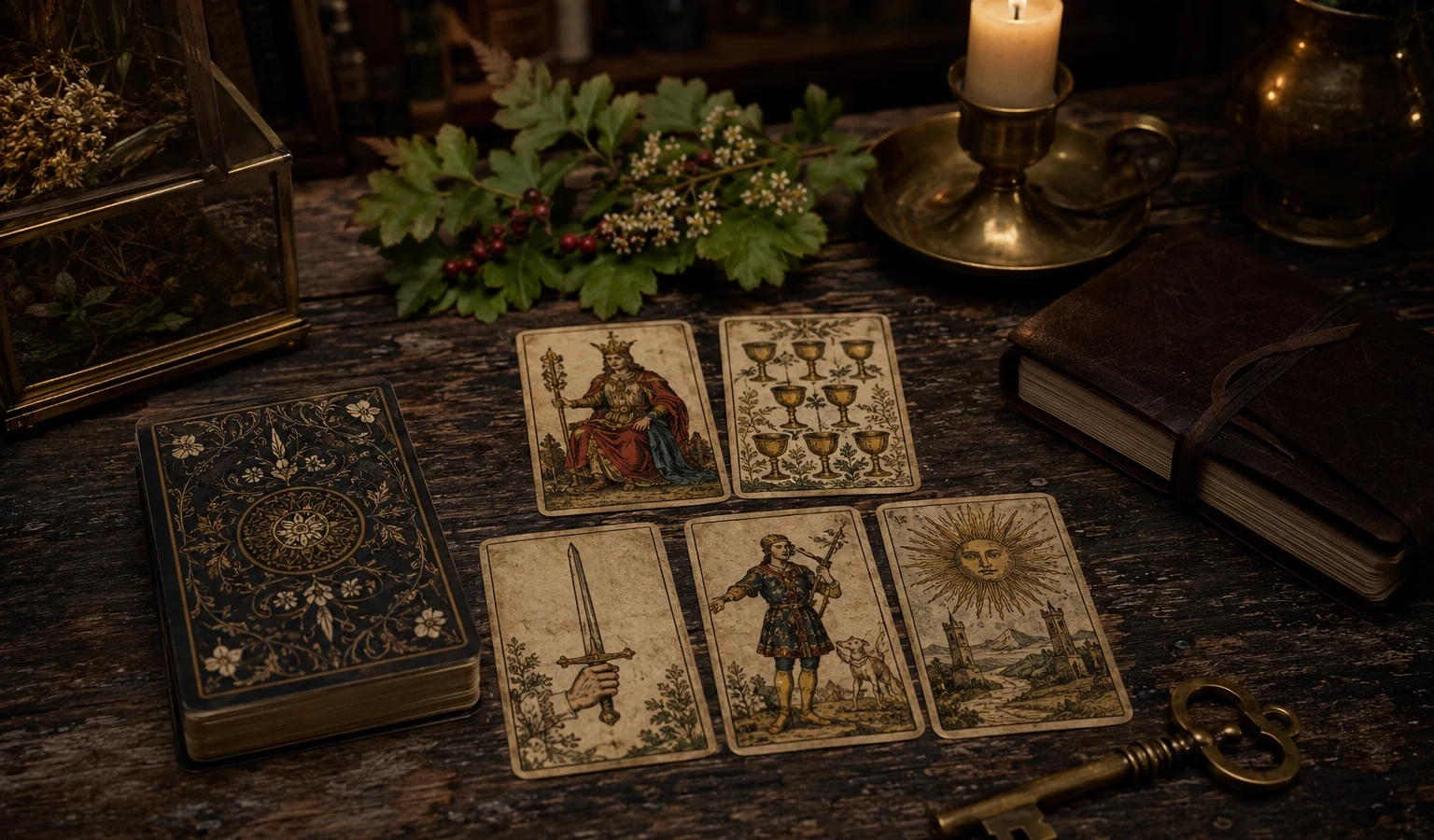
Seventy-eight cards. Painted figures. Swords, cups, towers, stars, wheels, devils, lovers and fools. A few cards have names that sound alarming. Others look almost reassuring. Books promise systems, correspondences and hidden meanings. Films tend to place the deck on a dark table five seconds before something dreadful happens.
For a beginner, it is easy to assume that tarot arrives with one fixed tradition and one correct way to use it.
It does not.
Tarot has a documented history as a European card game, a later history as a tool of divination and occult interpretation, and a very broad modern life as a symbolic language used for reflection, storytelling, art, spiritual practice and, for some people, fortune-telling.
The useful place to begin is not with a claim about what tarot can reveal. It is with the cards themselves.
The question what are tarot cards is historical before it is mystical: first a deck, then a game, then a language of symbols.
What are tarot cards made of?
Most modern tarot decks contain 78 cards. Once the structure is clear, the question what are tarot cards? becomes easier to answer without exaggeration.
They are usually divided into two large groups: 22 trump cards, commonly called the Major Arcana, and 56 suit cards, commonly called the Minor Arcana.
The Major Arcana includes cards such as The Fool, The Magician, The Empress, The Hermit, Death, The Tower, The Star, The Moon and The World.
The Minor Arcana is divided into four suits. In many English-language decks these are Cups, Swords, Wands and Pentacles, although names vary between traditions. Each suit contains numbered cards and court cards.
If you want the structure in more detail, see the beginner’s guide to the Major Arcana and the guide to the four Minor Arcana suits.
The split between Major and Minor Arcana is now so familiar that it can feel ancient. The terminology itself, however, belongs to the later occult history of tarot rather than to the earliest card players.
For a beginner asking what are tarot cards, that distinction matters: the physical deck, the historical game and the later language of interpretation are connected, but they are not the same thing.
What are tarot cards at a glance?
A clear answer to what are tarot cards works best when the main layers are kept separate.
| Layer | What it means | Why it matters |
|---|---|---|
| Card structure | A modern tarot deck usually has 78 cards: 22 Major Arcana and 56 Minor Arcana. | This gives beginners a practical map before memorising meanings. |
| Historical game | Early tarot belonged to fifteenth-century European card play and courtly culture. | It prevents the deck from being mistaken for a timeless book of prophecy. |
| Occult history | Later writers connected tarot with divination, esoteric philosophy and imagined ancient origins. | Those systems shaped modern tarot, but they are later interpretive layers. |
| Visual language | Decks such as Rider-Waite-Smith made symbolic scenes central to how many readers interpret cards. | The images help readers notice patterns, moods and questions. |
| Modern use | Tarot may be used for divination, reflection, journalling, art or conversation. | Those uses can be meaningful without becoming guaranteed prediction. |
Tarot did not begin as a book of secret prophecy
The surviving historical evidence places early tarot in fifteenth-century Europe, especially northern Italy.
The Metropolitan Museum of Art notes references to tarot in the 1440s and 1450s around centres including Venice, Milan, Florence and Urbino. Early decks used familiar Italian suit symbols and added a sequence of illustrated trump cards and a Fool.
These were cards for play.
Luxury examples could also be impressive objects. Some surviving fifteenth-century cards were hand-painted and gilded, commissioned for wealthy patrons rather than printed as inexpensive everyday packs.
The Victoria and Albert Museum holds rare Italian examples from around 1490, while other important early groups survive in museum and library collections.
None of this makes the early history dull. On the contrary, it gives tarot something better than a fabricated ancient pedigree: a real history of games, craftsmanship, printing, courtly culture and changing imagery.
This is one reason the answer to the question what are tarot cards should begin with history before it moves into symbolism.
So where did the idea of ancient Egypt come from?
Much later.
During the eighteenth century, European occult writers began proposing grander origins for tarot. Ancient Egypt became especially influential in these theories.
Jean-Baptiste Alliette, better known as Etteilla, developed an important system of tarot divination in the late eighteenth century. Wellcome Collection preserves his 1783–1785 work on using the cards, along with imagery that presents tarot through an imagined Egyptian frame.
Those materials are historically important because they show the development of occult tarot.
They are not evidence that tarot was actually created in pharaonic Egypt.
This distinction is one of the simplest ways to avoid confusion when reading tarot history: an old occult claim is evidence that people made that claim, not automatically evidence that the claim was true.
An old theory about tarot is evidence for the history of that theory, not automatic evidence for the origin of the cards.
When did tarot become associated with divination?
Cards had been used for fortune-telling before tarot acquired its modern occult identity, and divinatory practices developed in different forms over time.
What changed in the eighteenth and nineteenth centuries was the growth of increasingly elaborate tarot systems.
Writers connected the cards with esoteric philosophy, astrology, Kabbalah, ceremonial magic and supposed ancient wisdom. These associations shaped later decks and books so strongly that many modern readers meet occult tarot before they meet its history as a game.
That is why the same object can belong to several histories at once.
In historical terms, what are tarot cards is not answered by one period alone: the game, the occult systems and the modern reading culture all have to be dated separately.
A fifteenth-century trump card, an eighteenth-century divinatory scheme and a twentieth-century esoteric deck are connected, but they are not interchangeable.
What is the Rider-Waite-Smith tarot?
For many English-speaking beginners, the most familiar tarot imagery comes from the deck usually called the Rider-Waite-Smith tarot.
Arthur Edward Waite provided the conceptual direction, Pamela Colman Smith created the artwork, and the deck was published in London in the early twentieth century.
Its enormous influence comes partly from Smith’s treatment of the Minor Arcana. Rather than leaving most numbered suit cards as arrangements of repeated symbols, she gave them full scenes with people, gestures, landscapes and implied stories.
Those scenes made visual reading easier. A beginner could look at a card and notice conflict, generosity, hesitation, celebration or loss before memorising a paragraph from a book.
The V&A identifies this illustrated Minor Arcana as a major influence on later tarot design.
Many contemporary decks therefore borrow the structure or visual grammar of Rider-Waite-Smith even when the artwork looks entirely different.
If you are comparing decks, the guide to choosing your first tarot deck explains why knowing the underlying system is often more useful than choosing by decoration alone.
Is Rider-Waite-Smith the original tarot?
No.
It is influential, not original.
Tarot was already centuries old when Waite and Smith worked together. Marseille-style decks, Italian traditions and other historical forms belong to a much earlier card history.
There are also later systems, including the Thoth Tarot associated with Aleister Crowley and Frieda Harris, with their own symbolic vocabulary.
This matters because beginner material sometimes presents one modern system as though every tarot deck has always worked that way.
It has not.
Why do tarot cards have so many meanings?
Because card meaning is produced by several layers at once.
There is the image on the card. There is the tradition of the deck. There are meanings supplied by particular authors. There is the position of the card in a spread. There is the question being considered. There is also the reader’s own attention and interpretation.
The Tower, for example, may be discussed in terms of disruption, instability, revelation, collapse or a structure that can no longer be maintained. Those ideas are related, but they are not identical predictions.
A card is therefore better understood as a symbolic prompt than as a sentence with one dictionary definition. In that sense, the question what are tarot cards is also a question about how images gather meanings over time.
This is also why two thoughtful readers can look at the same card and emphasise different aspects without one of them necessarily having made a mistake.
Does every card predict an event?
No.
Some readers use tarot predictively. Others do not.
A reflective approach treats a spread as a structured way to examine a question: what you are noticing, what you may be avoiding, what competing priorities are present, what assumptions are shaping the situation and what possibilities deserve attention.
This does not require a belief that the deck mechanically reveals a fixed future.
In fact, treating every image as an unavoidable forecast can make tarot less useful. It encourages the reader to turn ambiguity into certainty and ordinary anxiety into fate.
If that distinction appeals to you, see how to read tarot without trying to predict every detail.
What about frightening cards?
Tarot’s reputation owes quite a lot to a handful of dramatic images.
Death is the obvious example.
In popular culture, drawing Death often means someone is about to die. In ordinary tarot reading, the card is far more commonly discussed in relation to endings, transition, irreversible change, release or the closing of one phase before another begins.
The Tower does not require a literal building to fall down. The Devil does not prove supernatural interference. The Ten of Swords does not announce that ten actual swords are on their way.
The images are strong because strong images are memorable.
That does not make them literal instructions from the future.
What is a tarot spread?
A spread is simply an arrangement of cards in which each position has a purpose. This is one practical answer to what are tarot cards in use: they become a structured conversation rather than a loose pile of images.
One position might represent the present situation, another an obstacle and another a useful direction of attention.
Spreads can be large and complicated, but beginners do not need them to be.
A simple three-card tarot spread is enough to learn how cards interact without creating a small administrative department on the table.
The structure matters because it gives the reading boundaries. Instead of asking the cards to explain the entire universe before lunch, you give each card a specific role.
Do tarot cards have to be shuffled in a special way?
No universal historical rule governs how every tarot reader must shuffle.
People use overhand shuffles, riffle shuffles, gentle mixing on a table or other methods depending on card size, mobility, habit and preference.
Some readers include ritual gestures because those gestures help mark a transition into focused attention.
That is a personal or traditional practice, not proof that the cards cease to work if the ritual is omitted.
Do tarot cards need to be cleansed?
Not in any objectively demonstrable sense.
Some tarot traditions include smoke, moonlight, knocking on the deck, crystals, prayer or other cleansing practices. For people who value those rituals, they can serve as meaningful ways to begin or end a reading.
Others simply keep the deck dry, clean and safely stored.
Both approaches can coexist if we distinguish symbolic practice from material care.
For practical guidance, see how to cleanse and store a tarot deck.
Can anyone learn tarot?
Yes, in the ordinary sense that tarot is a learnable visual and symbolic system.
You do not need to inherit a secret gift.
You do not need to memorise all 78 cards before beginning.
You do not need to buy an expensive deck, study ceremonial magic or wait until intuition arrives in dramatic fashion.
Learning usually comes from repeated contact with the same cards: looking carefully, reading reliable material, making notes and comparing interpretations over time. A beginner asking what are tarot cards will often learn more from patient observation than from memorising dramatic claims.
A tarot journal can be more useful than trying to force perfect recall on the first week.
Is tarot a religion?
Tarot itself is not a religion.
People use it within many different religious, spiritual and secular frameworks. Some incorporate cards into contemporary Pagan or occult practice. Some use them alongside prayer or personal ritual. Others use tarot without any supernatural belief at all.
A deck does not tell you what worldview you must adopt in order to look at it.
Is tarot the same as oracle cards?
No.
Tarot normally refers to a recognisable card structure derived from historical tarot traditions, even when an artist reinterprets the imagery.
Oracle decks are much less standardised. They may contain almost any number of cards and use a structure created entirely by the author or artist.
Neither format is inherently deeper or easier. They simply operate differently.
The distinction is explained in Tarot and Oracle Cards: What Is the Difference?
Can tarot make decisions for you?
It should not need to.
A reading may help you identify a conflict, phrase a question differently or notice that you are giving one possibility more attention than another.
That is different from handing responsibility to a card.
For decisions involving health, law, finance, personal safety or other serious consequences, tarot should not replace qualified professional advice or reliable evidence.
Even in everyday matters, a card can suggest a perspective without acquiring authority over your life.
Why does tarot sometimes feel surprisingly accurate?
Symbolic images are good at inviting pattern recognition.
They are often broad enough to connect with many ordinary human concerns: change, uncertainty, conflict, affection, work, loneliness, ambition, fear, patience and loss.
A well-posed reading also directs attention towards a topic you already care about.
That can produce genuinely useful insight without requiring the conclusion that the cards possess independent knowledge.
Human beings are skilled meaning-makers. Tarot gives that meaning-making a visible structure. In that modest sense, the question what are tarot cards can be answered without either dismissing them or exaggerating their authority.
So what are tarot cards actually for?
There is no single answer.
Historically, tarot has been a game. For a modern beginner asking what are tarot cards, the most honest answer is layered: game, image system, occult tradition, reading tool and reflective object.
For occultists, it became an elaborate symbolic and divinatory system.
For artists and collectors, decks can be miniature galleries of illustration and design.
For modern readers, tarot may be spiritual practice, creative prompt, journalling tool, form of divination or method of reflective conversation.
Those uses do not need to be collapsed into one claim.
A sensible way to begin
Choose one clear deck.
Learn its basic structure.
Look at the images before reaching for keywords.
Use small spreads.
Write down what you thought before checking a guidebook.
Notice where history ends and a modern tradition begins.
And be suspicious of anyone who tells you that one wrong shuffle, one reversed card or one missing ritual has ruined the entire process. Seventy-eight pieces of printed card are sturdier than that.
The Hawthorn & Key approach
At Hawthorn & Key, the answer to the question what are tarot cards is deliberately grounded: a deck can be historical, symbolic, artistic and personally meaningful without being turned into a machine for guaranteed prediction.
We do not need to pretend that a Renaissance card game was secretly designed in ancient Egypt to find the later occult history fascinating. Nor do we need to promise that a spread can guarantee what will happen next in order to take symbolic reflection seriously.
The cards have accumulated meanings because people have played with them, written about them, redesigned them, argued over them and used them to think about ordinary human problems for centuries.
That history is strange enough without improving it.
Sources & Further Reading
- Victoria and Albert Museum — A History of Tarot Cards.
- The Metropolitan Museum of Art — Tim Husband, Before Fortune-Telling: The History and Structure of Tarot Cards.
- Wellcome Collection — Jean-Baptiste Alliette (Etteilla), Maniere de se récréer avec le jeu de cartes nommées Tarots, 1783–1785.
- Wellcome Collection — Etteilla, The Tarot, in the form of leaves of the book of Thoth placed in the temple of Fire at Memphis, Egypt, late eighteenth century.
- Arthur Edward Waite — The Pictorial Key to the Tarot, 1910/1911.
- Ronald Decker, Thierry Depaulis and Michael Dummett — A Wicked Pack of Cards: The Origins of the Occult Tarot, 1996.
- Helen Farley — A Cultural History of Tarot: From Entertainment to Esotericism, 2009.