August 28, 2026
The New Moon: Symbolism, Reflection and Simple Rituals
The new Moon is easiest to misunderstand because it is the phase people are least likely to see. To understand new Moon symbolism, it helps to begin with that physical fact: the Moon is still present, but its illuminated side is turned mostly away from us.
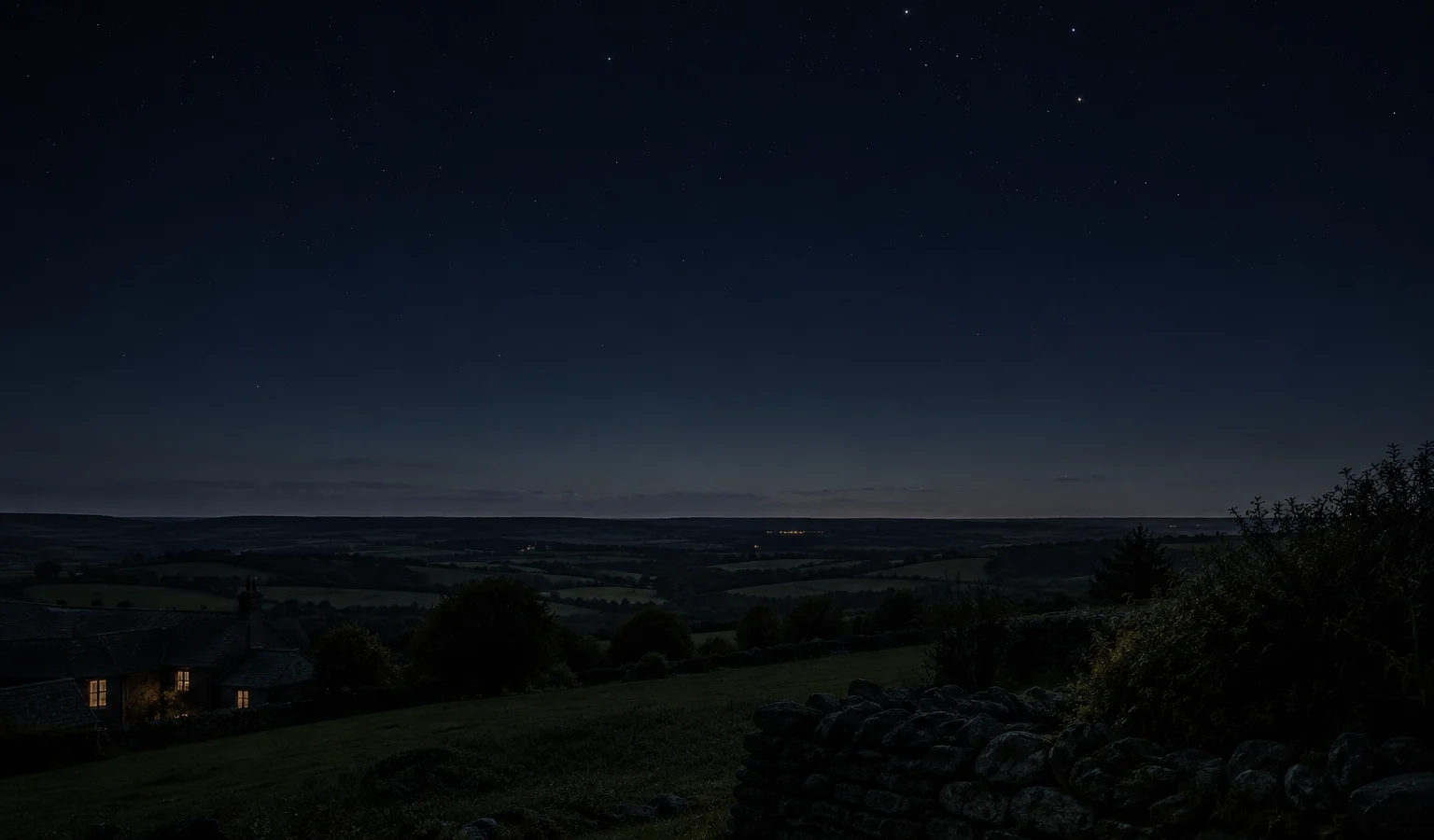
In photographs and illustrated calendars, it is often represented by a black circle suspended in a dark sky. In reality, the astronomical new Moon is usually lost in daylight. It lies in roughly the same direction as the Sun, with the illuminated half facing away from Earth. It rises and sets with the Sun, and the side turned towards us is dark.
What follows is not a guide to an invisible force that makes wishes more powerful. It is a guide to new Moon symbolism: why an invisible phase has become such a compelling image of beginnings, how that symbolism differs from astronomy, and how a person can use a recurring monthly pause without turning it into another set of rules.
What exactly is a new Moon?
NASA and Royal Museums Greenwich describe new Moon as the point in the lunar cycle when the Moon is in roughly the same part of the sky as the Sun from our perspective on Earth. The Sun still illuminates half of the Moon, but the illuminated hemisphere faces mostly away from us.
That is why the new Moon is normally invisible.
It is not a Moon with its light “switched off”. It is not Earth’s shadow falling across the Moon. Ordinary lunar phases are produced by changing viewing geometry as the Moon orbits Earth.
The full cycle from one new Moon to the next takes about 29.5 days.
New Moon and thin crescent are not the same thing
In everyday language, people sometimes call the first thin crescent after conjunction the new Moon.
Astronomically, however, new Moon is the dark phase itself. The slim evening crescent appears afterwards as the Moon moves farther from the Sun in our sky and a small portion of its illuminated side becomes visible.
This distinction matters historically because not every calendar or religious tradition has defined the start of a lunar month in exactly the same way. Some systems depend on calculated conjunction; others have used the first visible crescent.
For a modern personal ritual, there is no need to turn that difference into a dispute. If you prefer to mark the astronomical new Moon, use the calculated date. If you prefer to wait until you can actually see a crescent, that is a different and equally clear observational choice.
The new Moon is a moment, not a whole night
Moon-phase calendars often label one date “New Moon”, which can make the phase sound like an event lasting from sunset to sunrise.
Strictly speaking, the exact new Moon is an instant in the cycle: the point of conjunction in ecliptic longitude. Before and after it, the Moon is moving continuously.
For ordinary reflection, exact minutes are rarely important. A ritual does not become invalid because it happens on the evening before or the morning after a published new-Moon time.
Precision is useful for astronomy. It need not become ritual anxiety.
Why new Moon symbolism often begins with darkness
At first glance, darkness might seem an odd symbol for beginning. A visible crescent looks more obviously like something starting.
Yet absence has its own imaginative power.
A darkened lunar face can suggest a page before writing, soil before germination, a room before the lamp is lit, or the moment before a decision becomes action. None of those metaphors is written into the Moon. They are human ways of reading a period in which the familiar object is present but largely unseen.
This is why new Moon symbolism in modern lunar practice so often connects the phase with intention, possibility and quiet preparation.
Modern new Moon symbolism should be labelled modern
Many websites describe “new Moon intentions” as though a single ancient civilisation handed down a standard ritual: write a wish, light a candle, speak it aloud and wait for the Moon to make it happen.
History does not support such a tidy lineage.
People in Britain certainly tracked the Moon. Medieval almanacs preserved by the British Library contain lunar conjunctions, eclipse calculations, phases, lunar age and astrological or medical material. These documents show deep practical and symbolic attention to lunar timing.
They do not demonstrate that a modern journal prompt called “set your new Moon intentions” was a universal medieval British practice.
Modern ritual can be worthwhile without borrowing an imaginary pedigree.
Modern lunar practice does not become more meaningful when it is given an invented ancient history.
Old almanacs treated the Moon as part of a working calendar
For a medieval reader, lunar information could sit beside saints’ days, agricultural work, medical guidance, zodiacal material and predictions about the year.
That combination can look strange to a modern reader because astronomy, astrology, religion and medicine are now separated more sharply.
A grounded approach reads each claim according to its type. A calculated lunar conjunction belongs to observational astronomy. A rule that a certain phase makes bloodletting favourable belongs to a historical medical and astrological worldview.
Both are historically interesting. They do not carry the same evidential weight today.
New Moon symbolism is not only about beginnings
The most popular modern new-Moon meaning is beginning.
But there are other useful interpretations:
- Uncertainty: not everything is visible yet.
- Privacy: an idea can remain unannounced while it forms.
- Rest: beginning does not have to mean immediate activity.
- Reorientation: a recurring date can prompt a small course correction.
- Attention: the absence of visible moonlight can make the wider night sky easier to notice.
These meanings are metaphors, not predictions. A grounded reading of new Moon symbolism keeps that distinction visible.
| Layer | What it tells us | How to read it |
|---|---|---|
| Astronomy | The Moon is near the Sun in our sky and is normally invisible from Earth. | A measurable physical phase. |
| Historical lunar practice | Calendars and almanacs tracked conjunctions, lunar age and other timings. | Evidence of historical attention to the Moon, not proof of today’s ritual system. |
| Modern symbolism | Beginnings, privacy, uncertainty, rest and reorientation. | Metaphors chosen by modern practitioners. |
| Personal ritual | Journalling, planning, walking or marking a monthly pause. | A chosen structure for attention, not a guarantee of external results. |
The new Moon is useful for stargazing
There is one very practical reason astronomers care about dark lunar nights: less moonlight means a darker sky.
For faint stars, the Milky Way, nebulae and other low-contrast objects, bright moonlight can make observing more difficult. Around new Moon, lunar glare is absent for much of the night.
This is a physical effect rather than a symbolic one.
It also offers a pleasing reversal. The phase most associated with the invisible Moon can be one of the best times to look at everything else.
Does the new Moon affect tides?
Yes, but not in the way popular “lunar energy” language often suggests.
The Met Office explains that the combined gravitational effects of Sun and Moon contribute to spring tides around new and full Moon, when Sun, Moon and Earth are more closely aligned.
That is a measurable oceanographic effect.
It does not demonstrate that new Moon causes a person to become more intuitive, fertile, decisive or lucky. Real tidal physics should not be used as evidence for unrelated psychological claims.
How new Moon symbolism becomes a personal ritual
In modern use, new Moon symbolism often becomes a small personal practice carried out near the phase: journalling, planning, tidying, sitting quietly, lighting a candle, taking a walk or choosing an intention for the coming month.
The ritual works as a structure for attention.
It does not need to be a transaction in which an object or celestial event is asked to guarantee a result.
This distinction is consistent with the broader approach in our calm beginner’s guide to Moon phases: astronomy describes what the Moon is doing; symbolism describes what people choose to make of it.
It also matches our approach to personal ritual, where meaning comes from attention and context rather than guaranteed supernatural causation.
A five-minute new-Moon ritual
The simplest way to work with new Moon symbolism requires only a piece of paper.
- Write the date.
- Write one thing that currently feels unfinished or unclear.
- Write one thing you would like to give more attention during the next month.
- Choose one action small enough to complete within the next few days.
- Close the notebook.
That is enough.
No special wording is required. No object has to be purchased. Nothing bad happens if the page is messy or the action changes later.
An intention is not a guarantee
In discussions of new Moon symbolism, the word intention is useful when it means direction.
It becomes less useful when it is treated as a supernatural contract.
“I intend to walk three evenings this week” can shape behaviour. “The new Moon guarantees I will receive money because I wrote an abundance statement” is a different kind of claim.
The first creates a practical commitment. The second gives a celestial phase responsibility for an outcome involving chance, systems and other people.
A grounded ritual keeps agency where it belongs.
Try one question instead of ten intentions
New-Moon worksheets often contain long lists of prompts. They can turn a quiet practice into homework.
One question is often better:
What deserves more attention during the next four weeks?
The answer might be work, sleep, a friendship, a garden, a book, a difficult conversation, paperwork or simply leaving more empty time.
A useful symbol should simplify attention, not multiply obligations.
You can use an object without giving it supernatural powers
A candle, key, stone, cup, notebook or small branch can make a ritual feel distinct from ordinary desk work.
The object can act as a marker: when it is placed on the table, the person knows this is a few minutes for reflection.
That does not require claiming the object is transmitting lunar energy.
The history of modern ritual is full of meaningful objects, but meaning and mechanism are not the same thing.
If you use a candle, keep the practice ordinary and safe
A flame creates atmosphere, but it also creates heat.
Use a stable holder on a heat-resistant surface, keep it away from dried plants, paper, curtains, children and animals, and never leave it unattended.
You do not need to burn herbs, oils, paper intentions or unknown materials.
The ritual is not improved by adding a fire risk.
A new-Moon walk can be more useful than a ritual table
Because the new Moon itself is usually not visible, a walk near the phase can make new Moon symbolism feel less abstract by shifting attention away from the lunar disc and towards the rest of the night.
Notice how dark the sky is. Look for stars between clouds. Listen to traffic fading behind houses, wind in a hedge or the difference between a lit street and a darker footpath.
In Britain, weather will often prevent the idealised clear-sky experience. That is not a failure. Cloud, drizzle and winter darkness are part of the actual landscape in which any British seasonal practice takes place.
You do not need to perform a ritual at midnight
There is no astronomical reason that a personal new-Moon reflection must take place at midnight.
The new Moon may occur at any time of day. A person may be asleep, commuting or making dinner at the exact moment.
If the practice is symbolic, choose a time that fits ordinary life.
Ritual becomes less calming when it demands that the household serve the timetable.
What if the new Moon happens while you are busy?
Nothing needs to be rescued.
Do the reflection the next evening, the next morning or not at all.
The lunar cycle will continue. Another new Moon will arrive in about 29.5 days.
This repetition is one of its strengths as a personal framework: missed opportunities are not permanent.
New Moon and modern witchcraft
Contemporary witchcraft and Pagan communities often use new Moon symbolism for beginnings, spell planning, cleansing, intention-setting or quiet devotional work.
Those practices are part of real modern religious and spiritual culture.
They should not automatically be described as direct survivals from pre-Christian Britain. As our article on historical and modern witchcraft explains, contemporary practice may combine inherited material, revival, reconstruction and invention.
Labelling something modern does not make it shallow. It makes the history clearer.
New Moon and divination
Some people combine new Moon symbolism with Tarot, oracle cards, scrying or other forms of divination.
Again, it is useful to separate historical existence from guaranteed accuracy. Britain has a long history of divinatory practices, explored in our guide to divination before the modern Tarot boom.
Drawing a card at new Moon can be treated as a prompt for reflection. It need not be treated as an order that overrides judgement.
A useful three-part journal page
If you enjoy structure, divide one page into three headings:
- Notice: What is happening now, without interpretation?
- Choose: What deserves attention next?
- Do: What is one realistic action?
This order matters.
It begins with observation rather than desire and ends with behaviour rather than waiting.
What not to use a new-Moon ritual for
A symbolic lunar practice should not decide whether to take prescribed medicine, seek medical care, report abuse, sign a legal document, make a high-risk investment or delay an urgent practical decision.
Nor should someone interpret an unsuccessful goal as proof that they performed the ritual incorrectly.
Life contains uncertainty. A ritual can help a person face it; it should not create a new system of blame.
There is no need to “manifest” everything
Modern lunar content often frames every new Moon as a demand to produce a larger life: more money, more romance, more achievement, more confidence, more possessions.
A quieter interpretation is possible.
An intention can be to finish something. To spend less. To answer one letter. To stop buying objects for a hobby and actually use the ones already owned. To protect an evening from work. To learn the names of three stars.
Beginning can mean beginning to do less.
The first crescent can become the visible follow-up
If the astronomical new Moon feels too abstract because it cannot usually be seen, wait for the young crescent.
A thin waxing crescent after sunset offers a simple second step: look back at the note written near new Moon and ask whether the first practical action has happened.
This creates a pleasant relationship between invisible preparation and visible movement without claiming the crescent caused the progress.
A Hawthorn & Key approach to new Moon symbolism
At Hawthorn & Key, new Moon symbolism is most useful when it creates a quiet boundary in time without pretending that the phase controls external events.
The astronomy is exact: a recurring alignment in a roughly 29.5-day lunar cycle. New Moon symbolism is flexible: darkness, beginning, privacy, uncertainty, rest or renewed attention.
A person can mark it with a notebook, a safe candle, a short walk or nothing more than noticing the date.
The Moon does not need to grant a wish. Sometimes a recurring reason to look carefully at one’s own life is enough.
Sources & Further Reading
- NASA Science, “Moon Phases”, for the astronomical definition of new Moon and the 29.5-day phase cycle.
- Royal Museums Greenwich, Royal Observatory material on the Moon, for lunar phases and observing.
- NASA Jet Propulsion Laboratory Education, “Look at the Moon! Journaling Project”, for repeated lunar observation.
- Met Office, “Tides”, for the relationship between tides and Sun-Moon-Earth alignment.
- British Library, “Stars in Their Eyes: Art and Medieval Astronomy”, alongside medieval almanac catalogues containing lunar conjunctions, phases, calendars and prognostications.