September 13, 2026
Wise Women and Cunning Men: Who People Turned to Before Modern Services
When something went wrong in an English household four hundred years ago, there was no single door marked help. A sick child might be treated at home, taken to an apothecary, discussed with a midwife, shown to a physician if the family could afford one, prayed over, or taken to someone known locally for charms and unusual knowledge. A stolen animal might lead to neighbours, constables, magistrates or a diviner. Anxiety about a marriage, journey or suspected witchcraft could bring a client to an astrologer whose practice crossed boundaries that now seem much more distinct.
The phrase “before modern services” can therefore mislead if it suggests a world without medicine, law or organised care. Early modern England had all of those things. What it did not have was the centralised professional landscape familiar today. Help came from overlapping networks of household knowledge, trades, institutions and informal specialists.
Wise women and cunning men belonged to that crowded landscape. They were not a single profession, and they did not replace physicians, midwives, clergy, courts or household medicine. They occupied some of the gaps between those forms of help.
There was no single pre-modern healthcare system
Early modern medicine included university-trained physicians, apothecaries, surgeons, barber-surgeons, midwives and many less formal practitioners. Some were regulated through universities, guilds, towns or church authorities. Others worked from experience, inherited knowledge or reputation.
Cambridge’s research on the medical casebooks of Simon Forman and Richard Napier describes a medical marketplace in which patients continued to shop around. The boundary between regular and irregular practice was fluid, and people did not necessarily commit themselves to one kind of healer.
A household could try several approaches. A treatment that appears contradictory to a modern reader might have felt entirely reasonable to a patient who understood illness through the body, religion, astrology, environment and social relationships at the same time.
Wise women and cunning men were not one profession
The figure of the wise woman has become one of the most romanticised characters in modern accounts of the past.
She is often imagined as a village herbalist, midwife and secret keeper whose ancient knowledge placed her in conflict with male physicians or the church. Real women certainly practised healing, prepared medicines, attended births, kept recipes and used charms. But the evidence does not support one universal occupation called “wise woman”.
The label could be informal. It might refer to a woman known for practical healing, divination or magical advice. The same caution applies when discussing wise women and cunning men together: their work could overlap with domestic medicine, midwifery or cunning practice, but those roles were not automatically identical.
Women also carried enormous responsibility for household health without being specialists at all. They prepared syrups, poultices, foods and remedies for relatives, children, servants and livestock. A great deal of medicine happened in the home.
The historical problem is not a shortage of healers, but the temptation to force very different kinds of care into one modern category.
Cunning men could be equally important local specialists
Men appear prominently in the history of cunning practice.
Some were astrologers. Some found stolen goods. Some diagnosed supposed witchcraft, prepared written charms or told clients whether a problem had natural or magical causes. Some cultivated a learned appearance through books and calculations.
The assumption that folk healing belonged to women while formal or magical expertise belonged to men is too simple. Gender shaped opportunities and reputation, but wise women and cunning men both appear across the practical magical world.
Our article on cunning folk in English history looks more closely at the specialists who offered such services.
Wise women and cunning men in a mixed medical marketplace
Few sources bring this world to life as clearly as the casebooks of astrologer-physicians Simon Forman and Richard Napier.
The surviving volumes record roughly 80,000 consultations from the late sixteenth and early seventeenth centuries. More than 60,000 people appear in them, ranging from servants to nobles.
Most consultations concerned health and disease, but clients also asked about marriage, careers, missing persons, stolen property, journeys, lawsuits and witchcraft.
The range of questions matters. To the clients, questions that modern institutions divide among doctor, police officer, counsellor, lawyer and spiritual adviser could arrive at the same table. It helps explain why wise women and cunning men could remain useful alongside more formal practitioners.
Forman and Napier were not simply village folk healers. They belonged to a sophisticated astrological medical tradition, used extensive records and competed within a crowded healthcare market. Yet their clients’ questions show why practical magical specialists could remain relevant: life’s problems did not respect professional boundaries.
| Who might be consulted? | Typical concerns | Why the categories overlapped |
|---|---|---|
| Household healer | Common illness, wounds, food, childcare and everyday remedies | Most care began at home and drew on family knowledge. |
| Midwife | Pregnancy and childbirth | Some midwives also knew remedies or charms, but midwifery was not inherently magical. |
| Apothecary or physician | Diagnosis, medicines and learned medical treatment | Formal medicine existed alongside domestic and informal practice. |
| Cunning practitioner | Healing, suspected witchcraft, stolen goods, divination and protective charms | Clients brought problems that crossed modern institutional boundaries. |
| Clergy or religious adviser | Prayer, providence, moral questions and spiritual explanations | Religion formed part of ordinary understandings of illness and misfortune. |
People often started with the household
Before consulting any specialist, families relied heavily on domestic knowledge.
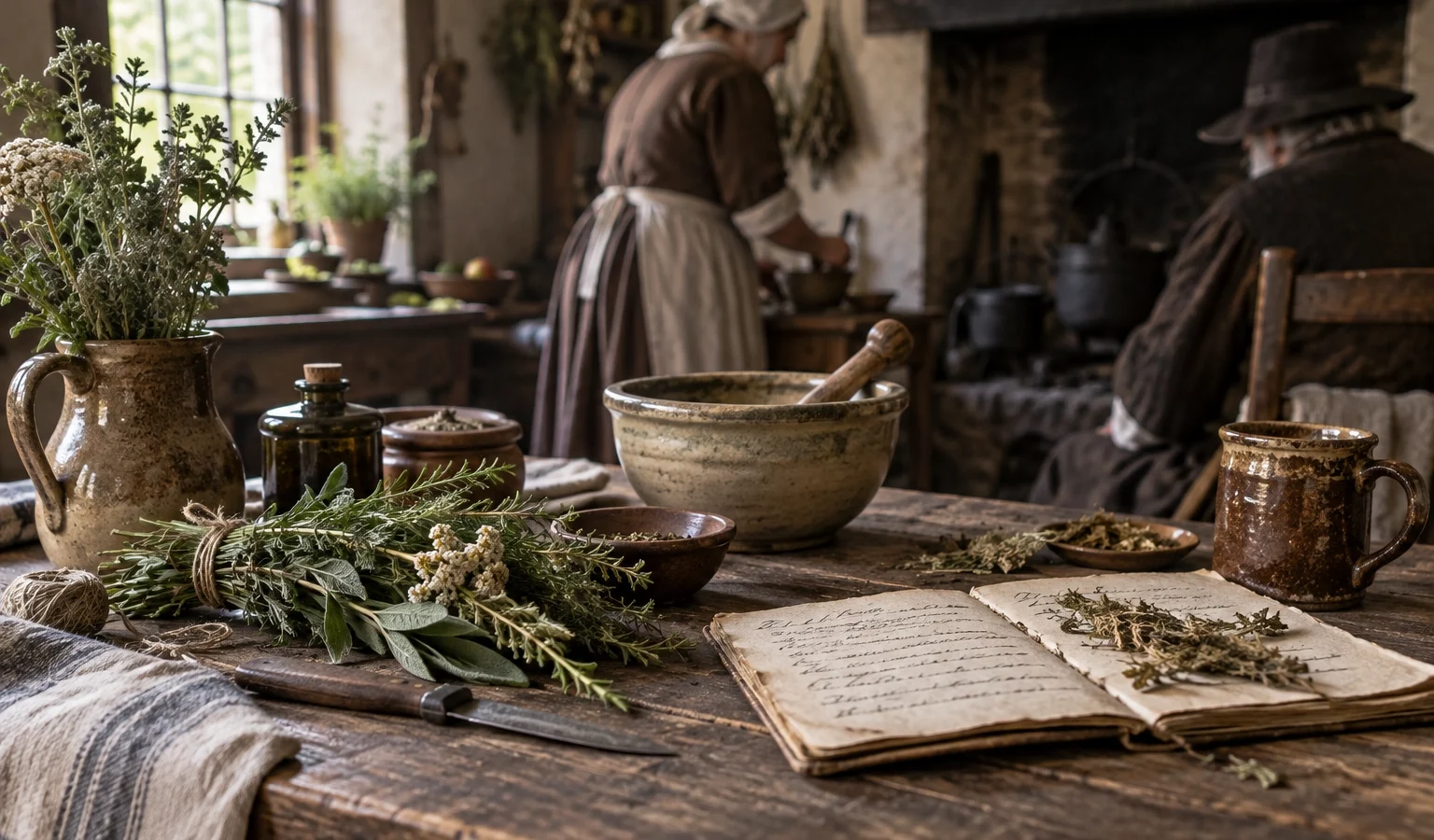
Recipe books preserved treatments for common illnesses, wounds and household needs. Knowledge moved through families, neighbours, manuscripts and printed books. Plants might be grown, gathered or purchased. Remedies could combine long-established medical theory with practical experience.
Recent research on English domestic medicine emphasises that older Galenic remedies did not simply vanish when new medical philosophies appeared. Household practice was capable of absorbing different systems.
The same is true of magical material. A prayer, charm or protective object could sit beside a practical remedy without its user experiencing the contradiction a modern historian might expect.
Informal healers mattered because trained physicians were not universally accessible
Licensed physicians represented an elite form of medicine. They were not the only healers, and they were not equally accessible to all patients.
Cambridge University Library’s work on the fifteenth-century healer Thomas Wort describes informal medical practitioners who lacked formal university training yet were sought out for their knowledge. Wort’s surviving manuscript contains more than two hundred Middle English medical recipes.
This evidence complicates the idea that useful medical knowledge flowed only from universities downward. Experience, domestic practice and manuscript culture sustained other routes of expertise.
It is also a reminder not to call every unlicensed healer magical. Informal medicine and folk magic overlapped, but they were not synonyms, and wise women and cunning men should not become a catch-all label for every practitioner outside a university.
Midwives, healers and the danger of collapsing different roles
Midwives deserve particular care in this discussion because modern folklore frequently turns them into witches or wise women by default.
Early modern midwives were important community practitioners and could be regulated by church authorities. Their work involved childbirth rather than a universal package of magical healing.
Some individuals may also have known charms, domestic remedies or divinatory customs. That does not make witchcraft or folk magic inherent to midwifery.
The stereotype matters because women who worked in intimate caring roles could become vulnerable when events went badly.
Women’s care work could create both trust and danger
Research using Richard Napier’s early seventeenth-century casebooks has shown how women’s occupations could intersect with witchcraft suspicion.
Women often worked in childcare, sick care, household medicine and livestock management. These tasks brought them close to precisely the moments when illness, infant death or unexplained animal loss might provoke fear and accusation.
Cambridge historian Philippa Carter has argued that such gendered working conditions could make witchcraft accusations an occupational hazard for some women.
This is more convincing than the romantic claim that “wise women were burned because they knew herbs”. Women’s practical knowledge was real, but the history of accusation involved neighbourhood conflict, gender, labour, religion, misfortune and legal structures rather than one simple campaign against female healers.
Not every healer was accused of witchcraft
Another common distortion runs in the opposite direction: if accusations could touch healers, perhaps all wise women and cunning people lived in constant danger of being prosecuted as witches.
The evidence does not support that either.
Many magical healers operated for years and attracted clients. Communities could distinguish a useful practitioner from a suspected harmful witch, even when theologians and sceptical writers objected to both.
The categories could blur, but they did not always collapse. Wise women and cunning men might be valued for services that neighbours did not automatically equate with harmful witchcraft.
A local specialist’s security depended greatly on reputation. Someone believed capable of removing harmful magic could be valued. The same claim could become dangerous if relationships deteriorated.
Religion, astrology and practical help
People also turned to clergy, prayer, scripture and providential interpretations of illness.
Religion did not simply compete with medicine. It helped people interpret why sickness occurred, how suffering should be endured and what kinds of remedies were legitimate.
Some cunning practitioners used Christian prayers and sacred words, which created an uncomfortable overlap. A client might consider a charm holy; a minister might consider the same procedure superstitious because sacred language had been turned into a technique.
The disagreement was often over how spiritual power could properly be used, not over whether the spiritual world existed. That helps place wise women and cunning men inside the religious arguments of their own time rather than outside them.
Astrology could belong to medicine without feeling alternative
To modern readers, an astrological physician sounds automatically occult. Early modern categories were different.
Forman and Napier used horoscopes as part of diagnosis while operating within the broader medical marketplace. Their clients might send urine, describe symptoms and ask astrological questions in the same consultation.
The casebooks therefore caution against projecting today’s boundary between medicine and magic backward into the seventeenth century.
Historical actors could be learned, religious and medically engaged while accepting astrological assumptions now rejected by science.
Wise women and cunning men were consulted for more than illness
Healthcare was only one part of the help people sought.
Lost and stolen property created a demand for specialists who claimed to identify thieves or reveal locations through divination. In such cases, wise women and cunning men could enter territory we would now assign to police and courts.
Formal justice existed, of course, but it could be slow, expensive or unable to produce an answer. Magical divination offered an apparently direct route from uncertainty to a named suspect.
That directness was also dangerous. An accusation produced by divination could damage a neighbour without reliable evidence.
Why advice itself had value
It is easy to judge a historical practitioner only by whether the magical mechanism seems credible. That misses another part of the service.
A consultation organised fear. The practitioner listened to a problem, named possible causes and prescribed a sequence of actions. Part of the appeal of wise women and cunning men may have lain in that structure, even where the proposed magical mechanism had no demonstrable efficacy.
Clients also gained a person who seemed confident when ordinary explanations were uncertain.
This does not prove that cunning practice was effective therapy in a modern clinical sense. It helps explain its persistence.
The countryside was not the only setting
Wise people and magical services are often imagined as remnants of an isolated rural world. The evidence is wider.
Astrological practitioners built substantial urban clienteles. Folklorist Edward Lovett later collected lucky and protective objects from working people in modern London. Magical thinking moved through towns, markets and printed culture as well as villages.
Industrialisation changed old traditions without automatically erasing them.
What should we mean by before modern services?
The phrase is useful only if we use it carefully.
People did not live without doctors, law, charity, clergy or skilled trades. What they lacked was today’s integrated network of professional and state services: universal expectations around evidence, licensing, emergency response, public health, policing, welfare and specialist referral.
Help was plural. A person could move between household remedies, neighbourly advice, a healer, an apothecary, a clergyman, a cunning practitioner and a court according to cost, availability and belief.
That is the world in which wise women and cunning men make historical sense.
A grounded way to read wise women and cunning men
At Hawthorn & Key, wise women and cunning men are best approached without dismissing them as foolish relics or turning them into romantic guardians of a lost ancient wisdom.
They were people working inside the gaps and overlaps of their own societies. Some possessed substantial practical knowledge. Some used methods we would now reject. Some offered comfort. Some reinforced harmful suspicions. Many probably combined all sorts of skills whose boundaries are difficult to recover.
Their history is ultimately a history of where people go when ordinary life stops making sense. That question has changed less than the institutions built to answer it.
Sources & Further Reading
- University of Cambridge, A Critical Introduction to the Casebooks of Simon Forman and Richard Napier, 1596-1634.
- University of Cambridge, research on witchcraft accusations and women’s occupations using Richard Napier’s casebooks.
- Cambridge University Library Special Collections, “Thomas Wort, leech, and his book of remedies”.
- Cambridge Department of History and Philosophy of Science, research guide to early modern medicine.
- Owen Davies, Popular Magic: Cunning-folk in English History.
- Tabitha Stanmore, Cunning Folk: Life in the Era of Practical Magic.
- Margaret Pelling, The Common Lot: Sickness, Medical Occupations and the Urban Poor in Early Modern England.
- Andrew Wear, Knowledge and Practice in English Medicine, 1550-1680.