September 5, 2026
How to Create a Quiet Ritual Corner in a Small Home
You do not need a spare room to create a place that feels different from the rest of the day. A quiet ritual corner in a small home can be one shelf, one end of a desk, the top of a small cabinet or even a tray that comes out when you need it and disappears afterwards.
The goal is not to recreate a film set.
It is to give a small part of your home one clear function: pause, read, write, remember or mark a transition.
Start a ritual corner in a small home with its function
Before buying anything, decide what the corner is for.
Do you want somewhere to journal for ten minutes?
A place to sit with tea before work?
A small shelf for seasonal objects?
A place to remember somebody?
A quiet visual cue that the working day is over?
The clearer the function, the easier the design. That matters especially when you are creating a ritual corner in a small home, where every surface may already have another job.
Why a ritual corner in a small home needs one clear purpose
In a large room, objects can spread out.
In a small flat, every surface is asked to do several jobs.
That is why a ritual corner works best when it is visually simple.
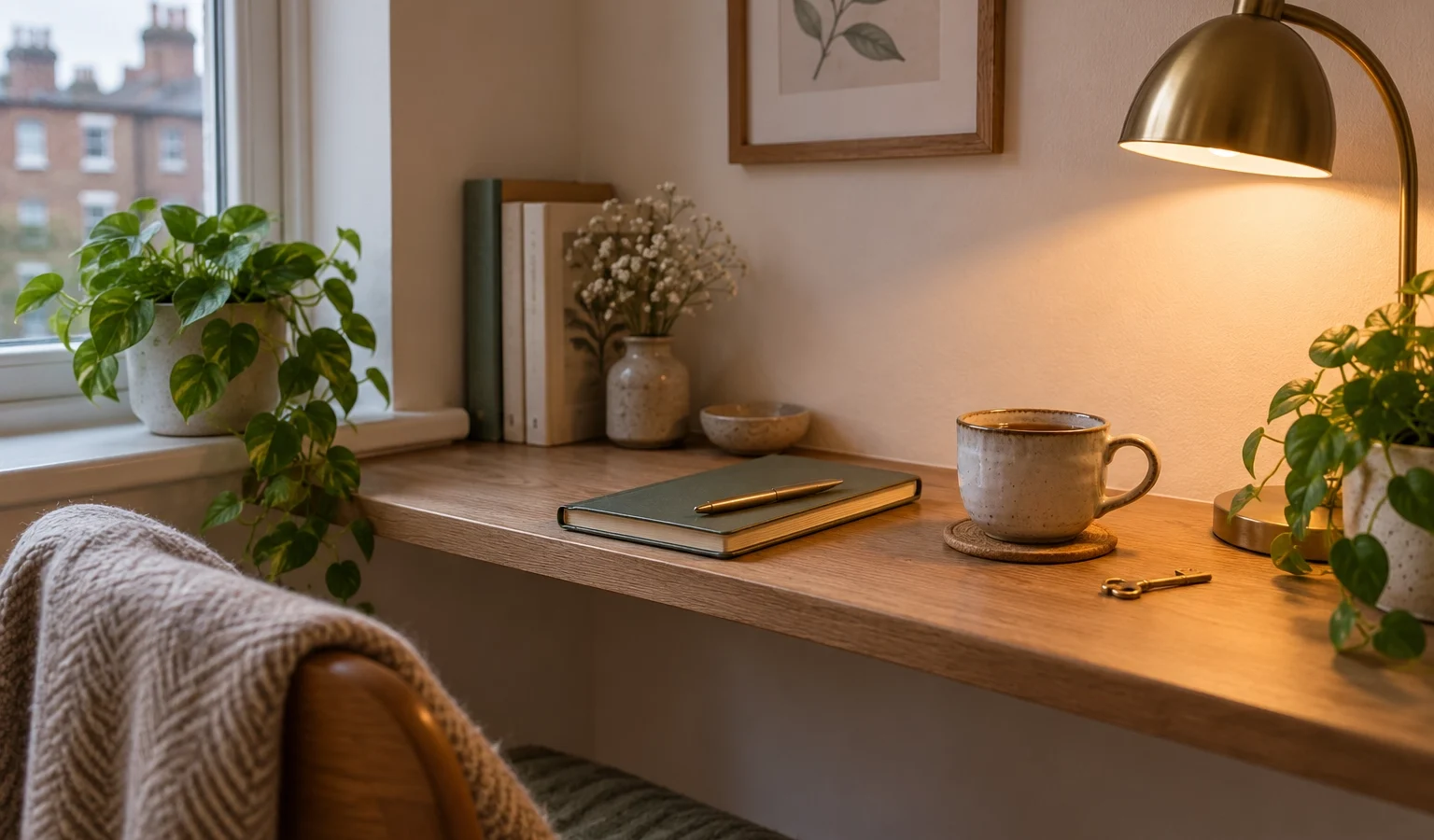
One notebook.
One lamp.
One cup.
One small object that means something.
That may be enough.
A portable ritual corner in a small home
If you cannot dedicate a permanent surface, use a tray.
Keep a notebook, pen, small cloth, tea cup or symbolic object together.
When you want the space, place the tray on the table.
When you are finished, put it away. For many people, this is the simplest way to keep a ritual corner in a small home without giving up a permanent piece of furniture.
This has two advantages.
It protects limited household space, and the act of bringing the tray out becomes part of the ritual itself.
| Format | Works well for | Keep in mind |
|---|---|---|
| Permanent shelf | Reading, remembrance and seasonal objects | Keep enough empty space to clean it easily. |
| Desk corner | Journalling, tarot or a short evening pause | Make sure work materials do not gradually take over. |
| Portable tray | Shared rooms and very small flats | Store only what you actually use. |
| Chair and lamp | Reading, tea and quiet reflection | Good light and comfort matter more than decoration. |
Choose one visual anchor
A ritual corner does not need a collection.
It needs an anchor.
That might be:
- a small framed photograph;
- a candle used only when you are present;
- a seasonal branch in a vase;
- a brass key;
- a smooth stone;
- a favourite book;
- a ceramic cup;
- a small wooden box.
The object works because you recognise its role. In a ritual corner in a small home, one recognisable object is often more useful than a crowded collection.
It does not need a universal symbolic meaning.
A useful ritual space is defined by what you return there to do, not by how convincingly it performs a mystical aesthetic.
Use light before decoration
Light changes a small space more effectively than adding ten objects.
A warm table lamp, a shaded reading light or natural window light can create separation from the rest of the room.
If you use a candle, treat it as a flame first and a symbol second.
Keep it stable, away from paper and fabric, and extinguish it when you leave.
Battery candles are perfectly acceptable if flame is inconvenient.
Do not confuse atmosphere with darkness
A calm corner does not have to be dim.
If you read or write there, you need enough light to do so comfortably.
Atmosphere should support the activity rather than make it harder. A ritual corner in a small home still needs to function as part of an ordinary room.
There is no prize for squinting at a journal by one heroic candle.
Keep scents optional
Fragrance can make a place feel distinct, but it is not necessary.
Some people enjoy a familiar tea, a mild candle scent, dried lavender or fresh rosemary.
Others find fragrance distracting, irritating or unsuitable around children, pets or people with respiratory sensitivities.
A ritual corner in a small home can be completely unscented.
For some homes, quiet is atmosphere enough.
Use walls and shelves carefully
When floor space is limited, walls and shelves matter.
A narrow picture ledge can hold a photograph and one small object.
A wall-mounted shelf can create a seasonal display without taking over a table.
A hook can hold a small pouch or headphones.
But avoid placing heavy stones or glass high above chairs, beds or children’s reach.
Practical safety still matters, however attractive the display.
Leave empty space deliberately
Empty space is part of the design.
If every centimetre contains an object, the eye has nowhere to rest.
A quiet corner often feels calmer when half the surface remains empty. That visual restraint is particularly useful for a ritual corner in a small home.
This also makes cleaning easier, which is less poetic but very useful.
Make cleaning part of the system
Any ritual space that cannot be dusted easily will eventually become a small archaeological site.
Keep the number of objects low enough that you can lift and wipe them without turning the process into a weekend project.
Use washable cloths.
Protect wood from hot wax and cups.
Store fragile objects safely.
Ordinary maintenance is not separate from atmosphere.
It is what keeps atmosphere from becoming clutter.
Choose objects with a reason to stay
Before adding something, ask:
- Do I use it?
- Does it remind me of something specific?
- Does it belong to the current season?
- Would I notice if it disappeared?
If the answer to all four is no, the object may simply be filling space.
That is fine on a decorative shelf.
It is less useful in a corner meant to feel intentional.
Do not buy a personality for the room
Small ritual spaces are easy targets for themed shopping.
One brass candleholder leads to a moon tray, then a crystal stand, then three apothecary bottles, then an antique-looking book nobody reads.
At that point the corner may be expressing a style more than supporting the activity it was meant for.
Use objects you genuinely like.
Let the atmosphere emerge slowly.
The space can be secular, spiritual or somewhere in between
You may use the space for prayer.
You may use it for tarot or journalling.
You may use it for tea and reading.
You may simply sit there for five minutes before the household wakes up.
There is no need to classify the practice more precisely than you want to.
The important thing is honesty about what the space means to you.
Make the corner work in a shared home
If you live with other people, a ritual corner should not quietly annex communal territory.
Talk about the space.
Make sure smoke, fragrance, noise or fragile objects do not inconvenience everyone else.
If the home is very small, a portable tray or box may be better than claiming a permanent table. A ritual corner in a small home should fit around the people who live there, not quietly displace them.
Personal practice works better when it does not require everybody else to participate.
If you have children or pets
Use stable, non-breakable objects within reach.
Keep candles, incense, matches, sharp crystals, small choking hazards and fragile glass safely away.
Consider whether trailing cords, heavy shelves or low tables could be pulled over.
A ritual corner should feel calm because it is safe, not because everybody has been warned not to breathe near it.
Rotate rather than accumulate
A seasonal corner becomes much easier to manage if you rotate objects.
Keep a small storage box for off-season pieces.
In autumn, perhaps display one found leaf, an apple-coloured candle or a book of local folklore.
In winter, replace them with evergreen cuttings from responsible sources and a small light.
Rotation gives familiar objects renewed attention without increasing the total amount you own.
Create a beginning and an ending
The ritual corner works best when using it has a simple boundary.
Sit down.
Put the phone face down.
Open the notebook.
Make tea.
When you finish, close the notebook, clear the cup and turn off the lamp.
The physical ending tells your attention that the pause is complete.
A ritual corner in a small home should make life simpler
If maintaining the ritual corner becomes another obligation, reduce it.
Remove half the objects.
Stop using the scent.
Put the candle away.
Use one chair and one notebook.
The space exists to support your life.
Your life does not exist to maintain the space.
Start with what you already own
Before shopping, walk around your home.
Look for a cup you already like, a box inherited from somebody, a photograph, a notebook, a lamp, a smooth stone from a legal collection point, an old key or a small cloth.
Objects already connected to your life often create a more convincing ritual corner in a small home than a complete aesthetic bought in one afternoon.
A Hawthorn & Key approach to a ritual corner in a small home
At Hawthorn & Key, a ritual corner in a small home is best understood as a small piece of practical atmosphere.
It should make space for attention without demanding a grand belief system.
One shelf, one light, one useful object and a few minutes may be enough.
The room does not need to look magical.
It needs to feel like somewhere you actually want to return to.
Sources & Further Reading
- Michael I. Norton and Francesca Gino, “Rituals Alleviate Grieving for Loved Ones, Lovers, and Lotteries”.
- Kathleen D. Vohs, Yajin Wang, Francesca Gino and Michael I. Norton, “Rituals Enhance Consumption”.
- London Fire Brigade, candle safety guidance.
- Victoria and Albert Museum, Arts and Crafts collections, for domestic design and material culture.
- Jacqueline Simpson and Steve Roud – A Dictionary of English Folklore, for historical household custom context.