
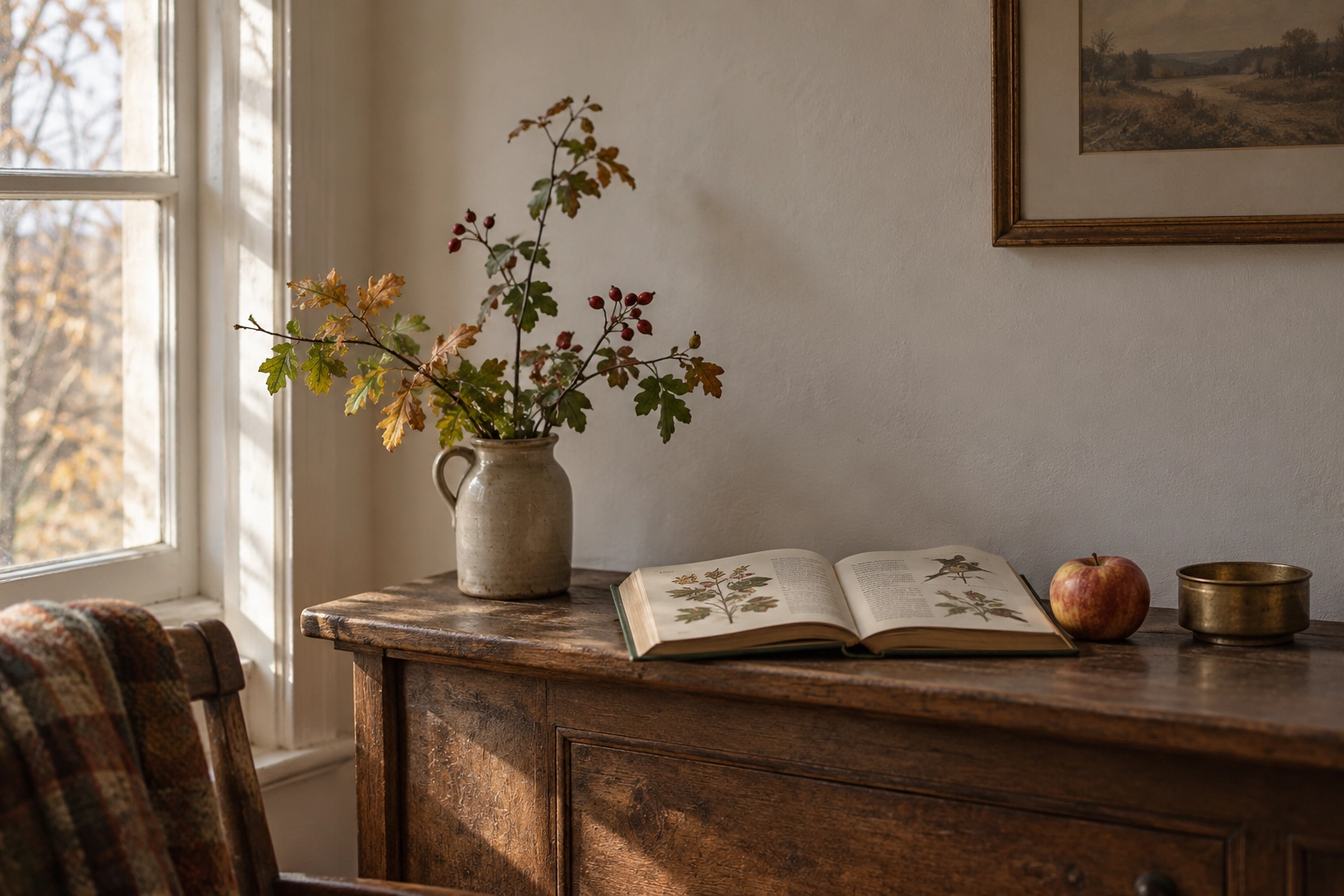
A better seasonal shelf changes because the season changes, not because the shopping basket does. One permanent base, a few objects you already own and one or two real seasonal cues are usually enough. The point is not to build four different displays. It is to notice the year moving through the same small space.
A seasonal shelf works best when the season provides most of the change and the objects simply help you notice it.
Seasonal shelf ideas start with one permanent base
Choose one shelf, tray, sideboard corner or narrow ledge and keep it through the year. The permanent part should be simple: perhaps a small lamp or safe candleholder, a shallow dish, a vase or jar, one book stand or frame and enough empty space for temporary material. You are building a stage, not buying four complete sets.
This approach gives the display continuity. A familiar brass key, wooden box, ceramic dish or old book can remain while the seasonal element changes around it. The object does not need a new symbolic meaning each time. A different context is enough.
Use the outside world as the calendar
The most convincing seasonal shelf ideas usually begin with what is actually happening outside. Early spring may mean bare twigs, snowdrops in the garden and noticeably longer evenings. Late spring brings blossom. Summer offers herbs, roses, grasses and long light. Autumn brings apples, seed heads and fallen leaves. Winter already provides evergreens, bare branches and early darkness.
That makes seasonal shelf ideas responsive rather than thematic. Instead of deciding that September requires a particular colour palette or that December needs a box of matching ornaments, look first at what the season is doing around your home.
Do not turn nature into free craft stock
Seasonal collecting still has limits. Do not uproot wild plants without permission, strip berries or seed heads from places where wildlife depends on them, or collect from protected species, nature reserves or private land where taking material is not allowed. Often the safest material is already in your own garden, on a pruning pile or in the kitchen.
A fallen leaf can be beautiful without becoming a procurement strategy.
Change one thing, not everything
Good seasonal shelf ideas do not require a complete reset every few months. Swap one branch in the vase, change one postcard or illustration, rotate one book, add one piece of fruit, move one object out of storage or replace the cloth beneath a tray. The permanent objects stay in place and the season arrives through one clear signal.
This is one of the easiest seasonal shelf ideas to maintain because it avoids the feeling that the whole display needs to be redesigned. It also makes the change more visible. One red apple on an otherwise familiar shelf can say autumn more clearly than twelve objects all competing to do the same job.
Use food, books and useful objects before decorative replicas
An apple is already an excellent autumn object. A bowl of walnuts can look more convincing than plastic woodland décor. A small loaf can mark harvest before becoming lunch, while oranges and cloves can bring winter scent without requiring a box labelled seasonal accessories. Edible objects have one practical advantage: eventually they disappear.
Books are especially useful in seasonal shelf ideas because they can change the atmosphere without becoming decorative clutter. In autumn, place a folklore collection or nature book on the shelf and actually read it. In winter, rotate in ghost stories, Christmas customs or British winter landscapes. Spring might bring a botanical guide. The shelf then has a seasonal function as well as a seasonal appearance.
A simple seasonal shelf through the year
| Season | One useful cue | What to avoid |
|---|---|---|
| Spring | A small vase of safely sourced garden growth, a botanical illustration or pale cloth | Buying a complete pastel collection just to signal spring |
| Summer | Long daylight, one flower or a small bowl of garden herbs | Covering the brightest season with objects trying to imitate brightness |
| Autumn | An apple, seed head, fallen leaf, wooden box or one brass object | Turning every surface into an orange and brown display |
| Winter | Evergreen pruning, a lamp, a safe candle or a familiar book | Buying large amounts of short-lived themed décor |
Spring: signs of return
Spring seasonal shelf ideas can be almost empty. One small vase of garden growth, a pale cloth, a notebook and a botanical illustration may be enough. Snowdrops, primroses and early blossom carry strong seasonal associations without needing to be described as objects that produce luck or renewal. They show renewal quite literally.
Summer: let light do most of the work
Summer seasonal shelf ideas usually need less decoration than we think. Use the longer daylight, move the shelf closer to natural light where that is safe for the materials on display, and add one flower or a small bowl of herbs. Leave some surface visible. A seasonal shelf should still look like part of a lived room.
Autumn: texture works better than volume
Autumn seasonal shelf ideas encourage collecting, which is precisely why restraint helps. Choose one apple, one fallen leaf, a small branch, a wooden object or a brass piece. When the apple needs eating, eat it. When the leaf becomes brittle, compost it. The shelf is allowed to change as the season moves on.
Winter: work with darkness rather than against it
Winter seasonal shelf ideas work best when light does most of the atmospheric work. A small lamp, battery candle or safely used candle can change a room more effectively than a dozen ornaments. Evergreen cuttings from responsible garden pruning can add scent and texture. Holly, ivy and mistletoe also have long histories in British seasonal custom, but berries, pets and children introduce practical safety questions that matter more than symbolism.
Keep a small rotation box
If you already own seasonal objects, keep them in one modest box. The box sets the limit. When it is full, something has to leave before something new comes in. This works better than repeatedly deciding that the next small decorative object somehow does not count as clutter.
A useful rule for seasonal shelf ideas is that storage belongs to the design. If an object has nowhere sensible to live for the other nine or eleven months of the year, that is part of the buying decision, not a problem to solve later.
Photograph the shelf before buying anything
When the display feels as though it needs something, take a photograph and look at it the next day. Often the problem is not absence but competition between too many small objects. Remove something before adding something. Empty space is part of the composition.
Do not buy folklore
Folklore is not an aesthetic product category. You do not need a mass-produced object labelled ancient or pagan to make a shelf feel connected to tradition. Read about a local custom, notice which tree flowers first on your street, learn the birds at the feeder or make bread for Lammas if that tradition interests you, while being clear about what is historical and what is your own adaptation.
Attention usually creates a stronger sense of season than themed merchandise. That is particularly important for Hawthorn & Key, where old customs are more interesting when they remain connected to real places, plants, objects and documented traditions rather than being turned into a shopping list.
Make the shelf do something
The best seasonal shelf ideas give the space a small purpose. Keep a seasonal notebook there and write one observation each week. Put a book on the shelf and read a few pages. Use the space for one object brought home from a walk while you decide whether it is worth keeping.
A lived shelf ages better than a styled one because it becomes part of ordinary behaviour rather than a static photograph of a season.
Give every season an exit
At the end of the season, clear the temporary material. Compost natural items where appropriate, return reusable objects to the rotation box and clean the shelf. Leaving it almost empty for a day or two makes the next change easier to see.
This also prevents one season from slowly accumulating on top of the next. A shelf that still contains autumn leaves, Christmas greenery and early spring flowers is no longer marking the year very clearly.
Before buying anything for a seasonal shelf
Before adding another object, ask five questions:
- Do I already own something that can do this job?
- Could I use food, garden pruning, a book or another ordinary seasonal object?
- Where will this item live for the rest of the year?
- Would I still like it without the seasonal display?
- What will leave the rotation box if this comes in?
If the last question produces silence, the box may already have answered for you.
A Hawthorn & Key approach to seasonal shelf ideas
At Hawthorn & Key, seasonal shelf ideas are most interesting when they bring the outside world into sharper focus rather than creating another reason to consume. A shelf can mark the year with a branch, a book, one familiar object and changing light.
The season already exists. The shelf only needs to help you notice it.
Sources & Further Reading
- English Heritage, Christmas traditions and seasonal household customs.
- Royal Horticultural Society, for seasonal plant, pruning and garden guidance.
- Woodland Trust, for British tree identification, seasonal change and responsible woodland engagement.
- Jacqueline Simpson and Steve Roud, A Dictionary of English Folklore.