August 16, 2026
What Is a Personal Ritual? Meaning Without Grand Claims
A personal ritual does not need a robe, an altar or a complicated set of instructions. To answer what is a personal ritual, it helps to begin with something ordinary. It may be as simple as making tea in the same cup before writing, opening a window after a difficult day, lighting a candle while reading, walking the same route on an anniversary or putting away one object when a project is finished.
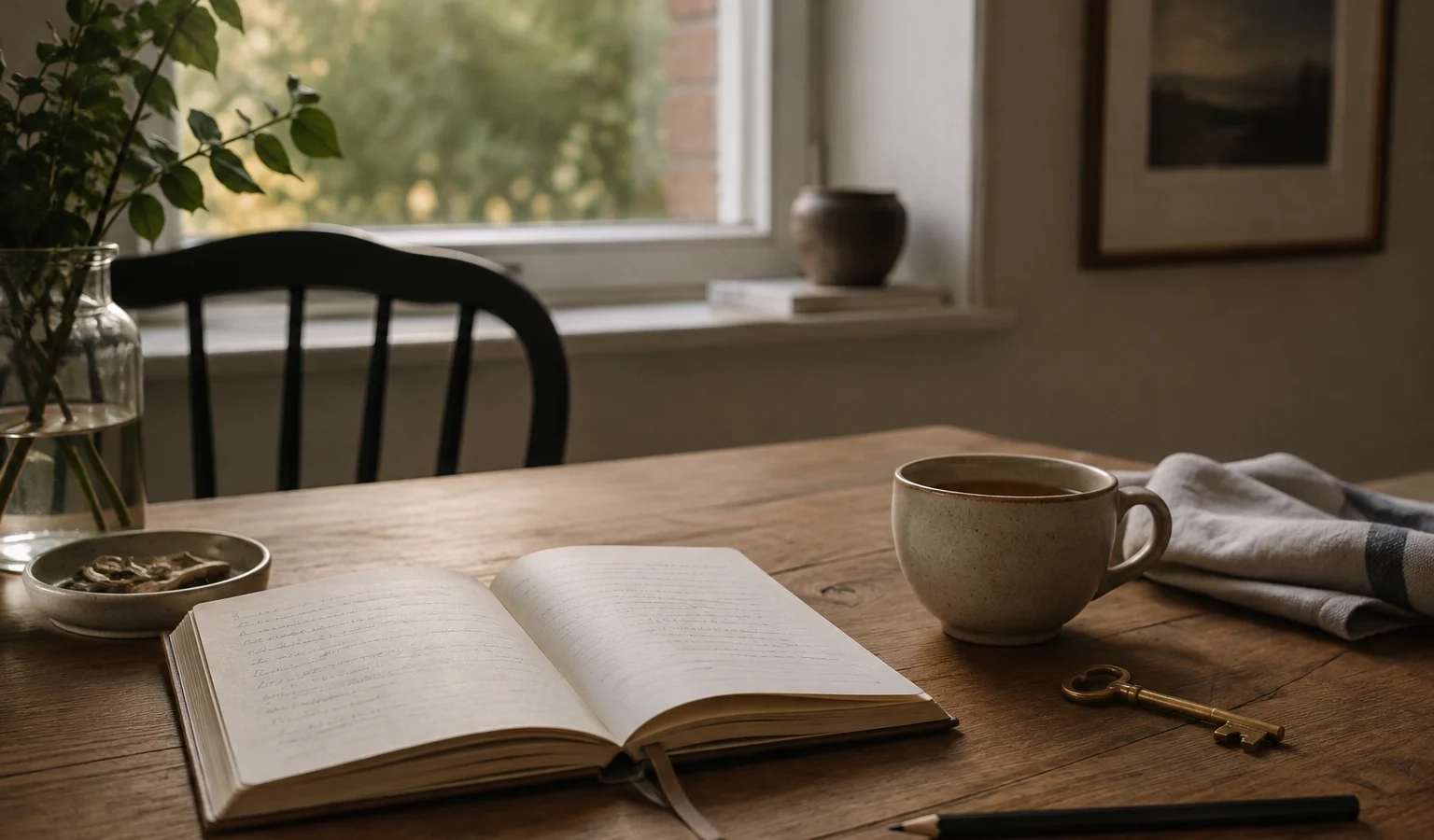
The important part is not spectacle. It is the fact that an ordinary action has been given a little extra attention.
A personal ritual is not a way of forcing the world to obey. It is a way of giving attention a shape.
That makes the subject easy to inflate. A simple practice can quickly be dressed up as manifestation, protection, destiny or secret ancient wisdom. A calmer approach is more useful. A personal ritual can mark a moment, support reflection or make a transition feel deliberate without claiming to control events outside itself.
What is a personal ritual?
A personal ritual is a repeated or deliberately shaped action that carries meaning for the person doing it. It may be private, quiet and entirely modern. It may also borrow inspiration from family custom, seasonal habit, religion, folklore or domestic routine.
The phrase what is a personal ritual is useful precisely because it keeps the question modest. We are not asking whether the action has supernatural force. We are asking what the action marks, why it matters and how it changes the way a person enters a moment.
A personal ritual can be practical and symbolic at the same time. Closing a notebook at the end of the workday may keep papers tidy. It may also tell the mind that the day has ended. Washing a cup may be ordinary cleaning. Repeating it slowly after a difficult conversation may become a way of returning to oneself.
Ritual is not the same as habit
Habits are often automatic. You brush your teeth because it is part of the day. You put your keys in the same bowl because losing them is annoying.
A ritual can contain habitual actions, but usually there is an added layer of meaning. You perform the action not only because it is practical but because it marks something: a beginning, an ending, a transition, a memory or a decision to pay attention.
This is why the question what is a personal ritual cannot be answered only by looking at the action from outside. The same cup of tea may be a habit on Monday morning and a ritual on the first day of a new project.
| Term | What it usually means | Useful boundary |
|---|---|---|
| Habit | A repeated action that often happens automatically. | Useful, but not always meaningful or deliberate. |
| Personal ritual | A deliberate action used to mark attention, memory, transition or care. | Meaningful without needing to guarantee an outcome. |
| Religious or communal rite | A practice held inside a living tradition, community or formal belief system. | Should be understood respectfully within its own context. |
| Distressing compulsion | A repeated action driven by fear, pressure or intense distress. | May need ordinary support or professional care rather than more symbolism. |
Rituals do not have to be religious
Many of the world’s most important rituals are religious or communal, and they should be understood within those traditions. A church service, a funeral rite, a pilgrimage custom or a household blessing does not become a casual lifestyle object simply because an outsider finds it interesting.
But ritual behaviour also exists outside formal religion. Families have birthday rituals. Football supporters have match-day rituals. Writers have pre-writing rituals. People make the same meal every Christmas Eve or visit the same place on a birthday.
Calling these actions rituals does not mean they all carry the same weight as sacred rites. It simply recognises that human beings often use repeated, structured actions to mark what matters.
Why repetition can feel meaningful
Repetition creates familiarity. Familiarity can make an action feel like a boundary between one state and another.
Put the laptop away, wash the mug, dim the light: work is finished. Open the notebook, make tea, sit in the same chair: writing begins.
The actions do not magically change the world. They help organise attention. In this sense, what is a personal ritual is a question about attention before it is a question about belief.
A grounded answer to what is a personal ritual therefore has to include repetition, but not repetition alone. Repetition gives the action a recognisable shape. Meaning gives it a reason to matter.
What psychology can reasonably say
Experimental research suggests that ritualised actions can influence how people experience loss, uncertainty and ordinary activities.
In one series of experiments, Michael Norton and Francesca Gino found that ritualised actions following losses were associated with lower reported grief, with a sense of regained control appearing to play a role.
Other work by Kathleen Vohs and colleagues found that ritualised actions could increase involvement and enjoyment in ordinary consumption experiences.
Cristine Legare and André Souza have also studied ritual, uncertainty and perceived control, especially the way people may evaluate ritual efficacy more strongly when randomness or uncertainty has been made salient.
These studies are interesting. They do not prove that every ritual works for everyone or that ritual is a treatment for grief, anxiety or another medical condition. They show something narrower and more useful: structured symbolic action can sometimes change subjective experience.
Uncertainty is fertile ground for ritual
People often become more ritualistic when outcomes are uncertain. Sports, examinations, travel, illness, weather, childbirth, courtship and death have all generated ritual behaviour in different cultures.
That makes intuitive sense. When control is limited, a small repeatable action provides something that can be done.
The danger begins when the action is mistaken for control over the outcome itself. A ritual before an interview may help you feel prepared. It does not force the employer to hire you.
For Hawthorn & Key, this is central to what is a personal ritual: the action may support the person, but it should not be sold as command over the world.
A useful ritual has a clear job
The easiest way to create a personal ritual is to give it one modest purpose.
- mark the end of the workday;
- remember somebody on an anniversary;
- begin a weekly planning session;
- create five quiet minutes before bed;
- make a new home feel inhabited;
- pause before making an important decision.
A ritual that knows what it is for is less likely to become theatrical or burdensome. It does not need to carry the whole weight of a life. It can simply give one moment a clearer edge.
Objects can support ritual without causing the result
A candle can mark ten quiet minutes. A key can represent a move. A stone from a walk can mark a particular place. A journal can hold the same three questions every Sunday evening.
The object does not need to emit anything invisible. Its usefulness may lie in recognition: when you see it, you remember the action you intended to take. A calm answer to what is a personal ritual leaves room for objects without making them responsible for results.
This matters for a shop or journal concerned with symbolic objects. A brass key, a candle, a notebook or a small keepsake can be meaningful without being exaggerated into a device that controls luck, love, health or another person’s choices.
Personal meaning is allowed to be personal
One of the stranger habits of modern symbolic culture is the urge to turn every personal association into a universal dictionary entry.
If your grandmother kept rosemary by the kitchen door, rosemary may mean home to you. That does not mean rosemary universally means “grandmother”.
If you wore a brass key pendant during a major move, that key may become your symbol of transition. It does not become an ancient law of key symbolism.
Personal meaning becomes clearer when it is not forced to pretend to be universal tradition. This is why what is a personal ritual is best answered through context rather than a fixed symbolic dictionary.
You do not need to buy anything
This is worth saying plainly. A personal ritual can be made from things already present in your life: a cup, a chair, a notebook, a particular song, a walk around the block or a window opened for two minutes.
A ritual that requires a shopping list before it can exist may be more retail concept than personal practice.
That does not make beautiful objects irrelevant. It only puts them in the right place. An object can support attention, atmosphere and memory. It does not have to be the source of the meaning.
Keep it physically safe
Symbolism does not cancel ordinary safety.
If you use candles, keep them away from curtains, papers, children and pets and never leave them burning unattended. If you use incense, consider ventilation, smoke sensitivity and the people and animals sharing the room.
If a ritual involves food, herbs or substances placed in water, use food-safety and medical guidance rather than symbolic correspondence charts.
A ritual should make daily life easier to inhabit, not introduce avoidable hazards. Any practical answer to what is a personal ritual has to include ordinary safety as well as atmosphere.
When a ritual stops helping
A personal ritual should remain optional enough to adapt.
If missing it causes intense fear that something terrible will happen, if it expands into repeated checking, or if it consumes large amounts of time, the situation is no longer simply about creating atmosphere.
That does not mean ritual itself is bad. It means distress and compulsion deserve to be taken seriously and, when needed, discussed with a qualified professional.
Ritual is not proof of supernatural causation
A ritual may feel powerful. Feeling powerful is part of the experience.
It is not evidence that the ritual altered probability, controlled another person or changed physical events at a distance.
This distinction lets us keep the interesting part, the symbolism, without making claims we cannot support.
The value of a personal ritual often lies in the pause it creates, not in a promise that the universe has changed its mind.
Inherited rituals and invented rituals
Some rituals are inherited from family, religion, region or community. Others are invented last Thursday because life needed a marker.
Both can matter, but they should not be presented as the same thing. If you adapt a historical or religious practice, learn where it comes from. If you invent a practice, say so.
“This is something I do” is often a perfectly respectable sentence.
How to design a simple personal ritual
The practical side of what is a personal ritual can be kept very simple. Use five parts.
1. Name the moment
What are you marking?
2. Choose one action
Make tea. Write one sentence. Light a candle safely. Put an object away. Step outside.
3. Add one sensory cue
A particular cup, lamp, scent, piece of music or place can help distinguish the moment.
4. Keep it short
Five meaningful minutes are usually more sustainable than a forty-five-minute ceremony you resent by Wednesday.
5. Give it an ending
Close the notebook. Blow out the candle. Wash the cup. Open the curtains.
An ending prevents a ritual from becoming vague background behaviour.
A ritual can change as you change
Rituals are often treated as though repetition requires permanence. It does not.
A ritual useful during one difficult winter may feel unnecessary in spring. A family tradition may need adjusting when children grow up or somebody moves away. A morning practice may become impossible after a change of job.
Keeping the meaning while changing the form is not failure. It is often what keeps a ritual alive.
Meaning without grand claims
The most useful personal rituals often make very small claims.
- This helps me begin.
- This helps me remember.
- This gives the day an ending.
- This reminds me what I decided.
- This makes an ordinary evening feel cared for.
Those claims may sound modest compared with promises of manifestation, protection or transformation. They are also much easier to live with. At its best, what is a personal ritual becomes a practical question about how to give small moments enough care.
What is a personal ritual in the Hawthorn & Key sense?
At Hawthorn & Key, personal ritual is best understood as a way of giving form to attention.
Old customs can provide inspiration. Beautiful objects can add atmosphere. A candle, key, journal or small keepsake can help mark a moment. Our guide to moon phases and their meanings shows a related approach: a visible pattern can support reflection without becoming a guarantee.
The same applies to symbolic objects. As the guide to crystals and their meanings explains, personal association can be meaningful without being turned into a medical, financial or supernatural claim.
None of these things needs to guarantee an outcome. The value is often quieter than that.
You decide that a moment matters, and then you act as though it does.
Sources & Further Reading
- Michael I. Norton and Francesca Gino, “Rituals Alleviate Grieving for Loved Ones, Lovers, and Lotteries”, Journal of Experimental Psychology: General, 2014.
- Kathleen D. Vohs, Yajin Wang, Francesca Gino and Michael I. Norton, “Rituals Enhance Consumption”, Psychological Science, 2013.
- Cristine H. Legare and André L. Souza, “Searching for Control: Priming Randomness Increases the Evaluation of Ritual Efficacy”, Cognitive Science, 2014.
- The Folklore Society, resources on folklore and vernacular tradition.
- Steve Roud, works on English traditional customs and folklore.
- Jacqueline Simpson and Steve Roud, A Dictionary of English Folklore.