June 8, 2026
British Ghost Stories: Why Britain Loves a Ghost Story
Britain has no monopoly on ghosts. Every part of the world has traditions of the returning dead, uncanny places and stories told after dark. Yet British ghost stories have acquired a particularly recognisable atmosphere: an old house with a corridor too long for comfort, a churchyard under winter trees, a railway cutting after the last train, a ruined abbey, a city lane where several centuries seem to occupy the same few yards.
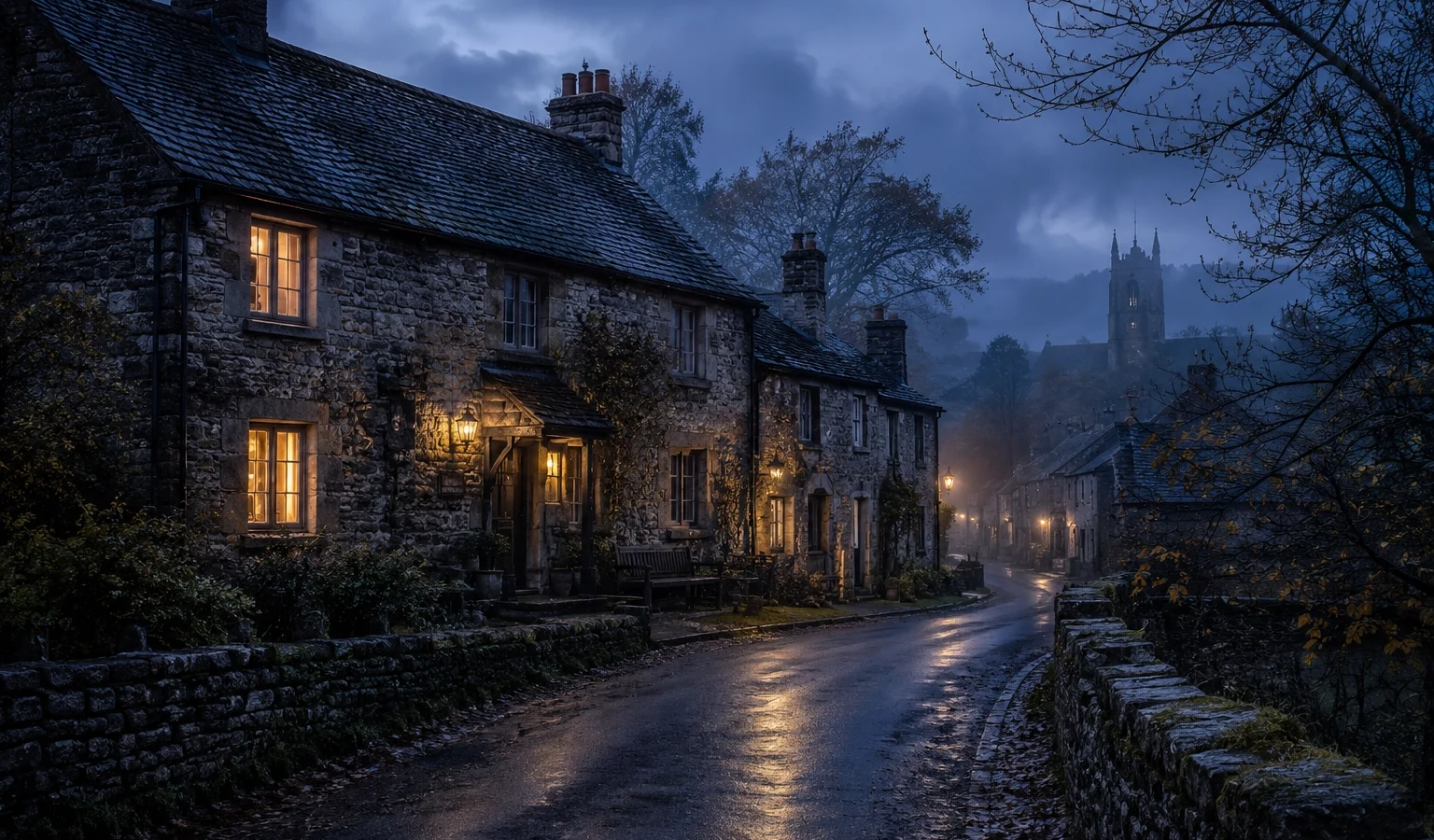
To understand British ghost stories, it helps to look not only at apparitions, but at the buildings, roads, seasons, books and local memories that allow such stories to survive.
That atmosphere can make the supernatural feel almost architectural. The building is real. The road can be walked. The name in the parish register existed. Then, somewhere between documented history and repeated story, a figure appears on the stairs.
The important distinction is that the reality of the place does not prove the reality of the apparition. A castle can have an impeccably documented execution and a much later ghost tradition. A witness can sincerely report an experience without giving us a way to establish its cause. A story can be culturally important even when its supernatural claim remains unverified.
That tension is one reason British ghost stories endure. It sits comfortably between belief and disbelief. It asks for attention more often than obedience. You may leave the door open to the possibility of a ghost while still checking the loose window before blaming the dead.
A ghost story does not need to prove a ghost in order to reveal how a place remembers.
British ghost stories are older than the Victorian parlour
The popular image of the British ghost story is heavily Victorian: firelight, Christmas, dark panelling and a small audience settling down while the weather behaves badly outside. The nineteenth century certainly shaped the form we recognise today, but British literature had been putting the dead back among the living for centuries.
Shakespeare’s stage is full of them. The ghost of Hamlet’s father demands action and raises questions about truth, memory and manipulation. Banquo returns to Macbeth’s feast as a figure of guilt and terror. In these plays a ghost is not simply decoration. It changes what the living think they know.
Earlier medieval literature and religious culture also contained revenants, visions, purgatorial tales and encounters with the dead. Those traditions did not all mean the same thing, and it would be misleading to turn them into one continuous national belief system. What they do show is that the idea of the returning dead was available long before gaslight and Gothic fiction.
Why the nineteenth century mattered so much for British ghost stories
The nineteenth century gave ghost stories an unusually fertile environment.
Britain was changing rapidly. Industrial cities expanded. Railways compressed distance. Old buildings were demolished or repurposed. New technologies altered communication and domestic life. At the same time, antiquarianism, archaeology and local history encouraged people to look backwards with new intensity.
British ghost stories thrived in that mixture of modernity and historical consciousness.
A railway could be a symbol of progress and still acquire an uncanny tale. Charles Dickens’s The Signal-Man places foreboding in the cutting of a modern railway rather than an ancient castle. The machinery is new; the fear is not. The story works because technological confidence does not eliminate uncertainty. It merely gives uncertainty another setting.
Spiritualism also became a prominent nineteenth-century movement, while the Society for Psychical Research, founded in 1882, attempted systematic investigation of apparitions, telepathy and related claims. The existence of such investigation is part of cultural history; it is not itself proof that any particular haunting was supernatural. What matters for the history of the ghost story is that belief, scepticism and attempted inquiry were all publicly present at once.
Christmas and the pleasure of being safely frightened
Christmas seems an odd home for ghost stories until we remember what a midwinter gathering provides: darkness arrives early, people stay indoors, families and friends assemble, and the year itself feels close to a threshold.
Dickens’s A Christmas Carol made the connection famous, but Christmas culture around British ghost stories was larger than one book. Periodicals, annuals and family reading helped make supernatural tales part of seasonal entertainment. Later writers, including M. R. James, became strongly associated with the tradition of telling ghost stories to an audience during the Christmas period.
The pleasure depends on safety. The room is warm. The threat belongs to the story. A creak in the house is allowed to become interesting because, in most cases, nobody actually expects an incorporeal visitor to demand the spare bedroom.
This controlled unease is central to British ghost stories. A good ghost story does not need constant shocks. It lets an ordinary environment become slightly unreliable.
The old house does half the storytelling
Britain contains an extraordinary density of historic buildings, but age alone does not make a place haunted. It does, however, provide excellent material for narrative.
An old house contains visible change: blocked doors, altered staircases, uneven floors, portraits of people nobody in the room knew, rooms that have changed purpose, and objects that outlived their owners. Even without a ghost, such a building makes the past physically present.
That is why haunting traditions so often attach to country houses, inns, castles and old urban properties. A building supplies names, dates and architectural features around which stories can organise themselves.
The mistake comes when the age of the building is used to date the ghost story. A Tudor house may acquire its best-known apparition in the twentieth century. A medieval inn can have a modern legend. The correct chronology therefore has two columns: the history of the place and the history of the haunting claim.
They may intersect, but they should not be merged automatically.
For a haunted place, it helps to keep several layers separate:
| Layer | What it can show | What it cannot prove by itself |
|---|---|---|
| Documented history | Who lived, worked, suffered or died in a place, and when records support the claim. | That a later apparition is objectively supernatural. |
| Witness account | That someone reported an experience and how they understood it. | The exact cause of the experience. |
| Local retelling | How a community, guidebook, newspaper or family kept the story alive. | That every detail belongs to the earliest version. |
| Modern reputation | How a place became known as haunted through tourism, books or repeated storytelling. | That “most haunted” is a measurable category. |
Real history gives ghost stories emotional weight
Some of Britain’s most famous haunted places are also sites of documented violence, imprisonment, execution or loss. That can make later ghost traditions feel morally charged.
But historical suffering should not be used merely as scenery for entertainment. A named victim was a person before becoming a character in a ghost tour. Dates, circumstances and surviving evidence deserve the same care we would give them in any historical writing.
The Tower of London is an obvious example. Its history contains imprisonment and execution that can be established from records; its ghost stories belong to additional layers of tradition. The two are related culturally, but an execution does not prove a later apparition.
The same approach matters in York, London and other places explored in our guide to England’s reputedly haunted cities. The more dramatic the history, the more important it becomes not to let folklore replace it.
Cities are especially good at accumulating ghosts
A city continually builds over itself. Streets are widened, houses replaced, religious buildings altered, industries moved and buried structures rediscovered. People walk daily through places whose earlier forms are no longer visible.
Ghost stories give that invisible depth a narrative shape.
York is particularly effective because Roman, medieval and later histories remain unusually legible in the city. The famous Roman-soldier story at Treasurer’s House is compelling partly because the modern witness account appears against a real Roman city beneath the later streets. Yet archaeology and apparition should still be kept separate. Roman remains demonstrate Roman activity; they do not authenticate a reported ghost.
Our article on the ghosts of York follows that distinction in detail.
London works differently because of scale. Its ghostlore spreads across royal palaces, theatres, streets, stations and demolished neighbourhoods. A city in constant change produces endless opportunities for the phrase “this used to be”. That sentence is almost a ghost story before the ghost arrives.
See Haunted London for the capital’s layered mixture of documented history and later supernatural tradition.
Landscape can be haunted without a house
British ghost stories are not confined to architecture.
Roads, moors, fields, coastlines and woods can all acquire uncanny reputations. Here the setting works through exposure rather than enclosure. A traveller is alone, visibility is poor, weather changes and familiar reference points disappear.
Practical danger matters. A lonely road at night was historically more hazardous than the same route in daylight. Moorland fog can genuinely disorient. Coastal weather can make sound and distance difficult to judge. Those conditions do not prove any supernatural story, but they help explain why certain landscapes generate them.
British ghost stories often grow where perception is already under strain.
The witness matters, but testimony is not the same as proof
Many haunting traditions begin with somebody saying, in good faith, that they saw or heard something extraordinary.
There is no need to insult the witness in order to remain cautious. Human perception is powerful and imperfect. Memory changes. Low light hides information. Expectation can influence interpretation. Sound travels strangely through old buildings. Sleep, stress and coincidence can all contribute to experiences that feel vivid and meaningful.
None of those possibilities allows us to reconstruct every reported encounter from a distance. “There must have been an ordinary explanation” can be as lazy as “therefore it was a ghost” if no evidence identifies the cause.
A careful account can stop at the correct boundary: a person reported an experience; the experience became part of local tradition; its cause remains uncertain.
Uncertainty is not a weakness in haunted history. Sometimes it is the most honest part of the record.
Why ambiguity is stronger than certainty
The best literary British ghost stories often refuse to settle completely.
M. R. James understood the power of suggestion. His stories frequently begin in scholarly, clerical or antiquarian settings where the protagonist has reason to feel rational and secure. The uncanny enters through an object, manuscript, landscape feature or apparently minor discovery. Explanation arrives slowly, if at all.
That structure has become deeply influential because uncertainty recruits the reader. If everything is shown, labelled and explained, the imagination has little work left to do.
Folklore benefits from the same ambiguity. A tale that has several versions can remain alive because each generation has space to retell it. A ghost whose biography is too perfect may begin to look suspiciously like later invention.
British ghost stories are also stories about memory
It is easy to focus on whether a ghost exists and miss what the story is doing for the living.
A haunting can preserve the name of a former resident. It can keep a local tragedy in circulation. It can express discomfort about an old building, a disputed history or a place changed beyond recognition. It can turn grief into narrative form.
Sometimes the ghost is a way of saying that the past has not become irrelevant.
This does not mean every haunting can be reduced to psychology or social metaphor. It means that ghost stories have cultural functions whether or not their supernatural claims can be established.
The ghost tour changed the ecology of local legend
Modern tourism gives British ghost stories new routes through a city.
A guide selects several tales, arranges them into a walk and repeats them night after night. Visitors photograph locations. Reviews and social media spread particularly memorable details. A story that once belonged to one street or family can become part of a city’s public identity.
This can preserve folklore. It can also standardise it.
One version becomes the version because it is easy to tell in seven minutes outside a building. Dates can drift. A nameless figure acquires a biography. A modest report becomes “the most haunted room in Britain”.
The responsible response is not to abolish ghost tours. It is to enjoy the theatrical form while keeping a separate question in mind: where did this version come from?
Why rankings such as “most haunted” should be treated lightly
There is no agreed instrument for measuring how haunted a city, castle or pub is.
Counts of reported ghosts depend on what gets recorded, how stories are divided, tourism publicity, local collecting traditions and simple repetition. One famous legend may generate more writing than twenty obscure ones.
So phrases such as “Britain’s most haunted” are best understood as folklore or tourism reputations rather than scientific classifications.
That does not make them useless. Reputation itself is worth studying. Why does York market so effectively as a ghost city? Why do certain houses become nationally famous while neighbouring buildings with comparable histories do not? The answer belongs to storytelling, publicity, preservation and cultural memory as much as to the supernatural.
Scepticism does not have to spoil the story
There is a tedious version of scepticism that treats every ghost story as an opportunity to congratulate the present for being cleverer than the past. It misunderstands both folklore and people.
Historical communities were not uniformly credulous, and modern people are not uniformly rational. Belief can be partial, playful and situational. Someone may happily tell a family ghost story, avoid walking one corridor alone, and still insist that they do not believe in ghosts.
That contradiction is part of the subject.
A grounded approach does not require us to flatten a haunting into “nothing happened”. It requires us to label evidence honestly. The house exists. The witness account exists. The later retellings exist. The supernatural explanation may remain unverified.
And belief does not need to become certainty
The opposite error is treating every unexplained detail as confirmation.
Old buildings make noises. Photographs produce reflections and motion blur. Memories shift. Local stories borrow from one another. None of these facts proves that every haunting is mistaken, but they are ordinary possibilities that deserve consideration before a supernatural conclusion is presented as fact.
Leaving an experience unexplained is a legitimate result.
There is no need to force mystery into proof in order to preserve its atmosphere.
Why Britain keeps returning to British ghost stories
British ghost stories survive because the form is unusually adaptable.
It can live in Shakespeare, Dickens and M. R. James. It can attach itself to a royal palace, a railway, a pub, a council flat or a bypass. It can be solemn, comic, frightening or almost affectionate. It can be told by somebody who believes every word and enjoyed by somebody who believes none of it.
Most importantly, it gives the past a way to remain present without pretending that history itself is simple.
The old building is not empty of previous lives merely because no apparition walks its corridor. The street still has earlier layers beneath it. The name in the archive still belonged to a person. A ghost story takes that ordinary historical fact — that places outlive people — and gives it a figure.
A Hawthorn & Key approach to haunted Britain
At Hawthorn & Key, a haunting is most interesting when its seams remain visible.
We want the documented history, the earliest version of the story, the witness account where one survives, the later embellishments and the modern reputation. We do not need to decide that every strange noise is a ghost, nor that every witness must have been foolish.
The best British ghost stories tolerate uncertainty. They let a real place keep its real history while allowing folklore to gather around it.
That is why Britain keeps telling them. The dead may or may not return, but the stories certainly do.
Sources & Further Reading
- William Shakespeare, Hamlet and Macbeth, for early modern literary ghosts and the dramatic functions of apparition, guilt and uncertain testimony.
- Charles Dickens, A Christmas Carol and “The Signal-Man” in Mugby Junction, for Victorian supernatural storytelling in domestic and technological settings.
- M. R. James, Ghost Stories of an Antiquary and “Some Remarks on Ghost Stories”, for the antiquarian English ghost-story tradition and the craft of suggestion.
- The Folklore Society, founded 1878, and the journal Folklore, for the scholarly study of traditional narrative, belief and custom.
- Society for Psychical Research, founded 1882, historical collections and publications on apparitions and psychical research; useful as evidence for the history of investigation rather than automatic validation of supernatural claims.
- Jacqueline Simpson and Steve Roud, A Dictionary of English Folklore, Oxford University Press.
- Jennifer Westwood and Jacqueline Simpson, The Lore of the Land, Penguin, for place-bound English legends and the relationship between landscape and story.