June 9, 2026
Hawthorn in British Folklore: The Tree at the Heart of Hawthorn & Key
Few British trees are as ordinary in the landscape and as complicated in folklore as hawthorn. To understand hawthorn in British folklore, it helps to begin with the hedge itself: practical, thorned, seasonal and impossible to separate from the places where people met it.
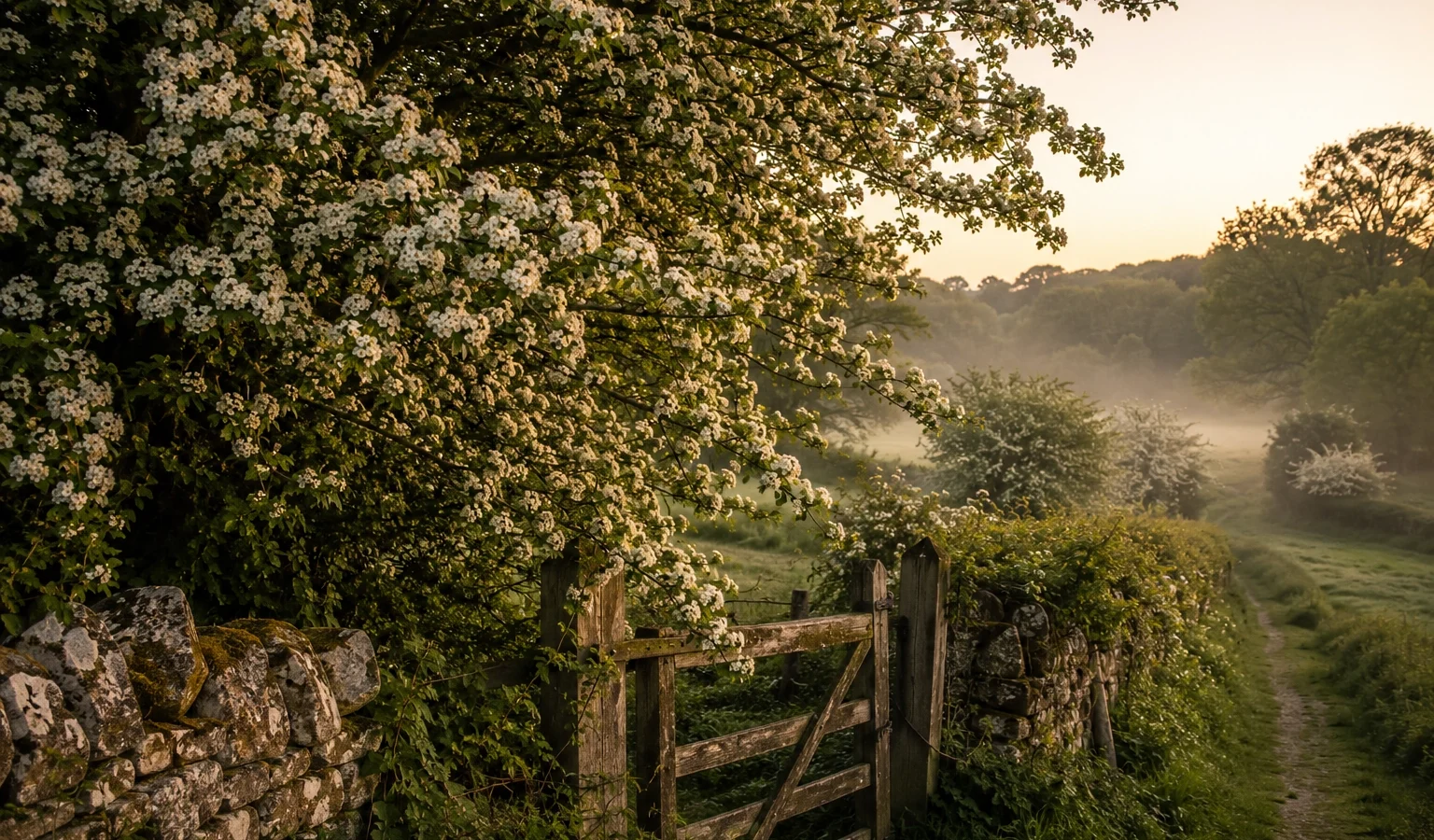
It is a hedge tree, a field boundary, a burst of white blossom in late spring and a source of red haws in autumn. It has been cut, laid, planted and managed for practical reasons for centuries. Yet the same plant has gathered stories about May Day, luck, fairies, thresholds, sacred places, marriage, death and the danger of carrying its flowers across the doorway.
That combination matters. Hawthorn was not first imagined as an occult symbol and then planted across the countryside. Its folklore grew around a living tree that people met on roadsides, farms, village edges and old boundaries.
That is precisely why the tree is worth returning to: not because it offers one tidy magical meaning, but because it sits where usefulness, season, memory and story overlap.
Read this way, hawthorn in British folklore is not a single symbol with one answer. It is a meeting point between plant life, weather, work, boundary-making, household caution and local imagination.
A hedge can be practical before it becomes symbolic. Hawthorn’s folklore begins with that living boundary.
First, what tree are we talking about?
The common hawthorn, Crataegus monogyna, is one of the familiar native trees and shrubs of Britain. It is especially characteristic of hedgerows, scrub and woodland edges. The Royal Horticultural Society describes it as a thorny, deciduous tree with deeply lobed leaves, creamy-white spring flowers and dark red fruits. The Woodland Trust likewise emphasises its value to insects, birds and small mammals.
Hawthorn is also called may, may-tree and quickthorn, among other regional names. “May” refers to the season traditionally associated with its flowering rather than to a rule that every tree opens on the first day of the month.
That botanical point is important. Folklore often works with seasonal expectation, while actual flowering responds to weather, latitude and local conditions.
The tree became symbolic because it was already useful
A hawthorn hedge is not an abstract boundary. It is a real one.
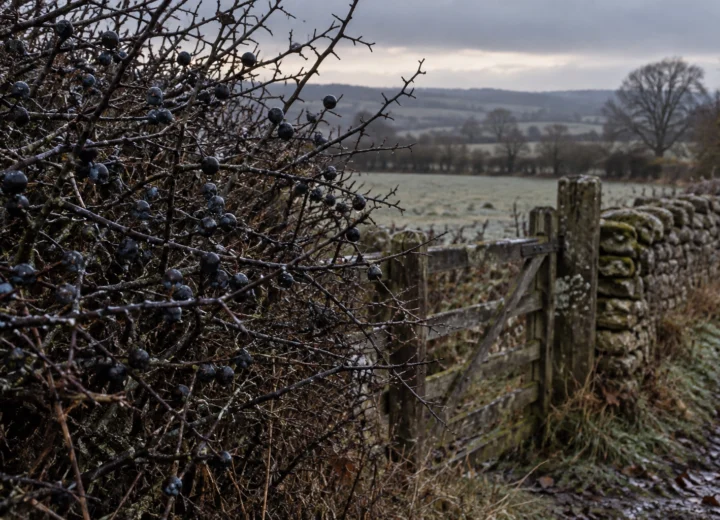
The plant grows densely, tolerates exposure and bears thorns capable of turning a living line of vegetation into an effective barrier. Rural communities used thorn hedges to divide fields, guide movement and control livestock. Hedge-laying could strengthen those boundaries by partially cutting and bending stems while keeping them alive.
It is easy to see how a plant with such a practical function could acquire symbolic associations with protection and limits. The hedge keeps some things in and other things out. Folklore can extend that visible action into less measurable ideas: guarding a household, marking a dangerous edge or defining a place where ordinary rules change.
A careful reading of hawthorn in British folklore therefore begins with the tree in the hedge, not with a ready-made list of magical correspondences.
Our more detailed article on hawthorn, May blossom and protective tradition explores those folk-magic associations in greater depth.
Hawthorn in British folklore as a tree of May
The tree’s most obvious annual transformation comes with its blossom.
Woodland Trust records show that hawthorn can flower from April into June, with timing varying between years and places. Historically, however, the abundance of blossom became so closely associated with May that the plant itself took the month as a common name.
May Day customs across Britain made use of greenery, flowers, garlands and decorated branches. Later folklore collections and modern heritage accounts repeatedly connect hawthorn with May garlands, May Queens and the seasonal movement from spring towards summer.
That does not mean every May custom was a surviving fragment of one ancient religion. Seasonal customs changed, borrowed from one another and were reinvented. What remains clear is that flowering hawthorn became one of the most recognisable botanical signs of the season.
“Ne’er cast a clout till May is out” is wonderfully ambiguous
The old warning about not casting a “clout” until May is out is often explained in two ways.
One interpretation takes May to mean the month: do not discard warm clothing until May has ended. Another takes it to mean hawthorn blossom: wait until the may-tree is properly flowering before trusting warmer weather.
The Royal Horticultural Society notes both readings.
There is no need to force the proverb into one perfect origin story. Its survival is interesting partly because the month and the flower had become culturally entangled. A weather saying could point at a calendar and a hedgerow at the same time.
The most famous contradiction is the blossom itself
Hawthorn flowers could be gathered for outdoor celebration, yet bringing them into the house was widely regarded as unlucky in later British folklore.
This is one of the tree’s most persistent popular associations. Woodland Trust summaries describe a belief that indoor hawthorn blossom could be followed by illness or death. Kew’s Grow Wild project also notes the taboo and the connection made between the flower’s smell and decay.
The contrast is striking: the same blossom that announces summer outdoors becomes uncomfortable when carried across the domestic threshold.
It is a useful warning against reducing plant folklore to fixed labels. Hawthorn cannot simply be filed under “luck”, “love” or “protection”. Place matters. Timing matters. Which part of the plant is being used matters.
This is why hawthorn in British folklore cannot be reduced to one meaning. The same tree changes depending on whether it stands in a hedge, flowers beside a path, grows near a holy well or crosses the domestic threshold as blossom.
Why did people dislike hawthorn indoors?
One modern explanation focuses on smell.
Hawthorn flowers produce a distinctive scent. Accounts from Kew and Woodland Trust note the presence of trimethylamine, a compound also associated with the odour of decaying organic material. This has led to the suggestion that the blossom could evoke illness, death or bodily decay, making the indoor taboo easier to understand.
The chemistry is real; the historical explanation is less certain.
We cannot demonstrate that one molecule created a centuries-old superstition. A sensory dislike, inherited warning and supernatural interpretation may have reinforced one another over time. Folklore rarely has to choose between “practical” and “symbolic” causes as neatly as modern explanations do.
The doorway changes the meaning of an object
A blossom on a hedge and the same blossom on a kitchen table are physically similar, but culturally they occupy different spaces.
British household folklore repeatedly concentrates attention on entrances: doors, windows, chimneys and hearths. These are places where outside becomes inside and where people imagined both welcome and unwanted forces crossing.
Seen from the doorway, hawthorn in British folklore becomes a lesson in placement: the same blossom can feel festive outside and troubling once it crosses into the house.
Hawthorn’s indoor taboo therefore belongs to a wider habit of thinking carefully about boundaries. Our article on doors, windows and chimneys in folk belief looks at that threshold logic across a broader range of protective customs.
Not every hawthorn was treated as sacred
Modern retellings sometimes produce a rule that hawthorn must never be cut.
That cannot describe ordinary British rural history. Hawthorn hedges were repeatedly trimmed, laid and managed because that was part of their purpose. Farmers did not preserve every branch as untouchable sacred wood.
What often received special respect was a particular tree: an old lone thorn, a tree beside a well, a conspicuous tree on a mound, or one attached to a local story.
This distinction matters. Folklore is frequently about individual places rather than species-wide commandments.
Lone thorns could become landmarks of story
A single hawthorn standing apart from a hedge can look very different from a managed field boundary. Age, form and location give it individuality. Once a story becomes attached to such a tree, cutting it may no longer feel like routine vegetation management.
Some traditions warned that harming a particular thorn would bring misfortune. Others connected solitary thorns with fairies or supernatural ownership. Such beliefs are especially strong in Irish tradition and have often been generalised across the wider British Isles in popular retellings.
A careful account should preserve geography. “Fairy thorn” is not a universal explanation for every hawthorn growing beside a British lane.
This is the same grounded habit described in our introduction to British folklore: keep place, source and version attached to the story before turning it into a general rule.
Handled carefully, hawthorn in British folklore becomes more interesting when it keeps its local names, places and recorded versions instead of being flattened into one broad “Celtic tree” idea.
Fairy lore is strongest when place is allowed to remain specific
Hawthorn’s fairy reputation is now one of its best-known modern associations.
Yet folklore becomes less useful when a regional story is turned into a botanical fact. A particular thorn associated with a mound or local tale is evidence for a tradition about that place. It is not proof that the species possesses measurable supernatural qualities.
This does not diminish the story. It makes it more interesting.
People remember landscapes through named trees, bends in roads, wells, stones and field edges. A tree can become part of a community’s map of caution and memory without needing to be literally inhabited by supernatural beings.
Hawthorn and holy places created another layer of meaning
Trees beside wells, chapels and pilgrimage places could gather Christian as well as folkloric associations. Offerings of cloth, ribbons or other small objects at trees and wells appear in several regional traditions, especially in Scotland and Ireland.
It is tempting to label every such practice a survival of pre-Christian religion. The historical record is usually more complicated. Devotional, healing and folk practices could coexist inside explicitly Christian landscapes for generations.
Hawthorn’s ability to accumulate several layers of meaning is one reason it resists simple classification.
The Glastonbury Thorn is a tradition of its own
No British hawthorn story is more famous than the Glastonbury Thorn.
Later Christian legend tells that Joseph of Arimathea came to Glastonbury and planted his staff, which took root and became a thorn. The tree’s unusual association with winter flowering strengthened the story, and descendants connected with the tradition became part of Glastonbury’s religious identity.
The legend should not be presented as documented evidence that Joseph travelled to Somerset. Its historical importance lies elsewhere: people told the story, cultivated associated trees, visited the place and incorporated the thorn into later ceremony.
A local tree became a vehicle through which sacred history was imagined in an English landscape.
May blossom could suggest courtship without becoming a universal “love spell”
Spring festivity naturally brought young people, flowers and courtship into the same cultural space. Hawthorn therefore acquired associations with fertility, marriage and love.
The Royal Horticultural Society preserves examples of May Queen traditions and regional stories in which the first blossom could be connected with dreams of a future husband.
But such material should not be rewritten as a timeless instruction that hawthorn “attracts love”. A recorded courtship custom is evidence for that custom. Modern ritual uses may draw inspiration from it, but they belong to their own period.
Modern correspondence lists tidy up what folklore leaves untidy
Contemporary Pagan and witchcraft writing commonly associates hawthorn with protection, love, fertility, fairies, Beltane and boundaries.
Those themes do have roots in older seasonal and regional material. What changes is the organisation.
Historical customs are scattered, local and sometimes contradictory. Modern systems often arrange them into stable correspondences that can be used consistently in ritual or personal symbolism.
That is not necessarily a problem. It becomes a problem only when a modern synthesis is presented as one unchanged ancient British doctrine.
The thorns and flowers tell different stories
Hawthorn almost seems designed to attract contradictory interpretation.
The branch bears hard thorns and soft blossom. The hedge can repel while the flower invites insects. White May blossom is followed by red autumn fruit. A managed hedge may be cut every year while a nearby lone thorn is left untouched for generations.
These contrasts make the tree symbolically flexible without requiring us to invent hidden meanings for every feature.
Sometimes symbolism begins with simple observation: the thorn catches; the hedge divides; the blossom announces a season; the berry marks autumn.
The contradictions around hawthorn in British folklore are part of what make the tree useful as a subject: it is festive and uneasy, practical and symbolic, ordinary and locally charged.
A quick guide to hawthorn in British folklore layers
| Layer | What it means in context | A grounded way to read it |
|---|---|---|
| Hedgerow and field boundary | Protection, division, enclosure, livestock control | The symbolic boundary grows out of a real rural function. |
| May blossom | Spring, courtship, seasonal celebration | The flower marks a season, not a universal love spell. |
| Blossom brought indoors | Household unease, illness or death taboo | Meaning changes when the flower crosses the threshold. |
| Lone thorn | Local story, fairy association, caution around cutting | The important evidence is usually place-specific rather than species-wide. |
| Holy well or pilgrimage setting | Devotional, healing and folk-practice associations | Christian and folkloric meanings may coexist rather than cancel one another. |
| Glastonbury Thorn | Later Christian legend and local sacred identity | The tradition matters culturally without proving the literal legend. |
Hawthorn in British folklore is strongest when the hedge, the blossom, the warning and the place are kept together.
Haws belong to the tree’s story as much as the blossom
By autumn the spectacular spring display has become clusters of red haws.
The fruits are important food for birds and mammals, and hawthorn has also entered human food and herbal traditions. Historical use, however, should not be confused with a recommendation for self-treatment.
Plant folklore and medical evidence are different questions. Hawthorn preparations have been studied in relation to cardiovascular health, but that does not turn a folkloric article into medical advice, nor does a traditional use establish that a homemade preparation is safe for a particular person.
The hedge is an archive of human work as well as plant life
Hawthorn is sometimes discussed as though folklore happened only around untouched ancient trees.
Much of its British cultural history is more workmanlike. Hedges were planted, repaired, trimmed and laid. Their forms reflect agriculture, landholding and skilled labour. A rural hedge can therefore carry ecological value, legal history, family memory and folklore at once.
This practical history helps keep romantic interpretations grounded.
Seen in this practical light, hawthorn in British folklore is not separate from labour, landholding and seasonal maintenance. It grows from the same worked landscape that gave the tree its everyday usefulness.
The tree is meaningful not because people avoided using it, but because they used it constantly and still found room for caution and story.
Why old hawthorns attract modern attention
An old tree is visibly a survivor.
Hollow trunks, layered branches and distorted growth invite narratives about age. A venerable thorn beside an old track or boundary can seem to hold the memory of the place even when its precise age is uncertain.
Modern visitors often want to know whether such a tree is “ancient”, “sacred” or associated with a named legend. Those questions are worth asking, but they should be separated.
Botanical age, documentary history and folklore are different kinds of evidence. One may be strong while another remains uncertain.
That is why hawthorn in British folklore is best read as layered evidence: plant fact, local story, later retelling and personal symbolism need not all make the same kind of claim.
The most useful folklore question is often “where was this recorded?”
Online writing about hawthorn in British folklore often tends to remove geography.
A belief recorded in one county becomes “British tradition”; an Irish fairy story becomes “Celtic belief”; a Victorian collector’s note becomes “ancient wisdom”. Hawthorn suffers especially from this flattening because it appears in so many traditions.
A better method is to keep asking for place, date and source.
Was the custom recorded in Cornwall or Yorkshire? Was it a seventeenth-century text, a nineteenth-century folklore collection or a twenty-first-century spiritual book? Was it attached to one tree or to hawthorn generally?
The answers usually make the story richer.
Why hawthorn in British folklore remains useful without requiring belief
Someone can value hawthorn folklore without accepting that cutting a fairy thorn causes supernatural punishment or that blossom in a room produces bad luck.
The traditions still reveal how people organised uncertainty, season and place. They show that a familiar plant could carry different rules depending on whether it stood in a hedge, beside a well, on a mound or inside a house.
That is the real strength of hawthorn in British folklore: it lets a common tree become a guide to how people noticed boundaries, weather, blossom, danger and memory.
They also remind us that landscape knowledge is cultural as well as botanical.
Why the tree sits at the heart of Hawthorn & Key
The name joins two ordinary things that become interesting at a boundary.
Hawthorn forms a living edge. A key opens or closes a made one. Both belong naturally to stories about entry, protection, privacy, permission and the line between what is outside and what is kept within.
The hawthorn is especially fitting because its folklore refuses to become too neat. It can be festive and unsettling, cut and protected, domestic and wild, commonplace and locally sacred.
As an emblem, hawthorn in British folklore gives Hawthorn & Key exactly the right kind of symbol: rooted in ordinary landscape, rich in story, and still careful enough to resist easy claims.
That complexity is more valuable than any promise of supernatural power. It leaves room for history, landscape, objects and personal meaning without asking folklore to become fact.
Sources & Further Reading
- Woodland Trust, common hawthorn species profile, and Woodland Trust Nature’s Calendar material on hawthorn, for identification, habitat, ecological value, flowering and seasonal observation.
- Royal Horticultural Society, hawthorn plant guide, and RHS Campaign for School Gardening, Trees: myths and folklore, for plant description, May associations and educational folklore material.
- Kew Grow Wild, “Love potions: meadows to myths”, for material on hawthorn folklore, love and protection associations, and the discussion of floral scent.
- Jacqueline Simpson and Steve Roud, A Dictionary of English Folklore.
- Steve Roud, The Penguin Guide to the Superstitions of Britain and Ireland.
- Roy Vickery, A Dictionary of Plant-Lore.
- Glastonbury Abbey, Myths and Legends, and Glastonbury Abbey, Holy Thorn Pamphlet, for heritage material relating to the Glastonbury Thorn tradition.