August 22, 2026
The Fair Folk: Why British Tradition Treats Fairies with Caution
There is something revealing about a supernatural being that is addressed politely even when nobody is certain it is kind.
To understand the Fair Folk in British folklore, it helps to begin with the respectful names that appear across different regional traditions. The Good Folk, the Good People, the Fair Folk and the People of Peace can sound flattering. In Scottish Gaelic tradition, respectful terms include Na daoine sìthe, the people of the fairy mound or peaceful people. In Wales, the Tylwyth Teg are literally the Fair Family.
These names should not be read too quickly as descriptions of gentle creatures.
Often they belong to a language of caution.
The older fairy of British tradition is not simply a tiny winged helper. Depending on place and story, fairies may reward good behaviour, punish insult, interfere with livestock, lead travellers astray, exchange children, offer gifts, demand privacy or object strongly to human intrusion. Their behaviour is inconsistent because British fairy lore is not one tidy mythology. It is a collection of regional traditions, narrative habits and beliefs that developed over centuries.
The caution surrounding the Fair Folk in British folklore tells us something important about folklore itself: people often used politeness, boundaries and rules to live beside uncertainty.
Why the Fair Folk in British folklore are not one ancient group
Modern writing often speaks of “the Fair Folk” as if everyone across Britain used the same term for the same supernatural race.
The historical picture is much more varied.
Scottish Gaelic has sìth and respectful collective expressions such as Na daoine sìthe. Welsh tradition speaks of the Tylwyth Teg. English regions preserve pixies, hobs, boggarts, Robin Goodfellow and other local beings. Northern traditions overlap with brownies and household spirits; border tales develop their own harsher figures.
Even the word fairy can flatten distinctions that mattered to individual communities.
For a modern reader, the phrase Fair Folk in British folklore is useful as a broad editorial label, but it should not be mistaken for evidence that Britain once possessed a single unified fairy religion.
| Tradition or region | Examples of names | What to keep in mind |
|---|---|---|
| Scottish Gaelic | Na daoine sìthe, people associated with the fairy mound | Respectful names do not automatically mean harmless beings. |
| Welsh | Tylwyth Teg, the Fair Family | Welsh material has its own local stories, places and vocabulary. |
| English regional traditions | Pixies, hobs, boggarts, Robin Goodfellow and others | Local beings should not be flattened into one national fairy species. |
| Modern popular culture | The Fair Folk, fae, courts and fixed etiquette | Some ideas have older precedents, while others are modern combinations or expansions. |
Why flattering names may be cautious names
Calling a dangerous or unpredictable being “good” can be a form of verbal diplomacy.
Historic Environment Scotland notes that Gaelic fairies were addressed by respectful names and gives “the good folk” as one example. The same pattern is familiar in many cultures: language becomes careful around powers whose attention is not necessarily wanted.
This does not prove that every euphemistic fairy name was chosen from fear.
But it explains why apparently pleasant titles should not be read literally.
“Good People” may express respect, avoidance, hope or all three.
Polite names do not prove that the beings were considered gentle. In many stories, courtesy is simply a sensible response to uncertainty.
The old fairies are not the flower fairies
One of the largest changes in the popular image of fairies came through literature, illustration and children’s culture.
By the nineteenth and early twentieth centuries, fairies increasingly appeared as delicate, diminutive, winged beings associated with flowers, gardens and childhood.
That image is culturally important in its own right, but it sits awkwardly beside many older regional traditions.
Historic Environment Scotland makes the contrast explicitly when discussing Gaelic lore: pastel flower fairies would look thoroughly out of place among stories of human-sized or nearly human supernatural neighbours who steal, deceive, exchange and bargain.
The Folklore Society similarly describes older British and Irish fairy narratives as full of beings who can be capricious, dangerous and vengeful, while still capable of benevolence when their protocols are respected.
The important point is not that one image is “real” and the other false.
They belong to different historical layers. The Fair Folk in British folklore become clearer when those layers are allowed to remain visible.
Why the Fair Folk in British folklore are tied to boundaries
Fairy stories repeatedly attach themselves to places that feel slightly apart from ordinary human space.
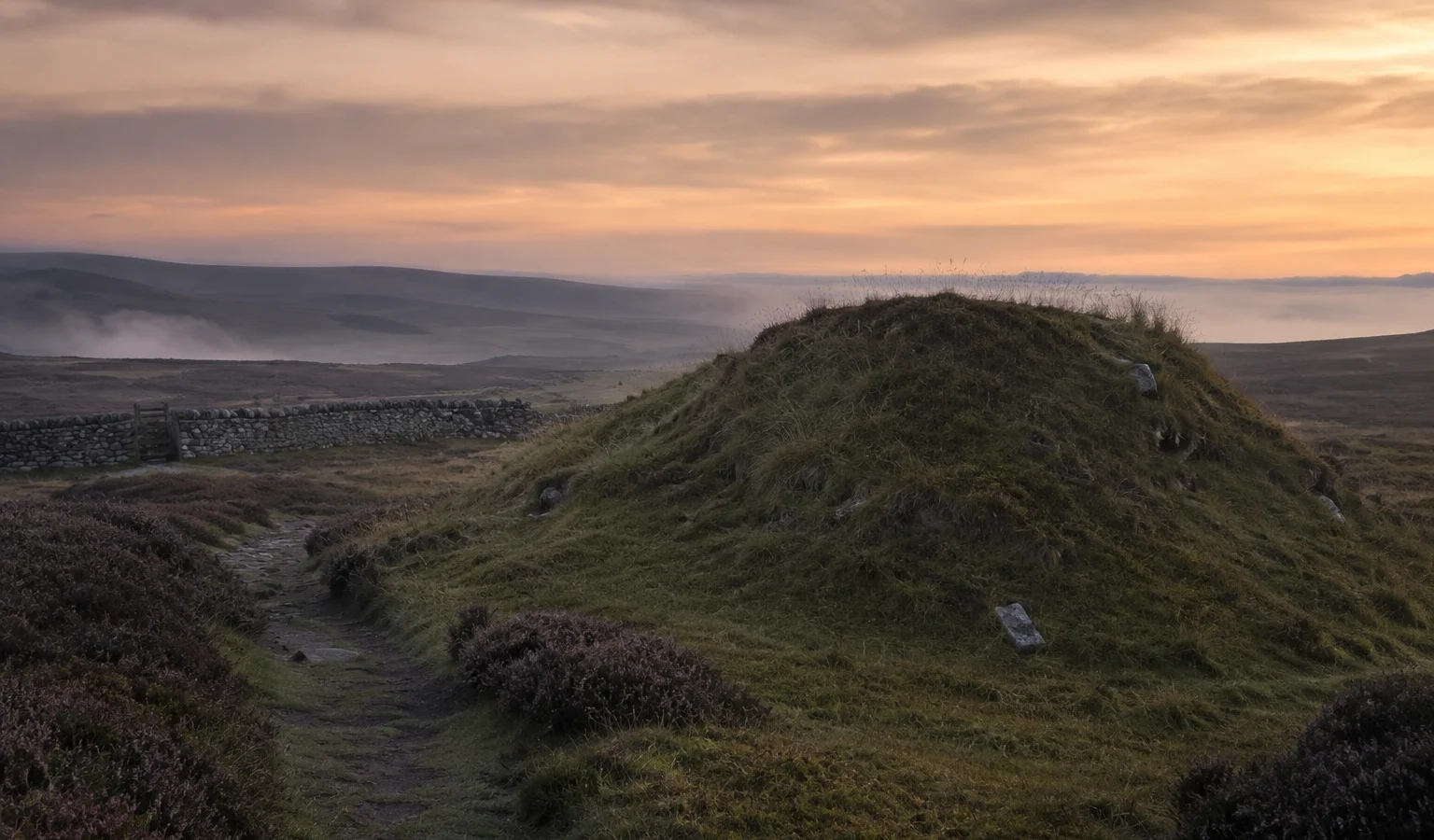
Mounds, caves, hollow hills, old tracks, woodland edges, certain springs, lonely fields and patches of ground can become fairy territory.
Once a place has that reputation, the story often gives people behavioural rules.
Do not enter at the wrong time. Do not damage the mound. Do not block a path. Do not follow the music. Do not stay after dark. Do not take what does not belong to you.
Such warnings can be read in several ways.
They may preserve supernatural belief. They may also protect dangerous landscapes, private spaces, grazing ground, caves or places carrying older communal significance.
Folklore does not require us to choose only one explanation.
A Welsh memory of fear and fascination
Museum Wales preserves recorded oral testimony from Ifan Gruffydd, born in 1896, describing childhood memories of fairy stories on Anglesey.
He remembered being deeply interested in fairies and deeply frightened of them.
His mother warned him not to go beyond a particular boundary near a cave because the fairies might take children. The stories located the fairies underground and in caves and connected them with the possibility of abduction.
This is valuable not because it proves fairies inhabited the cave.
It shows how belief narratives could shape actual childhood behaviour within living memory.
A story created a boundary in the landscape, and that boundary felt real enough to obey. This is one reason the Fair Folk in British folklore are often best understood through place and behaviour rather than appearance alone.
The fairy mound is both landscape and story
Scottish tradition offers many similar examples of ancient earthworks and natural features becoming fairy places.
Historic Environment Scotland notes that prehistoric monuments could later be understood as fairy mounds. The archaeology and the fairy story belong to different periods, but they become layered onto the same piece of ground.
This is a recurring British pattern.
Old places attract later explanations because their original makers and purposes may have become obscure.
Our article on why folklore clings to real places explores that relationship between physical landscape and inherited narrative. It also helps explain why the Fair Folk in British folklore so often remain attached to mounds, caves, paths and other specific locations.
Hospitality is rarely free in fairy stories
Another reason for caution is that fairy generosity often comes with conditions.
A household spirit may help with work but become offended by the wrong payment. Food offered by supernatural hosts may carry consequences. Gifts may reward courtesy, then vanish when discussed too freely. A human invited into a fairy dwelling may return to discover that time has moved differently outside.
These motifs vary by region and tale, but they share an important structure.
Exchange matters.
The Fair Folk in British folklore are not vending machines for blessings. Their stories are about reciprocity, restraint, obligation and the danger of assuming that human rules apply everywhere.
Why “thank you” can be complicated
Modern lists of fairy etiquette often present dozens of rules as if they came from one ancient manual.
They did not.
Different stories attach different consequences to payment, praise, gifts and spoken thanks. Household-spirit traditions in particular can be contradictory.
A brownie may accept food but leave after receiving clothing. A hob may help one household and torment another. Some stories make excessive curiosity the offence; others focus on broken promises or ridicule.
Rather than memorising a universal etiquette, it is better to notice the theme: relationships with supernatural neighbours are represented as delicate and conditional.
Fairy music and the danger of following
Music is one of the most attractive and dangerous elements of fairy lore.
People hear dancing or music from a mound, field or distant place. They follow. Time passes strangely. They join a dance and cannot easily leave. In some tales a short visit becomes years in the human world.
The narrative works because pleasure itself becomes uncertain.
The fairy world is not always frightening in appearance. It may be beautiful, abundant and compelling.
Caution is necessary precisely because attraction can be part of the danger.
Changelings are one of the darkest layers of the Fair Folk in British folklore
Fairy abduction traditions cannot be treated as harmless whimsy.
In British and Irish folklore, fairies are sometimes said to take children or adults and leave substitutes behind. Changeling stories could be used to explain illness, disability, unusual development, failure to thrive, maternal illness or sudden changes in behaviour.
Historic Environment Scotland notes that modern research has connected such beliefs with attempts to understand difficult experiences around infant health, maternal death and disability.
That historical context matters because changeling belief could contribute to cruelty towards vulnerable people.
We can study the folklore without romanticising the harm that belief sometimes enabled.
Fear does not mean constant hostility
It would also be misleading to reverse the modern stereotype and insist that old fairies were simply demons.
Many stories allow cooperation.
Fairies may reward kindness, return help, give food, lend objects, protect a household or offer knowledge. The same tradition may contain both warning tales and stories of mutual benefit.
The uncertainty is the point.
A being whose behaviour is perfectly predictable is easy to manage. Fairy stories tend to preserve beings whose motives remain partly outside human understanding.
Good, bad and the problem of modern categories
Modern fantasy often asks whether a supernatural race is good or evil.
Folklore frequently asks a different question: how should a person behave when entering a relationship they do not control?
That shift matters.
The Fair Folk in British folklore can be courteous and dangerous, generous and possessive, beautiful and frightening. A story may approve of their punishment of arrogance without presenting them as morally perfect.
Their ambiguity is one reason the tradition remains compelling.
Iron, bells and other protective ideas
British folklore contains many traditions in which iron, bells, rowan and other materials are treated as protective against fairies or harmful supernatural influence.
These ideas belong to the history of folk belief, not to tested protective technology.
When an old story says iron troubled fairies, the useful question is what iron represented within that culture: human craft, boundaries, tools, weapons, domestic security or simply inherited custom.
Folklore symbolism should not be converted into guaranteed modern protection claims. References to iron, bells or rowan tell us about traditions surrounding the Fair Folk in British folklore, not about tested protective technology.
Why fairy etiquette survives online
Contemporary internet culture has rediscovered the pleasure of fairy rules.
Do not give your name. Do not eat the food. Do not step inside the ring. Do not make bargains. Carry iron. Never say thank you.
Some of these have genuine precedents in particular traditions. Others are simplified, combined from different regions or shaped by modern fantasy fiction and role-playing culture.
That does not make the modern lists uninteresting.
They are another stage of transmission.
Our guide to folklore, urban legend and reported experience explains why a living tradition can move between oral story, print and online culture without remaining unchanged. Modern lists about the Fair Folk in British folklore should therefore be read as part of an ongoing transmission process, not as a single ancient rulebook.
Regional names for the Fair Folk in British folklore deserve to remain regional
One of the easiest ways to flatten fairy lore is to translate every local being into “a fairy”.
The Welsh Tylwyth Teg, Scottish Gaelic sìth, English pixies, northern hobs and border supernatural figures have overlapping motifs but different cultural histories.
Even within one region, storytellers disagree.
Good folklore writing should preserve those differences rather than build a fictional national taxonomy.
Our article on how local legends change from county to county shows why variation is evidence of tradition rather than a problem to be edited away.
Politeness as a technology of uncertainty
There is a broader human lesson in the old etiquette.
When people cannot control an uncertain environment, they often create rules that make behaviour feel safer.
Do not mock what you do not understand. Do not trespass carelessly. Do not boast about gifts. Keep promises. Respect boundaries. Share food. Be cautious about strangers who offer too much.
These principles work perfectly well as social advice even when the supernatural explanation is set aside.
That may help explain why stories about the Fair Folk in British folklore carry etiquette so effectively between generations.
What modern readers can keep without pretending
You do not need to claim literal belief in fairies to understand the intelligence of cautionary folklore.
A fairy mound can be treated respectfully because it is an archaeological monument. A cave can be approached carefully because caves are dangerous. A story about exchange can remind us that gifts create relationships. A changeling story can be studied as evidence of how communities once explained illness while also acknowledging the suffering such beliefs could cause.
The tradition remains meaningful when its historical layers are left visible. The Fair Folk in British folklore do not need to become literal instructions for modern life in order to remain culturally interesting.
The Hawthorn & Key approach
At Hawthorn & Key, the Fair Folk in British folklore are best approached as figures of folklore, landscape and inherited imagination rather than as guaranteed supernatural neighbours.
The old stories deserve more respect than either sentimentalising them into harmless flower sprites or exaggerating them into a modern system of magical rules.
The caution in the tradition is interesting because it belongs to a long human habit: when the world feels uncertain, good manners and clear boundaries become ways of moving through it.
Sources & Further Reading
- Historic Environment Scotland: “Scary fairies! Scotland’s Gaelic fairy folklore”
- Museum Wales: Folk Tales from Wales
- Museum Wales: Ifan Gruffydd’s memories concerning fairies
- The Folklore Society: Old Faery Narratives of Britain and Ireland
- The Folklore Society: Revisiting the Origins of British Fairies
- English Heritage: Where Do Myths, Legends and Folktales Come From?