September 11, 2026
Hobs and Brownies: Household Spirits You Should Not Annoy
Hobs and brownies belong to the domestic side of British folklore. Dragons belong to hills and caves; black dogs wait on roads; fairies dance in rings or disappear into hollow ground. A hob or brownie, by contrast, may be imagined in the barn, beside the hearth, under a stair or in an unused corner of a working building.
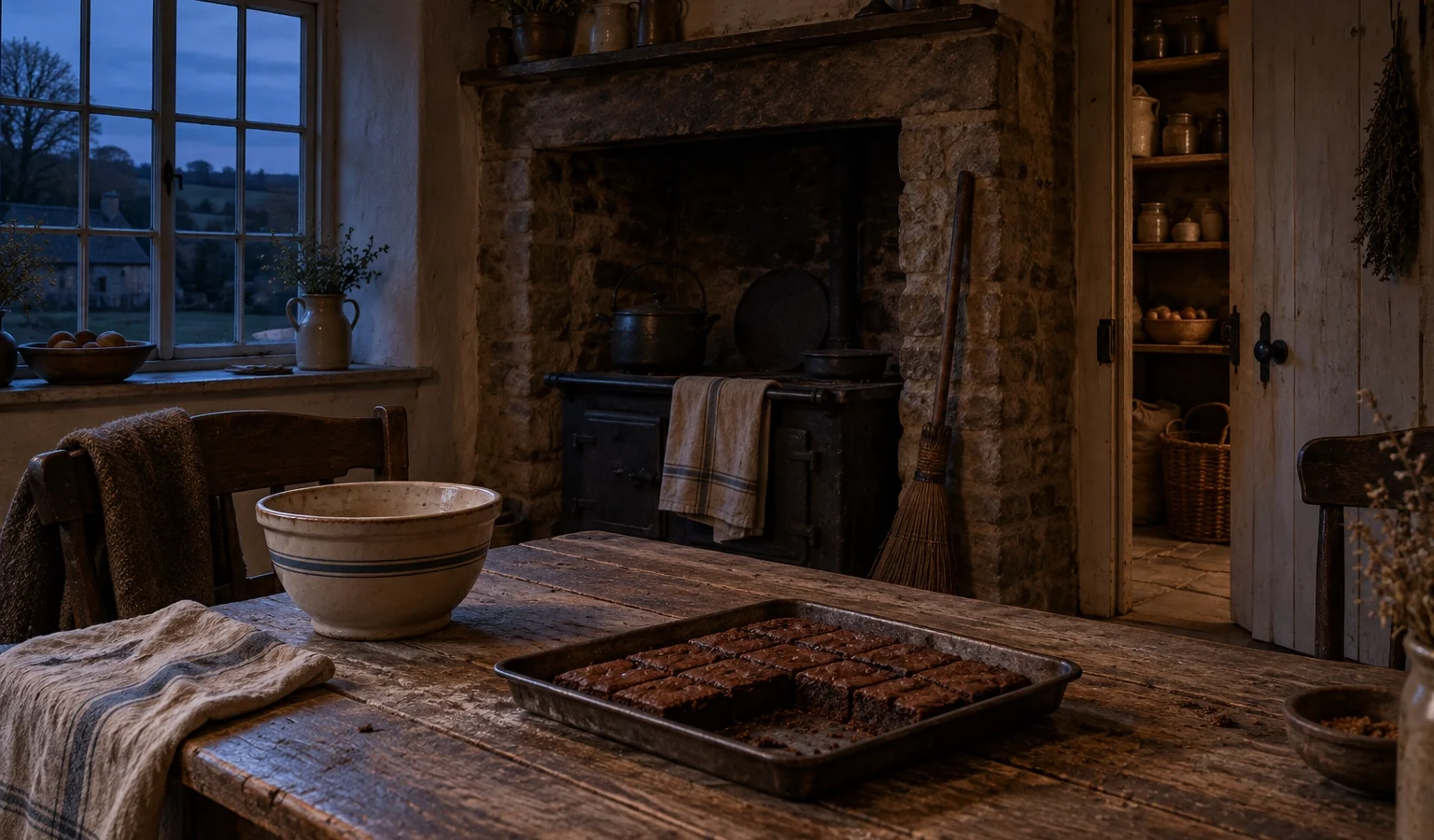
In older stories these beings are not decorative companions. They are part of a practical household world: butter must be churned, grain ground, animals tended, floors swept and tools put away. A helpful spirit may complete work while people sleep. The bargain, however, is rarely simple. Hospitality matters. Gratitude matters. Curiosity can be unwelcome. A gift can become an insult if it looks too much like wages.
This is why hobs and brownies are so useful for understanding British fairy lore. They are neither simply kind nor simply dangerous. Their stories are about reciprocity, boundaries and the uneasy idea that help is safest when no one tries to own the helper.
The household helper is useful precisely because it remains independent. Gratitude may preserve the relationship; ownership tends to break it.
Hobs and brownies are related terms, not one fixed creature
Modern summaries often treat hob, brownie, hobgoblin and household fairy as interchangeable. Historical folklore is less tidy.
The word hob appears in a range of English regional names for sprites, bogeys and hobgoblins. English Heritage notes that the name survives in Peak District place-names, including Hob Hurst’s House, where a prehistoric mound became attached to a local “hob” tradition long after the monument itself was built.
Brownie is especially associated with Scotland and the Border country. Historic Environment Scotland describes brownies as shy household or farming helpers, usually imagined as working unseen at night and accepting food or other small tokens under particular conditions.
These traditions overlap, but they should not be collapsed into a single zoological chart. Folklore names move across regions and centuries. A being called a hob in one place may resemble a brownie elsewhere; another hob may be more troublesome, wild or bogey-like.
Hobs and brownies belong to a working household
Stories about hobs and brownies make the most sense when we remember how labour-intensive an older farm or household could be.
Before modern machinery, domestic and agricultural work continued every day. Water had to be carried. Animals needed feed and bedding. Grain, dairy work, cleaning, mending and fuel all demanded time. A story in which someone wakes to find work mysteriously completed transforms ordinary exhaustion into wonder.
Historic Environment Scotland preserves a brownie tale about an elderly miller who can no longer manage his work. During the night, unseen helpers complete the tasks for him. The wonder is not abstract magic. It is labour performed when labour is urgently needed.
That practical background matters because it prevents us from turning household spirits into modern lifestyle mascots. Their stories come from places where work, food, shelter and neighbourly obligation were central facts of life.
Why the work happens at night
Many brownie stories insist that the helper prefers not to be watched.
This creates a useful narrative rhythm. The household sees results before it sees a worker: a swept floor, finished threshing, milled grain or animals mysteriously tended. Only later does someone hide awake to discover who is responsible.
The secrecy makes the helper liminal. It belongs to the household but not quite to the family. It uses the same buildings and tools, yet keeps a different timetable.
Night also preserves the dignity of the exchange. The human household receives help without commanding it directly. The spirit remains independent.
Food is a gift, but payment can change the bargain
One of the best-known brownie motifs concerns food.
Some traditions say a bowl of cream, porridge, bread or another simple offering could be left for the helper. Yet the same stories often warn that an explicit payment may end the arrangement.
Historic Environment Scotland’s mill story gives a particularly neat version. The miller and his wife decide to reward the brownies with food. The brownies interpret the gesture as being “paid off” and leave.
The point is not that every brownie story follows the same rule. They do not. The larger pattern is that the relationship is governed by etiquette rather than contract.
| Recurring motif | What often happens in the story | What it suggests |
|---|---|---|
| Food left for the helper | Work continues while a modest gift acknowledges it. | Reciprocity without formal employment. |
| Clothing is given | The helper leaves or the old arrangement changes. | A gift can alter the terms of the relationship. |
| The spirit is watched or exposed | Help ends or the being becomes offended. | Privacy and boundaries matter. |
| The household becomes demanding | The helper withdraws or becomes troublesome. | Help is not ownership. |
A wage says: you work for me. A gift says: I recognise what has been done. Folklore repeatedly worries about the moment when one becomes the other.
Why clothes can end the arrangement
Later collections contain many stories in which a household spirit is given clothes and promptly departs.
Modern readers often recognise this motif through later literary versions of helpful house-elves, but it belongs to a much older European story family.
The meaning varies. In some tellings, clothing is a reward that releases the spirit. In others, the recipient is delighted with the garment and chooses a new life. Sometimes the gift is simply too much: once the relationship becomes formal or visible, the old arrangement is broken.
The important point is not to invent one universal “fairy law”. Folklore works through variants. The repeated clothing motif shows that generosity itself can alter a delicate relationship.
Gratitude is not ownership
Stories about hobs and brownies often punish entitlement.
A family may prosper while it accepts unexplained help quietly. Trouble begins when someone boasts about the spirit, spies on it, orders it about, withholds an accustomed offering or tries to trap it into permanent service.
This makes the stories unusually sharp little studies of power.
The helper is useful precisely because it is not a servant in the normal human sense. The moment the household treats it as property, the relationship changes.
This is one reason our broader article on why British tradition treats the Fair Folk with caution matters here. Courtesy in fairy lore is rarely just politeness. It is a way of acknowledging that the other party has its own rules and cannot safely be reduced to a convenient category.
Hobs and brownies can be helpful without being harmless
Some hobs and brownies are generous. Others can become troublesome when angered.
English Heritage, discussing witchcraft beliefs, notes the old connection between household brownies or hobs and the idea of small supernatural helpers who might turn disruptive when offended. In later learned demonological thinking, such beings could be reinterpreted as sinister familiars or devils.
This is an important historical change.
A vernacular household spirit and a witch’s demonic familiar are not automatically the same thing. Early modern authorities could reinterpret ambiguous popular beings through a theological framework that made them more dangerous and morally legible.
Folklore therefore does not sit outside religious history. The same being can be redescribed according to the fears of a different age.
The hobgoblin was not always a Halloween monster
Today the word hobgoblin suggests a comic monster, fantasy creature or Halloween decoration.
Older English usage was broader.
A hobgoblin might be a mischievous spirit, a household being, a bogey or a local supernatural nuisance. The word could carry humour and danger at the same time.
Vernacular supernatural vocabulary is rarely tidy. Modern fantasy tends to separate creatures into fixed types; folklore keeps local names, overlapping categories and personalities that change with the teller.
Place-names keep hobs in the landscape
Hobs are not confined to kitchens and barns.
English Heritage’s Hob Hurst’s House is a good example of how a supernatural name can settle onto a much older archaeological place. The site is a prehistoric funerary monument on the Peak District moors, excavated by Thomas Bateman in 1853. The “hob” belongs to later naming and folklore, not to the Bronze Age or Iron Age burial evidence itself.
That distinction is exactly the kind of separation Hawthorn & Key tries to preserve. The archaeological monument is real. The hob-name is also real as a later cultural layer. One does not prove the other.
It also shows how a creature associated with the household can move outward into rougher ground. “Hob” could name a local presence wherever a place felt owned by something not quite human.
The Cauld Lad and the overlap with ghosts
English Heritage uses the “Cauld Lad” of Hilton as an example of a household spirit or hob tradition. The story is often told in ways that blur the categories of ghost, brownie and local sprite.
The overlap is worth preserving rather than tidying away.
Folklore does not always ask whether a being is technically the spirit of a dead person, a fairy or an independent household presence. A later storyteller may give a supernatural figure a human biography; an older local name may survive beside it.
When we force such stories into modern boxes, we can lose the very uncertainty that made them memorable.
Hobs and brownies across regional traditions
Scottish traditions of hobs and brownies are especially rich because related stories survive in printed collections, place traditions and oral storytelling.
Historic Environment Scotland describes the brownie as a generally shy helper who may inhabit unused parts of a building and perform household or farm labour at night. The same source stresses that brownies can be offended by mistreatment or by the wrong kind of reward.
This is not evidence that rural households literally employed invisible labourers. It is evidence that brownie stories were useful ways of thinking about work, luck, fairness and the personality of a place.
A farm with a “good brownie” is not merely a building. It becomes a household with a relationship to something beyond its visible members.
Why cream appears so often
Dairy food has an obvious place in household-spirit stories because it belonged to the rhythm of domestic and farm work.
Cream, milk and butter were valuable products of daily labour. Leaving some aside creates a meaningful gift: modest enough to be household food, valuable enough to signal respect.
English Heritage notes the association between brownies or hobs and offerings such as cream. The detail should be understood historically and folklorically, not as an instruction that leaving dairy products today will “attract” a spirit.
That distinction matters. A cultural association can be preserved without turning it into a promised ritual mechanism.
Hobs and brownies, labour and household disorder
There is another side to these stories.
In stories of hobs and brownies, a helpful spirit can explain unexpected order, while an offended one explains disorder.
Things go missing. Work is undone. Animals behave strangely. Noises disturb the night. The household’s routines seem to have acquired an invisible opponent.
Before electricity, modern plumbing, mechanical appliances and scientific explanations for many domestic disturbances, the house itself could feel more alive. Timber moved, chimneys moaned, animals reacted to sounds people could not identify, and food spoiled unpredictably.
Stories gave that domestic uncertainty a personality.
These stories are more than primitive explanations
It is tempting to say that people invented hobs because they did not understand creaking buildings or missing tools.
That explanation is too simple.
Stories also entertain. They express values. They explain luck, reward generosity, mock greed, warn against spying and make difficult labour narratable.
A brownie story can survive even when nobody literally expects one in the barn because the story still works as a social lesson.
The recurring theme is reciprocity
Again and again, hobs and brownies help when treated with consideration and withdraw when the relationship becomes exploitative.
That pattern reflects a broader world of customary exchange.
In small communities, much work historically depended on obligations that were not fully contractual: neighbours helped at harvest, households shared food, servants and labourers negotiated status through custom as well as wages, and hospitality carried expectations.
Brownie folklore turns that social world into miniature supernatural drama.
Why the helper is usually invisible
Invisibility protects ambiguity.
If a brownie were described as a fully visible worker with fixed clothes, age and anatomy, the story would begin to resemble a fantasy character sheet.
Instead, many tales keep the being glimpsed only briefly. Its presence is known through completed work or through the consequences of offence.
This gives the household spirit a strange intimacy. It may know the rhythms of the home better than any visitor, yet remain almost entirely unseen.
From oral tradition to literary character
Hobs and brownies have travelled easily into literature because the basic story is so adaptable.
A hidden helper offers comedy, melancholy and moral tension. Writers can make the spirit loyal, resentful, enslaved, mischievous or tragic.
But modern literary versions often regularise what folklore leaves uncertain. They give clear rules, species, powers and legal conditions.
When reading backwards from fantasy fiction, it is worth remembering that older hob and brownie traditions were more regional and contradictory.
What hobs and brownies are not
They are not reliable evidence of a single pre-Christian household cult surviving unchanged across Britain.
They are not a manual for “working with” fairies.
They are not proof that every odd noise in an old house has a supernatural cause.
And they should not be flattened into the modern idea that a helpful spirit is always benevolent.
The historical value lies in the stories themselves: where they were told, how they changed and what kinds of behaviour they praised or punished.
How to read stories about hobs and brownies
When you encounter a story about hobs and brownies, ask four questions.
What work does the spirit do? What does the household give in return? What action breaks the arrangement? And what changes once the helper leaves?
Those questions usually reveal more than asking whether the brownie is “good” or “bad”.
The story is often less about identifying the creature than about testing the relationship around it.
A Hawthorn & Key approach to hobs and brownies
At Hawthorn & Key, hobs and brownies are most interesting when they remain slightly difficult to categorise. Their stories belong to kitchens, mills, farms, barns and old place-names, but they also belong to questions that still feel familiar: when does help become obligation, when does gratitude become payment, and how do we live respectfully with what we do not entirely control?
The old stories rarely demand a neat explanation. They ask instead for manners, restraint and the recognition that the helper does not belong to the household.
Sources & Further Reading
- Historic Environment Scotland – “Supernatural Creatures in Scottish Folklore”
- English Heritage – “A Journey into Witchcraft Beliefs”
- English Heritage – “History of Hob Hurst’s House”
- English Heritage – “Where Do Myths, Legends and Folktales Come From?”
- William Henderson, Notes on the Folk-lore of the Northern Counties of England and the Borders (1866; 2nd ed. 1879), especially the sections on local sprites and brownies.