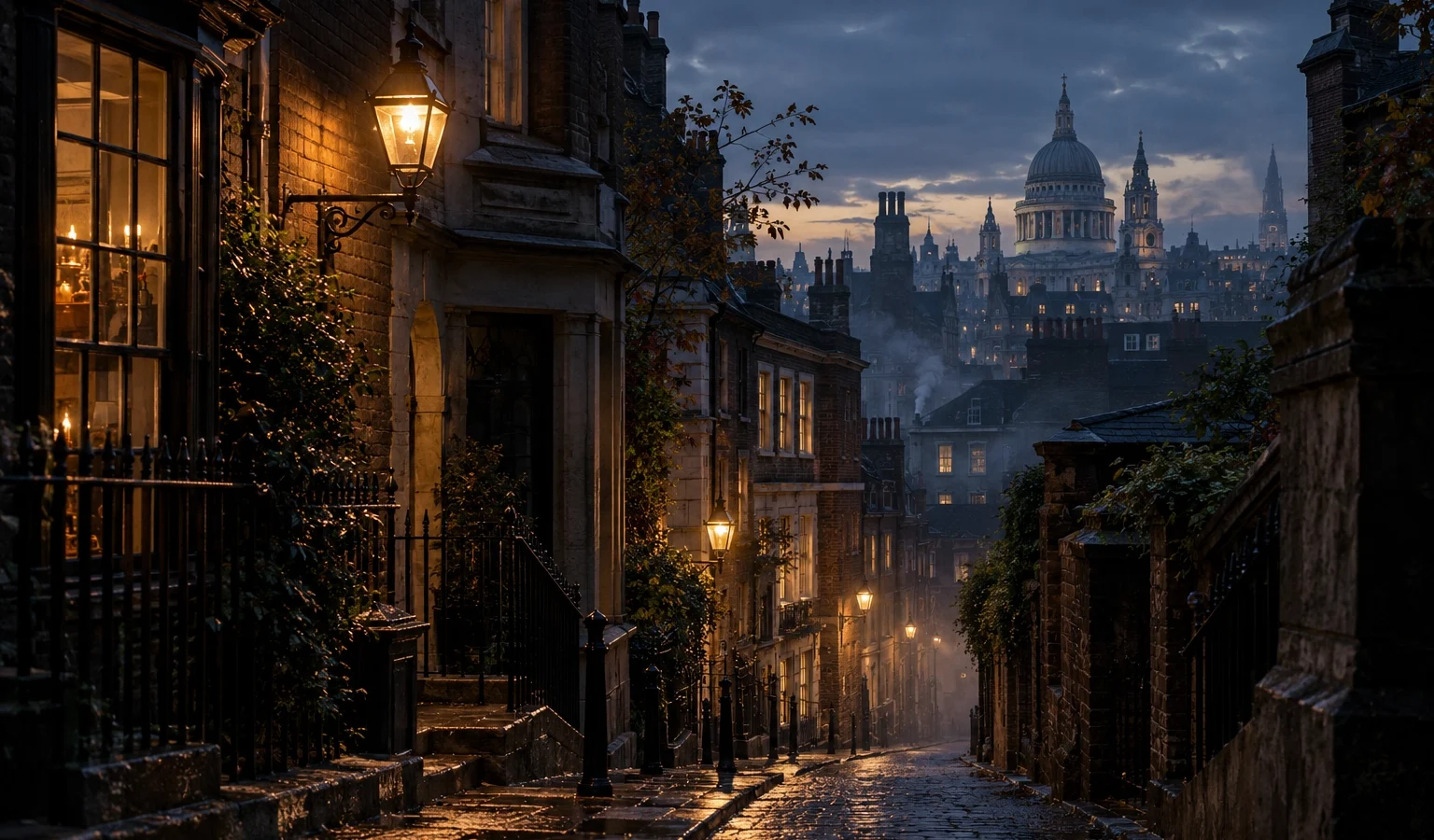
To speak of haunted London, then, is to make a cultural statement rather than a measurable one. The capital has a vast body of reported apparitions, inherited legends and deliberately cultivated tales, but these belong to different periods and kinds of evidence. A documented death is not evidence of a ghost. A Victorian account shows that a story was being told in the Victorian period, not necessarily that it began then. A modern tour may preserve genuine folklore while also reshaping it for an audience.
The most rewarding way to explore haunted London is to let history and legend remain close without forcing them to become the same thing.
A documented tragedy can explain why a place attracts ghost stories without proving that the reported ghost is real.
Why haunted London has so many different ghost traditions
London has several advantages as a ghost-story city. It is old, densely inhabited and repeatedly rebuilt. Its institutions have long memories. Palaces, prisons, theatres, churches, cemeteries and railway stations all provide places where individual lives can be attached to recognisable settings.
There is also an enormous documentary record. Newspapers, diaries, court papers, theatre archives and antiquarian books preserve stories that in a smaller community might have vanished. Later writers can return to those records, sometimes carefully and sometimes not, and give an old report a new life.
The result is not one London ghost tradition but many overlapping traditions. Royal ghosts cluster around the Tower and palaces. Theatrical ghosts inhabit stages and dressing rooms. Road and station legends belong to a more modern city. Churchyards and former burial grounds acquire stories from the unsettling fact that London has repeatedly built over its dead.
| Layer | What can be established | What remains folklore or report |
|---|---|---|
| Documented history | Executions, murders, burials, building dates and known occupants | Whether those events produced later supernatural activity |
| Recorded ghost account | Who reported a sighting, when it was written down and how it circulated | What caused the experience |
| Later legend | How a story changes through books, staff tradition, journalism or tourism | Whether later details belonged to the earliest version |
| Heritage interpretation | How institutions present the history and ghost tradition today | Whether visitors should treat the legend as historical fact |
Haunted London at the Tower: history and legend kept apart
The Tower of London is the capital’s most concentrated example. Its history supplies real imprisonment, political violence and execution. Anne Boleyn was held there in 1536 and executed on Tower Green; Catherine Howard followed in 1542. Lady Jane Grey was executed in 1554. The Chapel Royal of St Peter ad Vincula became the burial place of several famous prisoners.
Those facts are documented. The ghosts are tradition.
Historic Royal Palaces, which cares for the Tower, now presents the distinction unusually clearly. Anne Boleyn is said to appear near Tower Green and the chapel. Arbella Stuart is associated with the King’s House. A phantom bear belongs to the folklore of the Jewel House. An 1864 story tells of a sentry confronting a white figure, while an earlier 1789 newspaper report describes a supposed spirit that turned out to be a prank involving a mannequin and sheet.
This mixture is more interesting than a simple list of apparitions. It shows how haunted London can be produced in different ways: tragedy becomes legend, workplace storytelling develops among staff, newspapers preserve anecdotes and visitors arrive already expecting a haunted fortress.
Anne Boleyn and the power of a named ghost
Anonymous ghosts can be eerie, but named ghosts are memorable. Anne Boleyn demonstrates why.
Her historical story is dramatic enough without supernatural embellishment. She entered the Tower before her coronation in 1533 and returned as a prisoner three years later. After conviction for treason and adultery, she was executed by sword and buried in St Peter ad Vincula.
Later ghost tradition returns her repeatedly to the same landscape. Some versions place her on Tower Green; others imagine a procession towards the chapel. The emotional logic is obvious: a person violently removed from life is imagined as unable to leave the place of death.
Yet the legend should not be mistaken for Tudor testimony. The Tower’s modern interpretation describes it as a ghost story, not a contemporary record of Anne’s afterlife. That restraint allows both parts of the story to remain intact: the historical woman and the later cultural memory.
The phantom bear and the Tower’s stranger folklore
Not every Tower ghost is royal. One of its oddest traditions concerns a spectral bear said to have terrified a Jewel House keeper.
The image is not entirely arbitrary. The Tower once housed a royal menagerie, including exotic animals, for centuries. A polar bear given to Henry III by the king of Norway in the thirteenth century is among the best-known examples from that history.
But the phantom bear is a later ghost story, not evidence that one of the menagerie animals returned. Historic Royal Palaces curator Alden Gregory has traced the tale as part of the Tower’s storytelling culture. Its persistence shows how ghost legends borrow from the known character of a place. A spectral bear feels peculiarly suitable at a fortress that really did keep bears.
Hampton Court and the Haunted Gallery
At Hampton Court Palace, Catherine Howard’s story has become attached to a specific corridor. Legend says that after learning of the accusations against her she escaped her guards and ran towards the chapel, hoping to plead with Henry VIII. She was seized and dragged back. Her ghost is now said to repeat the desperate journey through the Haunted Gallery.
The documented history is firmer at either end of that scene than in its dramatic centre. Catherine was Henry’s fifth queen. Evidence against her reached the king in 1541; she was detained at Hampton Court, transferred to the Tower and executed on 13 February 1542. Historic Royal Palaces itself labels the gallery episode as legend.
That distinction matters because the running-and-screaming scene is often retold as though it were an established event. The palace’s own interpretation is more careful: Catherine’s fall is history, while the famous dash to the chapel belongs to the story subsequently attached to the place. This is a useful pattern throughout haunted London.
How the Victorians and Edwardians helped haunt a palace
Hampton Court also reveals how haunting can become part of heritage culture.
Historic Royal Palaces notes that by the early twentieth century visitors could buy postcards showing fabricated spectral photographs. Double exposure offered apparent visual proof of ghosts in historic rooms. The pictures did not document apparitions; they documented a market for apparitions.
That does not make the palace’s folklore worthless. It tells us something important about the period in which older royal tragedies were being repackaged for mass visitors. Railways, photography, popular history and tourism allowed a palace ghost to circulate far beyond the palace itself.
Photography and tourism allowed the ghost story to travel far beyond the palace itself.
The Grey Lady and stories that follow disturbance
Another Hampton Court tradition concerns Sybil Penn, a Tudor nurse associated with Edward VI and Elizabeth I. Her tomb at nearby Hampton church was disturbed during nineteenth-century rebuilding. Afterwards, stories spread of a Grey Lady walking the palace and of the sound of a spinning wheel behind a wall.
This is a familiar structure in British ghost folklore: a burial or old building is disturbed, and uncanny events follow. The pattern appears in many places and should not be treated as proof of a causal supernatural mechanism. What it does show is how strongly ideas of respectful burial and historical continuity shape haunting stories.
The story expresses a familiar concern in British ghostlore: disturbing the dead or their resting place is imagined to have consequences.
Theatre ghosts in haunted London
London’s theatres form another rich haunted landscape. This is hardly surprising. Theatres are spaces of repetition, illusion and memory. Actors return night after night to speak words written by the dead, while buildings preserve traditions through companies and staff.
The West End also has genuine historical depth. The Victoria and Albert Museum traces London’s theatrical culture through centuries, while Historic England records the development of major theatre sites around Drury Lane and Covent Garden. That depth gives haunted London another setting in which professional memory and supernatural storytelling can overlap.
Ghost stories flourish in this environment because theatre already asks audiences to accept presence and absence at the same time. A performer appears as somebody else; a dead playwright speaks through a living actor; yesterday’s production survives in anecdote.
William Terriss and the Adelphi
One London theatre ghost has a firmly documented tragedy behind it. Actor William Terriss was murdered outside the Adelphi Theatre in December 1897 by Richard Prince, an actor whom Terriss had previously helped financially.
The Royal Parks, which maintains Terriss’s grave at Brompton Cemetery, records both the murder and the later tradition that his ghost haunts the Adelphi.
Again, the categories should remain separate. Terriss’s death is historical fact. Reports of his ghost belong to the theatre’s later folklore. Their connection is culturally understandable without requiring us to claim that one proves the other.
The story also demonstrates how a haunting can preserve professional memory. Terriss was once a major stage celebrity. For many people today, the ghost story is the route by which his name remains familiar.
Stations, tunnels and modern haunted London
Ghost stories did not stop when London became modern. They moved into modern infrastructure.
Underground stations, railway platforms and tunnels have accumulated their own legends. These tales differ from palace ghosts because their settings are technological rather than aristocratic, yet they use similar ingredients: liminal spaces, night work, isolation and fragments of older landscape beneath the new.
A station after closing is particularly suited to uncanny storytelling. A place designed for crowds becomes almost empty. Familiar announcements echo without passengers. Tunnels hide their ends. Staff occupy the building at hours when most users never see it.
Modernity does not remove the conditions in which ghost stories grow. In haunted London, it creates new settings for them.
Burial grounds beneath the living city
London’s rapid growth has repeatedly brought the living into contact with earlier burial grounds. Archaeological discoveries during construction can feel uncanny even when they are entirely explicable.
Here it is especially important not to use archaeology as supernatural evidence. Human remains establish that people were buried at a site. They do not establish that later noises, sensations or sightings were caused by those burials.
Folklore nevertheless often connects the two. The idea of a disturbed grave is one of the oldest engines of ghost narrative because burial carries expectations of permanence and respect. When a city changes the ground itself, stories offer a way of imagining what that disruption means.
Why rebuilding can strengthen a London ghost story
London’s ghosts often survive buildings that do not.
The city has endured fire, war, demolition, road schemes and commercial redevelopment. A story may begin in one version of a building and be inherited by its successor. Sometimes the physical setting changes so thoroughly that the legend becomes one of the few apparent continuities.
This makes dates crucial when researching haunted London. If a reported apparition is associated with a staircase built after the person supposedly haunting it died, the mismatch deserves attention. If a legend is first recorded centuries after an event, that gap should be stated rather than filled with invented continuity.
Researching a ghost story therefore often requires architectural history as well as folklore.
Ghost walks and haunted London as a performance
London’s modern ghost walks belong to the history of haunted London too. They are not neutral containers carrying unchanged old tales. Guides select routes, compress complicated histories, choose dramatic endings and adapt stories to contemporary audiences.
That does not automatically make them inauthentic. Oral tradition has always involved performance. The useful question is not whether a story has been retold, but what happened to it in the retelling.
Did an unnamed figure acquire a famous identity? Did “it is said” become “this happened”? Did a twentieth-century anecdote become “an ancient legend”? Those small changes are often where folklore can be watched forming in real time.
What haunted London can tell us without proving a ghost
A haunted London story can be historically valuable even when it cannot establish a supernatural event.
It can reveal which deaths a community remembers, which buildings feel vulnerable, which periods later generations romanticise and what kinds of injustice seem to demand narrative return. Royal women executed by Henry VIII recur in London haunting traditions partly because their stories remain emotionally legible. Murdered actors return to theatres because performance culture values continuity. Disturbed graves generate tales because burial carries moral expectations.
In many cases, the ghost becomes a figure through which a place explains its own memory.
A Hawthorn & Key approach to haunted London
For Hawthorn & Key, haunted London is most compelling when the city is allowed to remain complicated. The Tower does not need a proven apparition to feel haunting; its documented history already gives later legends extraordinary weight. Hampton Court becomes more interesting, not less, when Catherine Howard’s real fall is separated from the later story of her run through the gallery. A theatre ghost gains texture when we know the life of the actor whose name it carries.
London’s ghost stories move through several layers of time: the historical event, the first surviving report, later retellings and the version told to visitors today.
Following those layers gives a clearer picture of the haunted capital than treating every atmospheric detail as evidence.
Sources & Further Reading
- Historic Royal Palaces, “Famous Ghost Stories of the Tower of London”.
- Dr Alden Gregory, Historic Royal Palaces, “The Jewel House Keeper’s Ghost”, 2024.
- Historic Royal Palaces, “Historic Hauntings at Hampton Court Palace”.
- Historic Royal Palaces, “Haunted Gallery and Processional Route”.
- The Royal Parks, “William Terriss (1847-1897)”, Brompton Cemetery.
- Victoria and Albert Museum, “The Story of Theatre”.
- Historic England, National Heritage List entries and historical material for London theatre sites.
- Jacqueline Simpson and Steve Roud, A Dictionary of English Folklore, Oxford University Press.