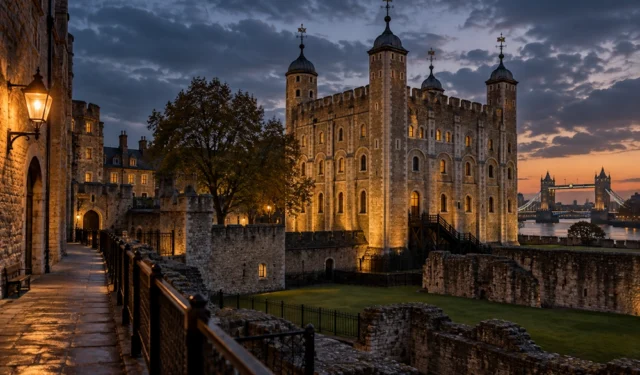
Within the walls are the remains of a royal residence, fortress, armoury, chapel, prison and former menagerie. The ghosts of the Tower of London did not emerge from one uninterrupted medieval tradition. Some tales attach themselves to deaths recorded in detail; others appear in nineteenth-century accounts, workplace recollections and later popular histories. A few grew from incidents with thoroughly human explanations.
Exploring the ghosts of the Tower of London means holding two histories side by side: events that can be documented within the fortress and the stories later generations told about what might return after dark. The distinction makes each account more interesting, because it gives the legend a place in the history of the people who repeated it.
Why the ghosts of the Tower of London have so many histories
William the Conqueror began the great stone fortress that became the Tower after the Norman Conquest. Over subsequent centuries it served monarchs as a royal residence and stronghold. It housed the royal mint, records, weapons and a menagerie of exotic animals. It also became a place of confinement for people whose political importance made ordinary imprisonment unsuitable.
The phrase “sent to the Tower” acquired its force from that history. Historic Royal Palaces notes that prisoners included Elizabeth I before she became queen, Lady Jane Grey, Sir Walter Raleigh and Guy Fawkes. During the Tudor period in particular, the fortress became closely associated with state imprisonment.
Contrary to a common impression, the Tower was not primarily a mass execution ground. Many prisoners were executed elsewhere. The private executions carried out on Tower Green are memorable partly because they were exceptional and involved people of high rank.
Royal lives and later ghost stories
Anne Boleyn: the woman behind the best-known ghost
Among the ghosts of the Tower of London, none is more firmly associated with a documented life and death than Anne Boleyn. That documentary foundation is worth establishing before considering sightings attributed to her.
The historical sequence is well established. Anne came to the Tower in triumph before her coronation in 1533. In May 1536 she returned as a prisoner, accused of adultery, incest and treason. She was tried, convicted and executed by sword on Tower Green on 19 May. Her body was buried in the Chapel Royal of St Peter ad Vincula.
Historic Royal Palaces records the later tradition that Anne’s ghost walks the Tower. Versions differ. She may glide around Tower Green, appear near the chapel or lead a silent procession towards the place of burial.
Such details belong to later legend, rather than surviving Tudor testimony to an apparition. They show how the memory of a documented execution was retold through the architecture of the place where it occurred.
Why Anne’s ghost became so durable
Anne Boleyn’s story has everything a named haunting needs: a famous identity, violent death, recognisable location and continuing disagreement over guilt, politics and reputation. Later centuries repeatedly reinterpreted her, and the ghost changed with the woman.
Some retellings emphasise a headless apparition, using the most obvious visual symbol of execution. Others imagine a dignified queen moving towards the chapel. The latter version turns haunting into ceremony rather than horror.
Neither image amounts to eyewitness evidence from 1536. They reflect what later storytellers chose to emphasise about her death and its location. This is a recurring feature of the ghosts of the Tower of London: the historical person remains identifiable, while the appearance of the supposed ghost changes between versions.
The Tower itself encourages the connection because the locations remain close together. Tower Green and St Peter ad Vincula can still be visited. The story does not float free of place.
Catherine Howard and the second Tudor queen
Catherine Howard, Henry VIII’s fifth wife, was also executed at the Tower and buried in St Peter ad Vincula. Her better-known ghost story, however, belongs to Hampton Court Palace, where later tradition places her running through the Haunted Gallery in an attempt to reach Henry. The palace setting matters because this is a different tradition from the better-known Tower stories about Anne Boleyn.
At the Tower, Catherine’s documented history remains clear. She arrived after her fall from queenship and was executed on 13 February 1542. Jane Boleyn, Lady Rochford, was executed on the same day. Later versions sometimes group the two queens together, although their stories developed in different places.
The tendency to gather Henry VIII’s executed queens into a single haunted landscape is understandable, but it can blur their individual histories. Anne’s strongest Tower tradition and Catherine’s strongest Hampton Court tradition developed differently. Treating every Tudor queen as interchangeable “royal ghost” loses precisely the human detail that gives the stories force.
Lady Jane Grey: nine days and a long afterlife
Lady Jane Grey was proclaimed queen in July 1553 and displaced after only nine days when support consolidated around Mary I. Jane was imprisoned in the Tower and executed in February 1554, aged about sixteen or seventeen.
Later tradition adds her to the Tower’s spectral company, sometimes placing her near the battlements or the place of execution. As with Anne Boleyn, the historical death is well documented while the apparition belongs to later storytelling.
Jane’s posthumous image has been shaped strongly by art and literature. Victorian culture in particular turned her into a figure of youth, innocence and pathos. A ghost legend emerging within that cultural memory cannot be treated as though it were independent of it.
Jane’s place among the ghosts of the Tower of London is therefore also part of the history of how successive generations remembered a young woman caught in Tudor politics.
The princes in the Tower
Edward V and his younger brother Richard, Duke of York, disappeared from public view in 1483 after being lodged in the Tower. Their fate remains one of the most famous unresolved questions in English royal history.
Tradition has long treated them as murdered children, and later ghost stories describe two small figures appearing within the fortress. But uncertainty about the historical event requires particular care.
The brothers disappeared from public view, but their precise fate and the question of responsibility remain contested. Reports of two childlike ghosts cannot resolve that historical debate. Nor can remains traditionally associated with the princes establish an identification without sufficient supporting evidence.
In this case, the ghosts of the Tower of London give later audiences a story to imagine where the surviving historical record leaves a question unanswered. The emotional force of the image should not be confused with evidence about what happened in 1483.
What the records establish, and what the stories add
| Story | Historical or documentary basis | Later tradition or report |
|---|---|---|
| Anne Boleyn | Execution and burial in 1536 | Different reported appearances near Tower Green and the chapel |
| Lady Jane Grey | Imprisonment and execution in 1554 | Apparition associated with the battlements |
| Princes in the Tower | Disappearance from public view in 1483 | Accounts of two spectral children |
| Sentry, 1864 | An encounter reported in a later historical account | White figure and bayonet story; supernatural explanation unverified |
| Phantom bear | Historic Tower menagerie and traceable nineteenth-century accounts | A bear-like apparition associated with the Martin Tower |
The 1864 sentry and a reported encounter
One of the Tower’s more specific haunting accounts concerns a rifleman on guard near the King’s House in 1864.
According to the version discussed by Historic Royal Palaces, the soldier was found collapsed and faced a court martial for neglecting duty. He said that a white figure had approached him. After challenging it without response, he charged with his bayonet and passed through it. Two witnesses were said to have observed the incident from a window, and the soldier was acquitted.
The details are more specific than a general claim that a lady in white has always haunted the Tower. But Historic Royal Palaces recounts the event as a story about a reported encounter, and the witnesses are part of that telling; the account should not be presented as independent proof of a supernatural event.
Its value lies partly in the setting: a military institution in which a sentry’s testimony had practical consequences.
The 1789 ghost that turned out to be a prank
The Tower’s own historical interpretation preserves a useful counterexample.
A Hereford Journal report from December 1789 described alarm over a supposed spirit. The terrifying presence proved to be a mannequin or figure dressed in a sheet, arranged as a prank by a resident.
The incident is valuable because it shows that eighteenth-century residents could explain a frightening encounter as a prank. People did not need to wait for modern scepticism before recognising how a human trick might produce a supernatural reputation.
It also shows how easily the conditions of the Tower could support misinterpretation. Darkness, guard duty, old buildings and expectation can make an ordinary object temporarily extraordinary.
The phantom bear and the Jewel House Keeper
Perhaps the strangest Tower ghost is not human at all.
Of the ghosts of the Tower of London, the phantom bear has an unusually well-traced literary and workplace history. A tradition shared among Tower staff holds that the animal’s appearance foretells death. Historic Royal Palaces curator Dr Alden Gregory has examined how versions of this tale developed around the Jewel House and the Martin Tower.
The Tower really did house bears. Its royal menagerie included exotic animals for centuries, and Henry III famously received a polar bear from the king of Norway. That historical background gives the phantom animal a local logic.
The historical menagerie explains why a bear would be a plausible creature in Tower storytelling, but not whether any spectral animal appeared. Gregory traces the bear story through a nineteenth-century publication and later testimony that placed one supposed encounter in January 1816. Even that more precise chronology records the development of an account, not the existence of a ghost.
How the ghosts of the Tower of London reached visitors
The Tower became increasingly important as a visitor attraction during the eighteenth and nineteenth centuries. Historic Royal Palaces notes that tourist numbers grew dramatically in the 1800s, when audiences were fascinated by imprisonment, execution and royal intrigue.
This matters to ghost history. Heritage tourism did not merely transmit stories; it helped organise them. Visitors wanted to know where Anne Boleyn died, where prisoners slept and which rooms were associated with famous events. Once history is mapped onto particular spaces, haunting traditions become easier to map too.
Accounts attached to particular rooms and courtyards are easier to repeat and to fold into visitor routes. For the ghosts of the Tower of London, place names such as Tower Green and the Martin Tower became inseparable from the stories.
The nineteenth century also produced a huge market for historical romance, antiquarian anecdote and illustrated guidebooks. Stories could circulate far more widely than the oral recollections of Tower residents.
The chapel and the people buried there
St Peter ad Vincula gives the Tower’s ghost stories unusual material gravity because several people associated with the legends are actually buried there.
During restoration in 1876, remains in the chancel were examined and reinterred beneath a marble pavement marked with names and coats of arms. Modern visitors therefore encounter not merely a memorial to Tudor death but a burial place.
It is important not to make the next unjustified step. Burial is evidence of burial, not haunting. Yet culturally the presence of the dead changes how a place is experienced. The chapel compresses biography, death, archaeology, commemoration and legend into a single room.
That concentration of tangible history helps explain why stories about the ghosts of the Tower of London have such a strong sense of place, even when their supernatural claims cannot be established.
The ravens and a separate Tower legend
The Tower’s ravens are not ghosts, but their famous legend belongs beside the haunting traditions because it demonstrates how apparently ancient stories can have surprisingly complicated histories.
The popular belief says that if the ravens leave the Tower, the kingdom will fall. Modern scholarship and curatorial work have questioned claims that this is an immemorial medieval prophecy, suggesting that its familiar form is much later.
The comparison is useful when discussing the ghosts of the Tower of London. A story’s setting may be ancient even though the earliest traceable version of the story is much later. Dating the building and dating the legend are different research tasks.
Why workplace folklore preserves the stories
The Tower is not only a monument. It is a workplace.
Yeoman Warders, curators, guards, conservators and other staff spend time in spaces that most visitors experience briefly. Their stories form a living layer of Tower folklore. The phantom bear, unusual sounds and personal anecdotes can circulate through professional communities as well as tourist culture.
Workplace recollections deserve attention, but their status needs to be clear. They may preserve details of how the ghosts of the Tower of London were discussed by residents and staff, while also changing as tellers pass them on. Recording who supplied an account is especially useful when an apparently ancient tradition can be traced to a much later retelling.
A good account asks who told the story, when, in what context and whether earlier versions survive.
Does the Tower have to be haunted to feel haunted?
In one sense, the Tower is a perfect test of what people mean by a haunted place.
If “haunted” means scientifically demonstrated supernatural activity, its legends do not provide that demonstration. If it means a place where the past remains emotionally present through architecture, burial, ritual, storytelling and repeated reports of uncanny experience, the description becomes easier to understand.
The fortress contains unusually visible consequences of political power. Some of its prisoners faced execution; others were eventually released or left behind written accounts of confinement. Later generations have returned to their lives through biography, architecture, heritage interpretation and stories of the ghosts of the Tower of London.
The two forms of remembering are different, but they occupy the same walls.
A Hawthorn & Key approach to the ghosts of the Tower of London
At Hawthorn & Key, the ghosts of the Tower of London are most worth exploring when their accounts remain attached to the available records. Anne Boleyn’s execution can be studied through Tudor history, while the supposed sightings belong to the later life of her reputation. The phantom bear’s changing story and the documented report of a prank in 1789 deserve the same care with dates and sources.
The evidence differs between stories. We can date an execution, identify a newspaper report and trace the wording of a later retelling, while remaining uncertain about the experience a witness claimed to have had.
Read this way, the ghosts of the Tower of London form a history of memory as well as a collection of legends. Their popularity tells us how people have continued to interpret royal deaths, prison life and the strange stories exchanged in the fortress long after particular events passed into history.
Sources & Further Reading
- Historic Royal Palaces, The Story of the Tower of London. Institutional overview of the fortress, its people and later legends.
- Historic Royal Palaces, The Tower of London as a Prison. Historical background on confinement and executions.
- Charlotte Gunnell, Famous Ghost Stories of the Tower of London, Historic Royal Palaces, 24 November 2025. Reports of the Tower Green sentry, Jane Grey and the 1789 prank.
- Dr Alden Gregory, The Jewel House Keeper’s Ghost, Historic Royal Palaces, 31 October 2024. Research into the phantom bear and the versions of the Martin Tower story.
- Historic Royal Palaces, Historic Hauntings at Hampton Court Palace. Context for Catherine Howard’s separate palace tradition.
- Jacqueline Simpson and Steve Roud, A Dictionary of English Folklore, Oxford University Press. General reference on British ghostlore.