June 11, 2026
Moon Phases and Their Meanings: A Calm Beginner’s Guide
The Moon changes without changing. To understand moon phases and their meanings, it helps to separate two things that are often mixed together: what the Moon is physically doing in the sky, and what human beings have chosen to make of that rhythm.
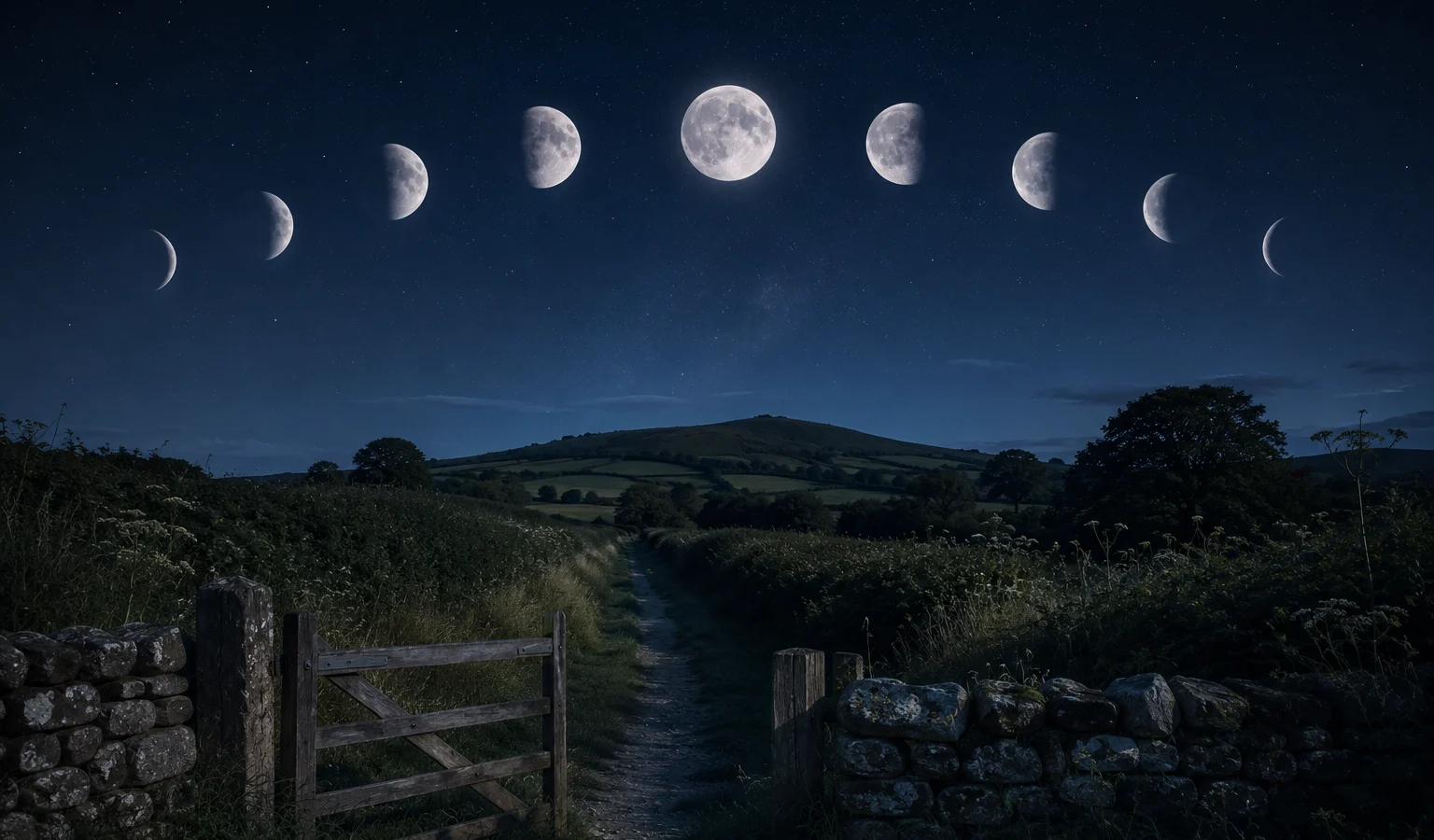
Across a month, its familiar disc seems to disappear, return as a thin crescent, grow towards fullness and then diminish again. The effect is simple enough to watch from a garden, pavement or upstairs window, yet it has carried an extraordinary amount of human attention. Calendars, tides, religious observance, farming lore, poetry and modern ritual have all found reasons to notice the lunar cycle.
That does not mean the Moon is sending private instructions, causing particular emotions or guaranteeing that one week is better than another for love, money or success. The astronomical cycle is real. The meanings people attach to it are cultural and personal. A grounded guide to moon phases and their meanings should keep those two layers visible.
That distinction is the best place to begin.
The Moon gives the month a visible shape. The meanings are the work of human attention.
What causes the phases of the Moon?
The Moon does not produce visible light of its own. What we call moonlight is sunlight reflected from the lunar surface.
At any given time, roughly half of the Moon is illuminated by the Sun. As the Moon travels around Earth, however, our viewing angle changes. We therefore see different proportions of the illuminated half.
Royal Museums Greenwich and NASA both describe the familiar sequence as new Moon, waxing crescent, first quarter, waxing gibbous, full Moon, waning gibbous, last or third quarter, and waning crescent.
A complete cycle from one new Moon to the next takes about 29.5 days. This is the synodic month, or lunation. The Moon itself completes an orbit around Earth in about 27.3 days; the longer phase cycle results from Earth also moving around the Sun while the Moon is orbiting us.
The Moon is not physically changing shape
The words crescent, quarter and gibbous describe how much of the illuminated lunar face we see from Earth.
They do not describe pieces of the Moon appearing and disappearing. Nor is Earth’s shadow responsible for the ordinary phases. Earth’s shadow matters during a lunar eclipse, but the monthly phases arise from the changing geometry of Sun, Earth and Moon.
This is worth stating because the physical explanation makes the symbolism more interesting, not less. Human beings have built stories around a predictable change in visibility, which is why moon phases and their meanings can be discussed without turning symbolism into a claim about physics.
Why “first quarter” looks like half a Moon
One of the most confusing names for beginners is first quarter.
From Earth, the Moon appears half illuminated at first quarter. The name refers not to the visible fraction but to the Moon’s progress through its monthly cycle: roughly one quarter of the way from one new Moon to the next.
The same applies to last or third quarter. The visible disc again looks half lit, but the lunation is around three quarters complete.
Waxing and waning are directions of change
Waxing means the visible illuminated portion is increasing. Waning means it is decreasing.
For an observer in Britain, the waxing Moon generally builds from a slim evening crescent towards a bright full disc, while the waning Moon becomes progressively slimmer and is more associated with the later night and morning sky.
These are observational descriptions. Modern symbolic practice often borrows them as metaphors: waxing for building, waning for reducing. That metaphor is intuitive, but it is still a human interpretation rather than an astronomical property.
Moon phases and their meanings at a glance
A compact table of moon phases and their meanings can be useful, provided it is treated as a set of reflective prompts rather than a rulebook.
| Phase | What is seen | Grounded symbolic use |
|---|---|---|
| New Moon | Usually hidden in the Sun’s glare | Pause, reset and decide what deserves attention. |
| Waxing crescent | A thin crescent after sunset | Begin gently; notice the first visible sign of movement. |
| First quarter | Half-lit disc, one quarter through the cycle | Meet resistance, adjust plans and do practical work. |
| Waxing gibbous | More than half illuminated and still growing | Refine what is already taking shape. |
| Full Moon | Fully illuminated disc, prominent through the night | Take stock of what has become visible. |
| Waning gibbous | Light begins to decrease after fullness | Review, share, maintain and recover. |
| Last quarter | Half-lit disc on the waning side | Edit, complete and remove what no longer serves. |
| Waning crescent | A final narrowing crescent before new Moon | Rest, release and leave some space unfilled. |
Read this way, moon phases and their meanings offer a simple monthly vocabulary for attention, not a set of commands from the sky.
New Moon
At new Moon, the Moon lies in roughly the same direction as the Sun from our point of view. The side facing Earth is largely unilluminated, so the Moon is normally invisible in the Sun’s glare.
Modern journals and ritual guides often treat this as a symbolic beginning: a blank page, a pause, or a moment to decide what deserves attention next. The astronomy itself does not require a new beginning. The usefulness comes from choosing a recurring point in the month at which to stop and reflect.
Waxing crescent
A few days after new Moon, a thin crescent appears after sunset. It is one of the most recognisable lunar forms.
Symbolically, the waxing crescent is often associated with the earliest signs of growth: making a first move, beginning a project, or returning gently to something neglected. It can be a helpful image precisely because the change is small. Nothing is full yet.
First quarter
At first quarter, half the visible lunar disc is illuminated. The Moon is about one quarter of the way through the lunation.
Modern symbolic systems sometimes connect this phase with effort, decision or adjustment. A calmer reading is simply that beginnings have consequences. After a plan has existed for a week, it may need practical work rather than more intention-setting.
Waxing gibbous
The Moon is more than half illuminated and still growing towards full.
Rather than treating this as a cosmic command to “manifest harder”, it can be used as a metaphor for refinement. Something has shape now. What needs correcting before it becomes more visible?
Full Moon
At full Moon, Earth lies roughly between Sun and Moon, so the lunar side facing us is fully illuminated. A full Moon rises around sunset and remains prominent through the night.
Its brightness makes it culturally powerful. Full Moons have attracted festival dates, folklore, warnings, poetry and modern ritual. Symbolically they are often associated with visibility, culmination and taking stock.
Claims that the full Moon reliably causes unusual human behaviour are a different matter and should not be treated as established simply because the image is culturally familiar.
Waning gibbous
After full Moon, the illuminated portion begins to decrease.
Modern symbolic practice sometimes frames this as a period for gratitude, sharing or reviewing what has just reached a peak. More practically, it can be a useful reminder that completion is followed by maintenance, distribution and recovery.
Last quarter
The Moon again appears half illuminated, this time on the waning side of the cycle.
As a metaphor, last quarter suits editing. What can be removed? What obligation has outlived its usefulness? What was learned from the previous three weeks?
The value lies in the questions, not in believing the lunar phase has made the decision for you.
Waning crescent
The final visible crescent becomes thinner as the Moon approaches new Moon again.
Modern guides often connect this phase with rest, release and quiet. That interpretation is especially attractive in a culture that tends to treat every day as an opportunity for more productivity.
A waning crescent can therefore serve as permission to leave some space unfilled. It does not need to become another task.
There is no single ancient system of “moon phase meanings”
Online charts often present moon phases and their meanings as eight tidy pairings, as if this were a single inherited tradition.
History is messier.
People have used lunar cycles for timekeeping for thousands of years. Medieval British almanacs tracked conjunctions of the Sun and Moon, eclipses, lunar age and other astronomical information. British Library manuscripts preserve calendars in which lunar calculations sit beside saints’ days, agricultural information, medical instructions and prognostications.
That evidence shows how seriously the Moon was observed. It does not prove that medieval people used today’s standard sequence of “new Moon = intention, waxing = manifestation, full Moon = abundance, waning = release”. That compact symbolic scheme is largely a modern way of organising moon phases and their meanings for contemporary practice.
Old lunar knowledge mixed observation with belief
A fifteenth-century almanac could contain accurate attempts to calculate lunar phases beside medical or astrological advice that modern evidence does not support.
This mixture is historically normal. Astronomy, astrology, medicine, religion and seasonal calculation were not always separated into the categories familiar today.
For a modern reader, the respectful approach is neither to dismiss the whole manuscript as superstition nor to revive every instruction as timeless wisdom. It is to ask what kind of claim is being made.
A table predicting a conjunction of Sun and Moon is not the same kind of thing as a rule about when bloodletting should be performed.
The Moon really does matter to tides
The Moon has a measurable physical relationship with Earth’s oceans.
The Met Office explains that tides result from the interaction of Moon, Sun and Earth. Around new and full Moon, Sun, Moon and Earth are more closely aligned, contributing to spring tides with a larger range between high and low water.
This real gravitational effect is sometimes stretched into unsupported claims about the Moon controlling human emotion because the body contains water.
The comparison sounds poetic but it is not good evidence. Oceans respond on an enormous planetary scale to gravitational gradients. A person’s feelings are not a miniature tide table.
Moonlight is also an ecological condition
Brightness at night changes across the lunar month, and many organisms can respond to light conditions, tides or other environmental rhythms.
That is another real field of study, but it should not be turned casually into a claim that every person sleeps, argues, gives birth or makes better decisions according to the same lunar timetable.
The sensible line is simple: natural systems can respond to lunar cycles in specific measurable ways. Human symbolic practice is something else.
Why moon phases and their meanings can still be useful
A symbol does not need to be a force in order to be useful. This is the calmest way to approach moon phases and their meanings: not as commands from the sky, but as repeated occasions for attention.
If someone decides that the new Moon will be a monthly point for reviewing priorities, the practice can create rhythm. If the full Moon becomes a date for looking back at what has changed, it can support reflection. If the waning phase is used to clear a desk, finish a notebook page or cancel an unnecessary commitment, the symbolism has done practical work.
The important phrase is used to, not caused by. In that sense, moon phases and their meanings belong closer to reflective practice than to prediction.
The Moon supplies a visible recurring pattern. The person supplies the meaning.
A lunar phase can mark a question. It should not be asked to replace evidence, care or judgement.
A simple way to work with the lunar cycle
You do not need crystals, special candles, an expensive journal or a precise ritual kit.
For one lunation, try recording four moments:
- New Moon: What deserves a beginning, or simply more attention?
- First quarter: What has become difficult now that the idea is real?
- Full Moon: What is visible that was not visible two weeks ago?
- Last quarter: What can be edited, completed or released?
These questions are deliberately ordinary. They do not require the Moon to guarantee anything.
You can observe before you interpret
One of the best beginner practices is simply to look.
Note the date, time, weather, where the Moon appears in the sky and what its shape looks like. NASA’s Daily Moon Guide and NASA JPL’s Moon journaling project encourage exactly this kind of repeated noticing, because a month of observations reveals how moonrise times and phases change.
Only after observing for a while need you decide whether you want a symbolic layer at all.
A journal that begins with “thin crescent above the roofs at 7.40 pm” is often more interesting than one that begins with a copied list of meanings.
Do not panic if you miss a phase
The lunar cycle is not an appointment system.
If clouds cover the full Moon, nothing has gone wrong. If you forget to journal at new Moon, you have not missed a cosmic window. If work, illness, children or travel make a ritual impractical, ordinary life takes priority.
The next phase will arrive without being chased.
This is one reason the Moon can be a useful antidote to perfectionism: the cycle repeats.
Be cautious with “best day for” claims
Search results for lunar practice often promise the best Moon phase for haircuts, money, conception, surgery, investing, breaking up, signing contracts or making major life decisions.
Such claims require evidence appropriate to the subject. Symbolic timing may feel meaningful, but it should not replace medical advice, financial judgement, legal deadlines, weather forecasts or practical planning.
A pleasant ritual calendar is not a risk-management system.
Where witchcraft fits
Modern witchcraft, Pagan practice and popular spirituality often give the lunar cycle a prominent role. This is real as contemporary culture, but it should not be collapsed into one supposedly unchanged “ancient British” system.
As our guide to the difference between historical and modern witchcraft explains, modern practices can contain older material, revival, reconstruction and new invention at the same time.
The same caution applies to lunar correspondences. A practice can be meaningful today without needing a false pedigree.
That is why moon phases and their meanings are best presented as layered: astronomy first, historical use second, and personal symbolism only after both have been kept in view.
Divination and lunar timing are related, but not identical
People have long connected the sky with prediction. Historical almanacs are full of attempts to read time, weather, health and fortune through astronomical and astrological systems.
That history sits beside the broader story of divination in Britain before the modern Tarot boom.
Yet keeping a Moon journal in 2026 does not automatically make someone an astrologer or diviner. It may be nothing more mysterious than using a recurring natural cycle as a prompt for attention, much like a personal ritual that gives ordinary time a little more shape.
A practical beginner’s vocabulary
- Lunation: one complete cycle from new Moon to new Moon, about 29.5 days.
- Waxing: the visible illuminated portion is increasing.
- Waning: the visible illuminated portion is decreasing.
- Crescent: less than half the visible disc appears illuminated.
- Gibbous: more than half appears illuminated, but the Moon is not full.
- New Moon: the Moon’s near side is mostly dark from Earth and usually lost in daylight glare.
- Full Moon: the near side appears fully illuminated.
- Earthshine: faint light reflected from Earth that can illuminate the dark part of a crescent Moon.
A Hawthorn & Key approach to Moon phases
At Hawthorn & Key, moon phases and their meanings are most interesting when astronomy and symbolism are allowed to sit beside one another without pretending they are the same thing.
The phases are physical, predictable and observable. Their meanings are layered: some historical, some folkloric, some modern and some entirely personal. Read carefully, moon phases and their meanings become less a fixed code than a monthly language of attention.
You can learn the geometry, look up at the sky, read an old almanac, keep a notebook and still leave room for atmosphere.
The Moon does not need to promise a result in order to give a month shape.
Sources & Further Reading
- Royal Museums Greenwich, Royal Observatory material on Moon phases, including the eight-phase sequence and the basic geometry of Sun, Earth and Moon.
- NASA Science, “Moon Phases”, for the astronomical sequence and visual explanation of lunar phases.
- NASA Science, Daily Moon Guide, for practical lunar observation and current phase information.
- NASA Jet Propulsion Laboratory Education, “Look at the Moon! Journaling Project”, for beginner-friendly observation practice.
- Met Office, “Tides”, for the interaction of Moon, Sun and Earth in tidal behaviour.
- British Library, “Stars in Their Eyes: Art and Medieval Astronomy”, for medieval astronomy, Bede and the historical study of lunar knowledge.
- British Library, Harley MS 937 catalogue record, for a medieval English almanac containing lunar conjunctions and calendar material.