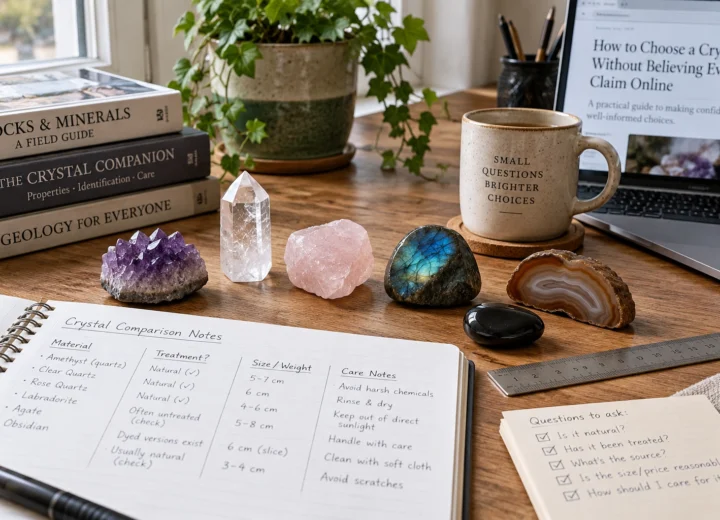
A personal feeling that an object should be reset, rededicated or marked after a difficult period is a symbolic one.
The first requires material care. The second, if it matters to you, can usually be done without putting the stone in water, salt, smoke, sunlight or anything else that may damage it.
That distinction is the simplest way to avoid many of the mistakes repeated in crystal-care advice online.
There is no universal cleaning method for every stone sold as a “crystal”. Different materials vary in hardness, toughness, cleavage, porosity, treatments and sensitivity to heat, light and chemicals. A method that is harmless for one gem may be unwise for another.
The safest rule is therefore not “water is good” or “water is bad”.
It is: identify the material first, then choose the least aggressive method that will do the job.
Safe crystal care begins with the material in front of you, not with a universal rule about water, salt, sunlight or energy.
How to clean crystals safely: cleaning is not cleansing
In crystal culture, the word cleanse often means a symbolic reset: placing a stone in moonlight, passing it through smoke, burying it, resting it on salt or rinsing it in water.
Those practices belong to personal or modern spiritual ritual. They should not be confused with conservation or gem care. The distinction matters whenever you are deciding how to clean crystals safely.
If you want to mark a new beginning with a stone, you do not need to expose it to a risky substance.
You can:
- wipe the surface safely if it actually needs cleaning;
- place the object on a clean cloth;
- write down the association you want it to hold;
- move it to a new place;
- hold it for a quiet minute;
- or simply decide that its meaning has changed.
Symbolic practice can be adapted easily; physical damage to a specimen is harder to undo.
Why hardness alone cannot tell you how to clean crystals safely
One of the most common shortcuts online is to use Mohs hardness as though it answers every care question.
It does not.
The Mohs scale measures resistance to scratching. It does not directly tell you how easily a stone may fracture, whether it has cleavage, whether it is porous, whether a treatment will react to solvents, whether colour will fade in strong light or whether rapid temperature change will cause damage.
GIA repeatedly makes this distinction in its care guides.
Amethyst is 7 on the Mohs scale and has good toughness, yet GIA still advises against steam and high heat and notes that some amethyst colour can fade with prolonged exposure to intense light.
Sunstone sits around 6.5 to 7.2 but has cleavage and poor toughness, which changes how it should be handled.
Iolite can reach 7 to 7.5 but has perfect cleavage in one direction and should not be cleaned with steam or ultrasound.
A single hardness number therefore cannot tell you whether a bowl of water, an ultrasonic cleaner or a sunny windowsill is sensible. It is not enough, by itself, to decide how to clean crystals safely.
Start with the gentlest practical method
Most shelf specimens do not need an elaborate cleaning ceremony.
If the object is simply dusty and you know it is a stable material, begin gently. In most cases, how to clean crystals safely starts with doing less rather than more.
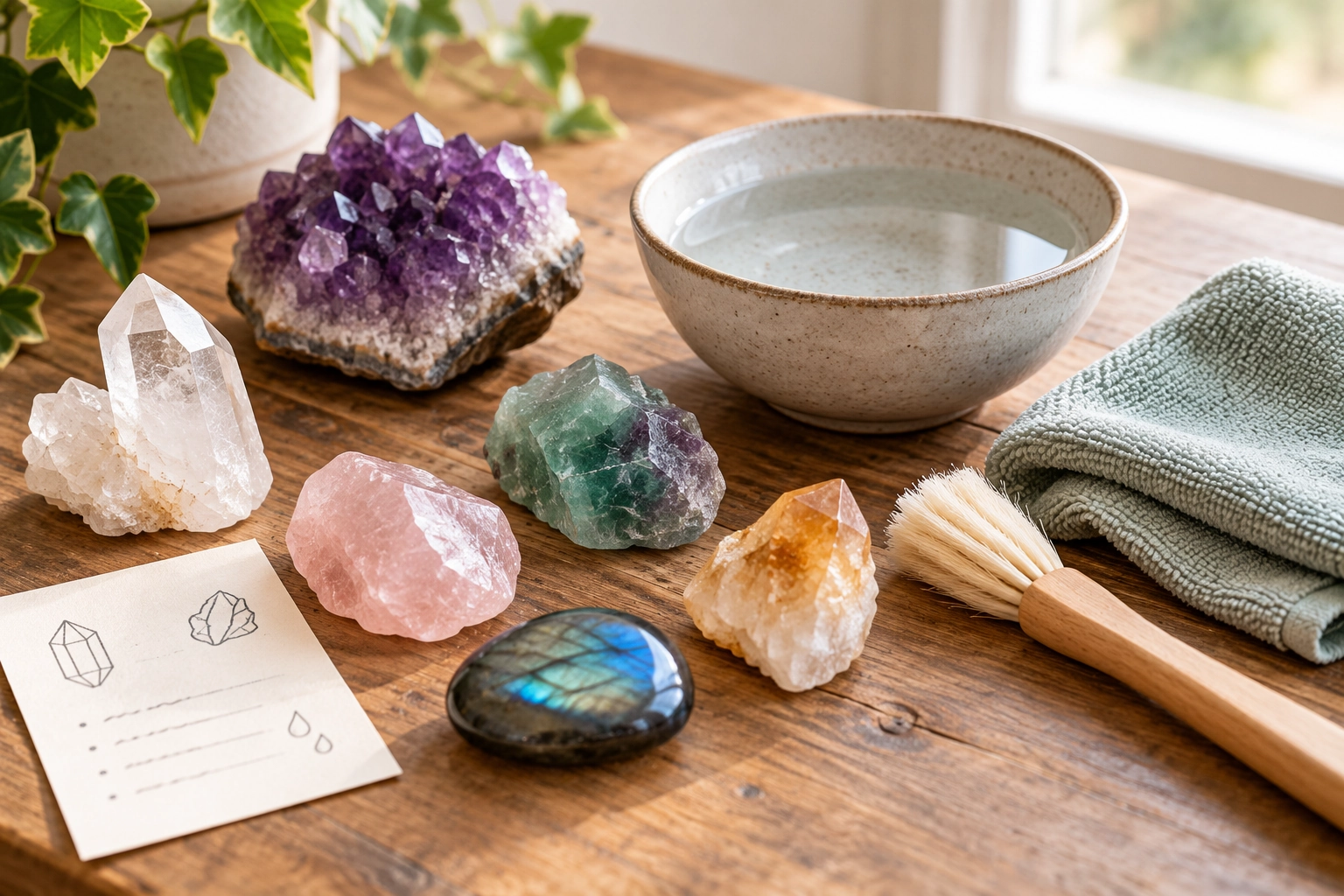
- Remove loose dust with a clean, soft brush or dry microfibre cloth.
- Inspect cracks, delicate crystal points, glued components, coatings and metal settings.
- If water is appropriate for the identified material, use a small amount of lukewarm water rather than soaking by default.
- Use mild soap only when the material’s care guidance supports it.
- Rinse residue carefully if appropriate.
- Dry with a soft cloth and allow inaccessible areas to dry fully.
This sounds less exciting than burying the entire collection under a full moon, but it is much easier on the collection.
| Method | When it may be appropriate | Main caution |
|---|---|---|
| Soft dry brush or microfibre cloth | Loose dust on many stable specimens | Be careful around fragile points, coatings and loose matrix |
| Lukewarm water | Only where reliable care guidance supports it | Identity, treatment, porosity, fractures and settings all matter |
| Mild soap | Where the exact material is known to tolerate it | Remove residue fully and avoid stronger household chemicals |
| Steam or ultrasound | Only for materials and treatments specifically known to be suitable | Heat, cleavage, fillings, fractures and treatments may make them unsafe |
| Direct sun or prolonged soaking | Rarely necessary for ordinary cleaning | Light sensitivity, heat and extended exposure can create avoidable risk |
Water, soaking and how to clean crystals safely
Water is safe for many common gems when used correctly, but how to clean crystals safely cannot be reduced to a universal water-safe list.
GIA, for example, recommends warm soapy water for amethyst, garnet, aquamarine, turquoise and several other jewellery stones, although the details vary and some treatments change what is safe.
But “many” is not “all”.
Crystal-shop collections can include soft or soluble minerals, porous materials, coated specimens, composite pieces, glued objects, metals and stones with unknown treatments.
That is why a viral rule such as “anything above 6 on Mohs can go in water” is unreliable.
Before adding water, ask:
- What exactly is this material?
- Is it a single mineral or a mixed specimen?
- Has it been dyed, coated, filled, stabilised or glued?
- Is it set in metal?
- Are there fractures or delicate points?
- Does a reputable gem or mineral source recommend water for it?
If you cannot answer those questions, dry cleaning is the more conservative starting point. That is often the safest answer when you do not yet know how to clean crystals safely for a particular specimen.
Soaking is rarely the default
Even when a stone tolerates brief contact with water, that does not automatically mean hours of soaking are useful.
A soak can expose fractures, settings, adhesives, coatings and porous areas for much longer than necessary.
For jewellery, water may also reach places around settings where soap or moisture is harder to remove.
The question should be: “What cleaning does this object actually require?”
Not: “How long can I leave it in a bowl before something interesting happens?”
Salt is not a universal cleaning method
Salt appears constantly in symbolic crystal-cleansing advice.
From a care perspective, there is no reason to make dry salt or salt water the automatic choice.
Salt can lodge in crevices, leave residue and create unnecessary problems for metal components or composite objects. Salt water also adds a dissolved chemical to what would otherwise be a simple cleaning process.
If the purpose is symbolic rather than physical, nothing is gained by making the material-care problem more complicated.
Place the stone beside a small dish of salt if that image matters to your practice. The symbolic distance of ten centimetres does not invalidate the thought.
Light, heat and temperature changes
Sunlight is another example of a symbolic practice that may conflict with material care.
Some crystal guides recommend leaving stones in direct sun to “charge” them.
GIA notes that some amethyst can fade after prolonged exposure to intense light. Ametrine can also show fading in some colour areas under prolonged intense light. Other materials have their own stability profiles.
The practical lesson is not that every crystal must live in darkness. It is that light sensitivity belongs in any sensible guide to how to clean crystals safely and how to store them afterwards.
It is that a bright windowsill is not a neutral storage environment.
If you value the colour of a specimen, especially one known to be light-sensitive, use indirect light for display and do not leave it in intense sun for ritual reasons.
Heat and sudden temperature changes matter
Heat is sometimes introduced unintentionally through steam cleaning, hot water, radiators, fireplaces, candles or sunny enclosed windows.
GIA warns that abrupt temperature changes can fracture amethyst. Opal can develop fracture lines known as crazing under damaging heat, and sudden temperature changes may also cause fracture. Iolite and several other gems can be vulnerable to rapid temperature change.
This is another reason to use lukewarm rather than very hot water and to keep specimens away from direct heat sources.
A stone does not need to be placed beside a candle flame to take part in an evening ritual.
Steam and ultrasonic cleaners need material-specific advice
Professional jewellery equipment can look reassuringly scientific, but it still has limits.
GIA does not recommend steam cleaning for amethyst, garnet, peridot, sunstone, iolite and a number of other gems. Heat, inclusions, fractures, cleavage and treatments all affect whether steam is appropriate.
If you own a mixed crystal collection, “put everything through the steamer” is therefore not a sensible general policy.
Follow care instructions for the exact material and treatment. This is more reliable than trying to decide how to clean crystals safely from appearance alone.
Ultrasonic cleaners are not universally gentle
Ultrasonic cleaners use high-frequency vibrations in liquid to remove dirt from jewellery.
They can be useful for suitable gems.
They can also be inappropriate for stones with fractures, fillings, delicate structures or particular treatments.
For example, GIA says ultrasonic cleaning is usually safe for untreated amethyst but not when the stone is dyed or fracture-filled. It advises avoiding ultrasonic cleaning for turquoise, sunstone, iolite and peridot.
The phrase “usually safe” matters because treatments, fractures and construction can change the answer.
If you do not know the material and treatment history, do not assume an ultrasonic machine is gentler simply because no hand is touching the stone.
Examples: treatment, toughness and material-specific care
Turquoise shows why treatment matters
Turquoise is an excellent case study because the mineral’s care depends partly on its surface and treatment.
GIA describes turquoise as generally stable to light but vulnerable to high heat and possible discoloration from chemicals, cosmetics, skin oils and perspiration. It recommends warm soapy water and advises against steam and ultrasonic cleaning.
Some turquoise is treated to improve its appearance or durability, and heat or solvents may damage treated surfaces.
This is why “What stone is it?” is only the first question when working out how to clean crystals safely.
“What has happened to it since it came out of the ground?” may matter just as much.
Opal shows why toughness matters
Opal can range roughly from 5 to 6.5 on the Mohs scale, but hardness is only part of the care story.
GIA describes its toughness as very poor to fair and recommends warm soapy water as the safe cleaning method. Opals may also be treated with oil, wax, plastic or surface processes.
A comparatively low hardness does not tell you all of that.
Nor would a simple “never use water on soft stones” rule be accurate, because GIA specifically identifies warm soapy water as safe for opal.
Material-specific guidance is more reliable than internet folklore in both directions. It prevents both unnecessary fear and unnecessary damage when deciding how to clean crystals safely.
Avoid improvised chemical and damage tests
Bleach, strong acids, abrasive cleaners, descalers, alcohol-heavy products and mystery cleaning sprays have no place in a general crystal-cleaning routine.
Different minerals react differently to chemicals, while treatments, coatings, adhesives and metal findings add further variables.
GIA notes, for example, that feldspars can be attacked by hydrochloric acid and advises avoiding bleach-containing cleaners for sunstone.
If mild soap and water are not known to be safe for the material, the answer is usually to research the specimen – not escalate to a stronger household product.
Do not identify unknown stones by damaging them
Another common internet habit is turning identification into a series of home experiments.
Scratch tests, acid tests, heat tests and attempts to see whether colour runs can permanently damage specimens and may still fail to identify them correctly.
If identity matters, use reliable mineralogical references or ask a qualified gemmologist, mineral dealer or museum/geology specialist.
A £5 tumbled stone does not need a laboratory investigation, but it also does not need to be damaged by improvised kitchen tests.
Mixed and decorative pieces need extra caution
A carved object may contain more than the named stone.
Jewellery includes metal, solder and settings. Decorative “crystal trees” use wire and adhesives. Boxes may have stone inlay. Specimens can sit on matrix rock. Some objects are coated, stabilised or assembled.
Care should therefore be based on the most vulnerable part of the object, not the toughest component. This is especially important when deciding how to clean crystals safely when metal, glue, coatings or matrix rock are involved.
If a quartz point is glued to a metal base, the fact that quartz tolerates water says nothing about the glue or the metal.
Symbolic cleansing without risking the material
Use a method that does not need to test the material. Symbolic practice does not need to complicate how to clean crystals safely.
For example:
- place the stone on a clean cloth overnight;
- write a new intention or association in a notebook;
- move it from one shelf to another;
- set it beside – not inside – a bowl of water, salt or herbs if those symbols matter to you;
- take it outside briefly in safe weather without leaving it in intense sun;
- or simply clean the surrounding space and treat that as the reset.
None of these practices needs to be described as scientifically changing an energy field. They can simply function as rituals of attention.
A simple decision tree for how to clean crystals safely
1. Do you know exactly what the material is?
If no, use a soft dry brush or cloth and identify it before adding water or chemicals.
2. Is it a single untreated material?
If no or unknown, consider coatings, fillings, dyes, adhesives and settings.
3. Does a reliable care source recommend warm soapy water?
If yes, use a small amount, handle gently and dry properly. If not, follow the material-specific method.
4. Are you considering steam, ultrasound, prolonged sun, heat, salt or chemicals?
Stop and check the exact material first. Those methods are not universal.
5. Is the goal symbolic rather than physical?
Choose a non-destructive ritual instead.
A Hawthorn & Key approach to how to clean crystals safely
At Hawthorn & Key, how to clean crystals safely begins with respect for the object that actually exists.
Mineralogy comes before ritual instructions. Known treatment comes before assumptions. The gentlest effective cleaning method comes before an impressive one.
If a symbolic practice matters to you, it should be flexible enough to avoid damaging the thing you are trying to value.
A quiet reset on a clean cloth may be less dramatic than a viral cleansing method, but it also avoids creating a material-care problem for the sake of symbolism.
Sources & Further Reading
- Gemological Institute of America – Amethyst Care and Cleaning Guide.
- Gemological Institute of America – Turquoise Care and Cleaning Guide.
- Gemological Institute of America – Opal Care and Cleaning Guide.
- Gemological Institute of America – Sunstone Care and Cleaning.
- Gemological Institute of America – Iolite Care and Cleaning.
- Gemological Institute of America – Peridot Care and Cleaning Guide.
- Gemological Institute of America – Garnet Care and Cleaning Guide.
- Gemological Institute of America – Aquamarine Care and Cleaning Guide.