July 19, 2026
Crystals and Their Meanings: A Grounded Beginner’s Guide
Crystals are easy to make mysterious. To understand crystals and their meanings in a grounded way, it helps to separate geology, history, modern symbolism and personal association before accepting any grand claim.
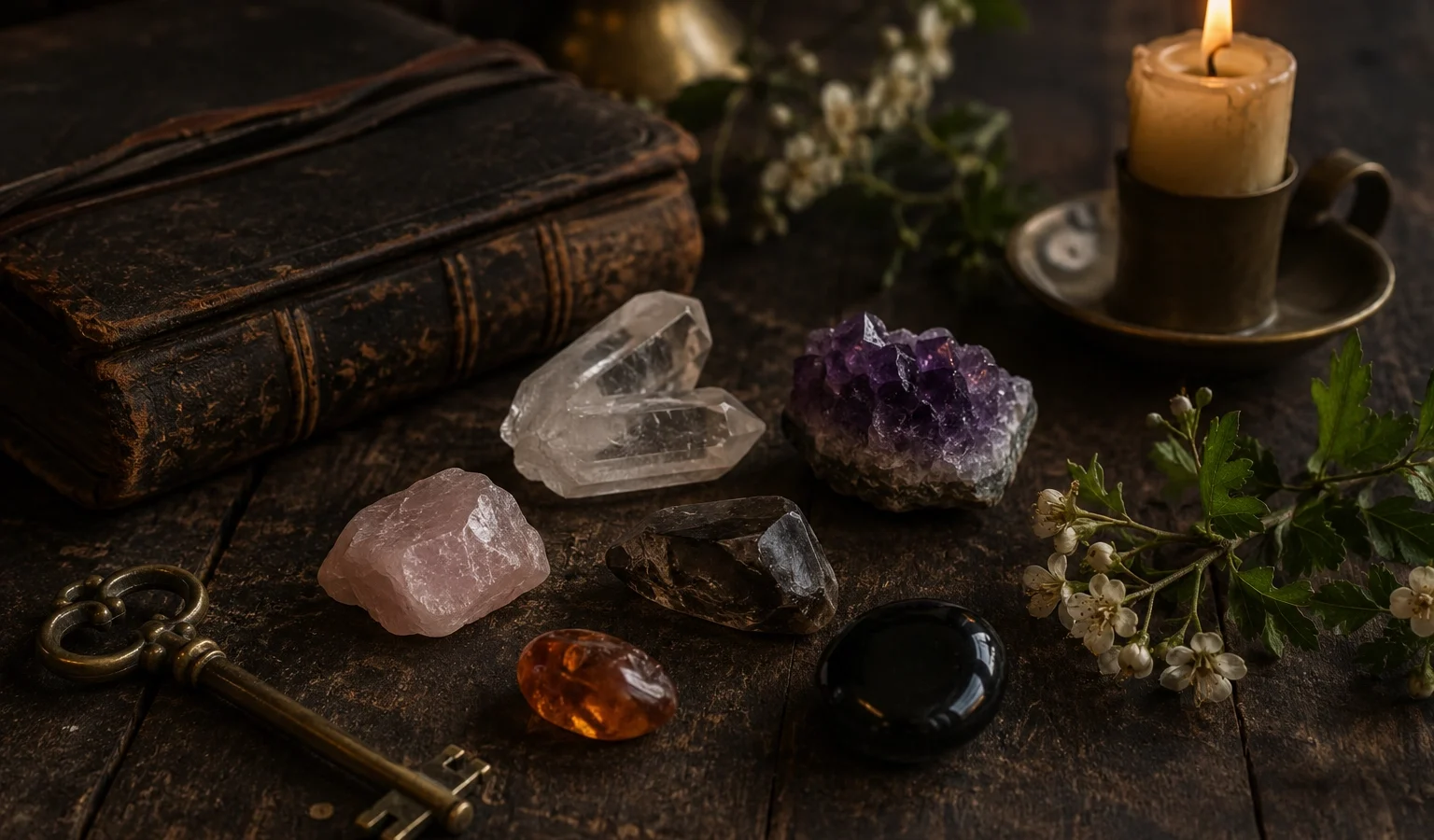
A piece of amethyst catches the light. Rose quartz looks soft enough to have been made from dusk. Labradorite flashes blue when it is turned in the hand. A clear quartz point can look almost architectural, as though geology briefly developed an interest in windows.
It is not surprising that people have attached stories, virtues and personal meanings to stones for a very long time.
The difficulty begins when those meanings are presented as fixed facts: rose quartz will bring love, black tourmaline will protect you, citrine will attract money, or a particular crystal will treat anxiety, pain or illness.
A calmer approach is both more interesting and more honest. A stone can have a geological identity, a documented cultural history, a modern symbolic association and a private meaning for its owner. Those layers can overlap without being the same thing.
This guide to crystals and their meanings explains how to read stones in that way: as real materials with histories and associations, not as machines that guarantee outcomes.
A meaningful stone does not need to promise a miracle; it needs to hold attention honestly.
What do crystals and their meanings actually include?
When people search for “crystals and their meanings”, they are usually looking for one of several different things.
- a traditional belief attached to a stone;
- a modern spiritual or New Age association;
- a colour-based symbolic interpretation;
- a personal reminder or intention;
- a historical use in jewellery, religion, mourning or status;
- or, sometimes, a claim about physical or emotional healing.
These categories should not be quietly blended together.
How to read crystals and their meanings by layer
A grounded approach to crystals and their meanings keeps each layer visible instead of letting history, marketing and personal feeling collapse into one claim.
| Layer | What it can tell you | What it cannot prove |
|---|---|---|
| Geology and material identity | What the object is, how it forms and why it looks or behaves as it does. | That the stone has emotional, spiritual or medical power. |
| Documented historical belief | How people in a particular period or place used, named or valued a stone. | That the belief was universal, ancient everywhere or physically effective. |
| Modern symbolism | How contemporary books, shops and communities commonly interpret the stone. | That the association is an unchanged inheritance from the distant past. |
| Personal association | What the object reminds one person of: a place, decision, memory or intention. | That the same meaning must apply to every owner or reader. |
If an ancient writer recorded a belief about amethyst and sobriety, that is historical evidence that the belief existed. It is not evidence that amethyst chemically prevents intoxication. If a modern crystal book associates rose quartz with tenderness, that is evidence of a contemporary symbolic tradition. It does not establish that every culture used rose quartz in the same way.
And if you keep a piece of smoky quartz on your desk because its dark colour reminds you to slow down before answering an irritating email, that meaning is perfectly real as a personal association. It does not need to be disguised as an ancient universal law.
First, a crystal is a physical thing
The word crystal has a precise scientific meaning as well as a broad popular one.
In mineralogy, crystals have atoms arranged in an ordered repeating structure. The Smithsonian National Museum of Natural History describes minerals as naturally formed solids with a crystalline structure and defined chemical composition. Quartz, one of the most abundant minerals in the Earth’s crust, is made from silicon and oxygen and occurs in many familiar varieties.
That includes clear rock crystal, amethyst, citrine, smoky quartz and rose quartz.
The modern crystal shop, however, uses “crystals” more loosely. Shelves may include polished minerals, rocks, volcanic glass, fossilised materials and carved objects alongside true mineral crystals.
That is not necessarily a problem. It simply means that “crystal” in everyday retail language is not always a geological classification.
Knowing what an object actually is makes its story richer. Moonstone’s glow, for example, is not trapped moonlight. GIA explains that moonstone is a feldspar gem whose moving sheen, called adularescence, is produced when light scatters between microscopic mineral layers. The real explanation is no less beautiful for being physical.
Why crystals and their meanings vary so much
There is no single historical dictionary from which all modern crystal meanings descend.
Meanings accumulate.
This is why crystals and their meanings are better read as layered associations than as a single magical dictionary.
Colour contributes. A red or orange stone is easily associated with warmth, blood, fire, activity or courage. A pale blue stone invites comparisons with sky, water and calm. Black stones often acquire ideas of boundaries, seriousness or protection. Transparent stones invite metaphors of clarity.
Names contribute too. Moonstone almost begs to be connected with lunar cycles. Tiger’s eye suggests watchfulness before any handbook is opened. Moss agate resembles miniature vegetation even though there is no moss inside it.
Historical use contributes. Stones worn by clergy, rulers, mourners, soldiers or travellers gather new layers of meaning around those settings.
Then modern books, shops, social media and spiritual communities add further associations. Some are thoughtful developments. Others are repeated so often that they acquire the appearance of antiquity without much evidence behind them.
A useful question is therefore not merely, “What does this crystal mean?”
Ask instead:
- Who says it means this?
- How old is that association?
- Is it historical, religious, literary, commercial or modern spiritual practice?
- Does the meaning come mainly from colour or name?
- Does it matter to me personally?
Those questions do not drain the romance from a stone. They stop the romance from turning into fake history.
That is the strongest way to approach crystals and their meanings: let the material remain material, the history remain historical, and the personal association remain personal.
Ten common crystals and their meanings
The associations below are not rules. They are a mixture of documented historical ideas and widely used modern symbolism. Think of them as prompts rather than instructions.
A beginner’s guide to crystals and their meanings should leave room for uncertainty, personal association and ordinary responsibility.
Amethyst – sobriety, clear thought and restraint
Amethyst has one of the stronger historical trails behind its symbolism.
GIA notes that Greek and Roman traditions connected the purple quartz with wine and the belief that it could help prevent drunkenness. Its very name is linked with the Greek idea of not being drunk. Over time it also appeared in religious jewellery and royal settings.
A grounded modern meaning might therefore be clear-headedness, restraint or considered judgement.
That does not mean an amethyst makes someone sober. It can, however, serve as a memorable object associated with the idea of pausing before acting.
Rose quartz – tenderness, affection and emotional softness
Rose quartz is a pink variety of quartz. GIA describes colours ranging from almost white to medium-dark pink, often with cloudy translucence caused by microscopic inclusions.
Its modern association with love is extremely widespread.
The most useful version of that symbolism is broader than “this stone attracts a partner”. Rose quartz can represent care, gentleness, affection or the wish to handle a relationship more thoughtfully.
It cannot make another person love you, repair a relationship by itself or override another person’s choices.
Clear quartz – clarity, attention and simplicity
Pure quartz is colourless, and transparency naturally lends itself to metaphors of clarity.
Modern crystal culture often gives clear quartz an enormous list of powers, including the idea that it “amplifies” other intentions.
You do not need that claim to use it meaningfully.
A clear piece of quartz can simply stand for focus, simplification or seeing a problem without unnecessary decoration.
It is also worth remembering that quartz has real measurable physical properties and important technological uses. Real physical properties do not automatically validate unrelated claims about spiritual or medical energy.
Smoky quartz – steadiness, weight and returning to the practical
Smoky quartz ranges from pale brown-grey to very dark tones.
Contemporary crystal writing often describes it as “grounding”. That word can become vague, but it has a useful ordinary meaning: returning attention to what is actually in front of you.
As a symbolic object, smoky quartz can represent steadiness, practical attention and the decision to deal with facts before fears.
Black tourmaline – boundaries and protection symbolism
Black stones are frequently given protective roles in modern crystal practice, and black tourmaline is one of the best-known examples.
It is sensible to keep the word symbolism in the sentence.
A stone on a desk or by a doorway may remind you of boundaries, privacy or the right to say no. It does not create a scientifically demonstrated shield around a person or building.
The practical boundary still has to be made by the person.
Moonstone – cycles, change and reflected light
Moonstone’s name and shifting sheen have encouraged lunar associations for generations.
Its actual optical effect is produced by its layered feldspar structure, yet the visual resemblance to moving moonlight is exactly what makes the symbolism persuasive.
A grounded meaning might be change, recurring phases, patience with uncertainty or attention to cycles.
It does not control the Moon, fertility or the timing of events.
Labradorite – changing perspective and hidden colour
Labradorite can look grey or subdued until the angle changes and a strong flash of colour appears.
That visual behaviour makes it an unusually good metaphor for perspective, complexity and the fact that something can look different when viewed from another position.
Modern descriptions often move quickly from that observation to claims about intuition or psychic ability. Those claims belong to spiritual interpretation rather than established mineral science.
Citrine – warmth, confidence and the complication of authenticity
Citrine is yellow to orange quartz. GIA notes an important fact that beginners often do not hear in crystal shops: natural citrine is relatively rare, and much citrine on the market is produced by heat-treating amethyst.
That does not make treated citrine worthless. Treatment is a gemmological fact, not a moral failure, provided it is represented honestly.
Its sunny colour has made warmth, confidence, optimism and opportunity common modern associations.
What it cannot do is guarantee money or business success.
Carnelian – warmth, action and creative momentum
Carnelian’s orange-red colour makes associations with heat and activity easy to understand.
A useful symbolic reading is movement, making something, beginning before conditions feel perfect, or bringing energy to a neglected project.
If it helps someone pick up a pen, open a sketchbook or return to a piece of work, the object has done something meaningful without needing to alter invisible forces.
Obsidian – reflection, edges and difficult honesty
Obsidian is a good reminder that “crystal” is used loosely in popular culture: it is volcanic glass rather than a mineral crystal.
Its dark reflective surface and ability to form extremely sharp edges have made it powerful symbolic material.
A grounded association might be honesty, boundaries, difficult reflection or the recognition that insight can be uncomfortable.
And because broken or freshly fractured obsidian can be physically sharp, the practical property matters more than any symbolic one when handling it.
Historical belief is evidence that people cared about an object, not proof that the object did what they hoped.
Meaning is not the same as healing
This distinction deserves its own section because crystal marketing often crosses it.
It is one thing to say, “I associate this stone with calm.”
It is another to say, “This stone treats anxiety.”
The first is a personal or cultural statement. The second is a health claim and needs clinical evidence.
The US National Center for Complementary and Integrative Health advises people not to use unproven complementary products or practices as substitutes for effective medical care or as reasons to postpone seeing a healthcare professional.
That is a sensible boundary here.
A crystal may be beautiful, tactile, comforting, familiar or useful as part of a reflective routine. Those experiences do not turn it into a medical treatment.
If a stone sits beside your notebook while you journal, the useful activity may be the pause, the writing, the repeated routine, the associations you have built, or simply the pleasure of handling an object you like.
None of that needs to be mocked. It simply needs to be described accurately.
Historical belief is interesting even when it is not literally true
One of the strangest habits of modern symbolic writing is the assumption that a belief becomes worthless if we say it was a belief.
The opposite is often true.
The British Museum holds a rock-crystal object that may have been a seventeenth-century Scottish “charmstone”, part of a tradition in which mounted crystals were associated with protection against disease. The museum does not need to prove that the object cured disease for the object to be historically fascinating.
It tells us something about fear, hope, material culture, medicine, belief and the social life of objects.
That is much richer than converting every historical charm into a modern wellness product.
Why personal meaning still matters
Suppose your grandmother wore amethyst, your first trip to the coast ended with a striped pebble in your pocket, or you bought a small piece of rose quartz on the day you moved into your own flat.
Those associations may matter more to you than any list online.
Personal symbolism works because memory is specific.
In practice, crystals and their meanings often become most convincing when they are tied to a real memory rather than a borrowed promise.
A stone can become shorthand for a place, person, decision or period of life. It can be a marker in a journal, a small object on a seasonal shelf or a reminder of a promise you made to yourself.
There is no need to claim that the stone imposed the meaning from outside.
You are allowed to give an object meaning.
A simple method for choosing a crystal
If you are new to crystals, try choosing one in this order.
Read carefully, crystals and their meanings become less a fixed set of claims than a way of looking at material, colour, history and memory together.
- Look at the object itself. Which colour, texture, shape or weight genuinely appeals to you?
- Find out what it actually is. Learn the mineral or material name rather than relying only on a shop label.
- Check whether it is natural, treated, synthetic or dyed. Treatment does not automatically make a stone bad; undisclosed treatment is the problem.
- Read the history separately from modern meanings. Look for museum, gemmological or scholarly sources before repeating “ancient” claims.
- Choose one association rather than twenty. A small object is easier to use as a reminder when it is not responsible for love, wealth, sleep, confidence, digestion and cosmic alignment before breakfast.
- Keep the meaning proportional. Let the stone support reflection rather than replacing judgement.
Questions worth asking before believing a crystal claim
- Is this a historical statement or a modern spiritual interpretation?
- Does the source identify a date, place or text?
- Is a seller also the only source for the claimed benefit?
- Is the claim symbolic, emotional, medical or financial?
- Could the same meaning have been inferred simply from the stone’s colour or name?
- Is the statement promising control over another person or a guaranteed outcome?
- Would I still value the object if the supernatural claim disappeared?
That last question is especially useful.
If the answer is yes, you probably have a healthier relationship with the object.
What about “energy”?
Quartz really does have physical properties used in technology. That fact is sometimes borrowed to make a leap from measurable physics to claims about healing or intention.
The leap is the problem.
A property demonstrated in electronics does not automatically establish that holding quartz changes health, luck, relationships or an invisible personal energy field.
Scientific language should not be used as decorative proof for a different claim.
If you prefer the word energy as a poetic way of describing atmosphere – a room feels heavy, a colour feels lively, an object feels comforting – that is ordinary metaphor. Just keep metaphor separate from measurable physical mechanisms.
Crystals as objects of attention
The most convincing role for a crystal may be the simplest one.
It is an object that asks to be noticed.
Stone has weight. Polished surfaces invite touch. Inclusions reward close looking. A crystal can sit in the same place for years while everything around it changes.
That makes stones well suited to small acts of attention: beginning a journal entry, marking a season, remembering someone, setting a boundary, decorating a shelf or creating a pause between work and home.
None of those uses requires certainty about invisible forces.
In this quieter sense, crystals and their meanings belong to attention, memory and proportion rather than to certainty or control.
This is close to the quieter practice described in our guide to personal ritual and meaning without grand claims: an object may help create attention without pretending to control the future.
The Hawthorn & Key approach
At Hawthorn & Key, crystals and their meanings are most interesting when geology, history, folklore and personal symbolism are allowed to remain distinct.
We would rather say that rose quartz has become a popular symbol of tenderness than promise that it will deliver a relationship. We would rather explore why amethyst acquired a reputation for sobriety than pretend a stone can replace self-control or medical care.
For Hawthorn & Key, the best guide to crystals and their meanings is therefore one that leaves room for beauty without turning beauty into a guarantee.
A meaningful object does not become less meaningful when we stop asking it to perform miracles.
Often it becomes more interesting.
Sources & Further Reading
- Smithsonian National Museum of Natural History – All Sorts of Quartz.
- Gemological Institute of America – Amethyst History and Lore.
- Gemological Institute of America – Rose Quartz.
- Gemological Institute of America – Moonstone.
- Gemological Institute of America – Citrine.
- Gemological Institute of America – An Introduction to Synthetic Gem Materials.
- British Museum – Rock Crystal Amulet, OA.1358.
- National Center for Complementary and Integrative Health – Are You Considering a Complementary Health Approach?.