September 3, 2026
How to Choose a Crystal Without Believing Every Claim Online
Buying a crystal should not require accepting a complete theory of the universe before checkout. You may like a stone because of its colour. You may want a small object for a desk, a shelf or a journal ritual. You may be interested in mineralogy, folklore or jewellery history. You may simply have seen a piece of labradorite flash blue and thought, quite reasonably, that geology was showing off.
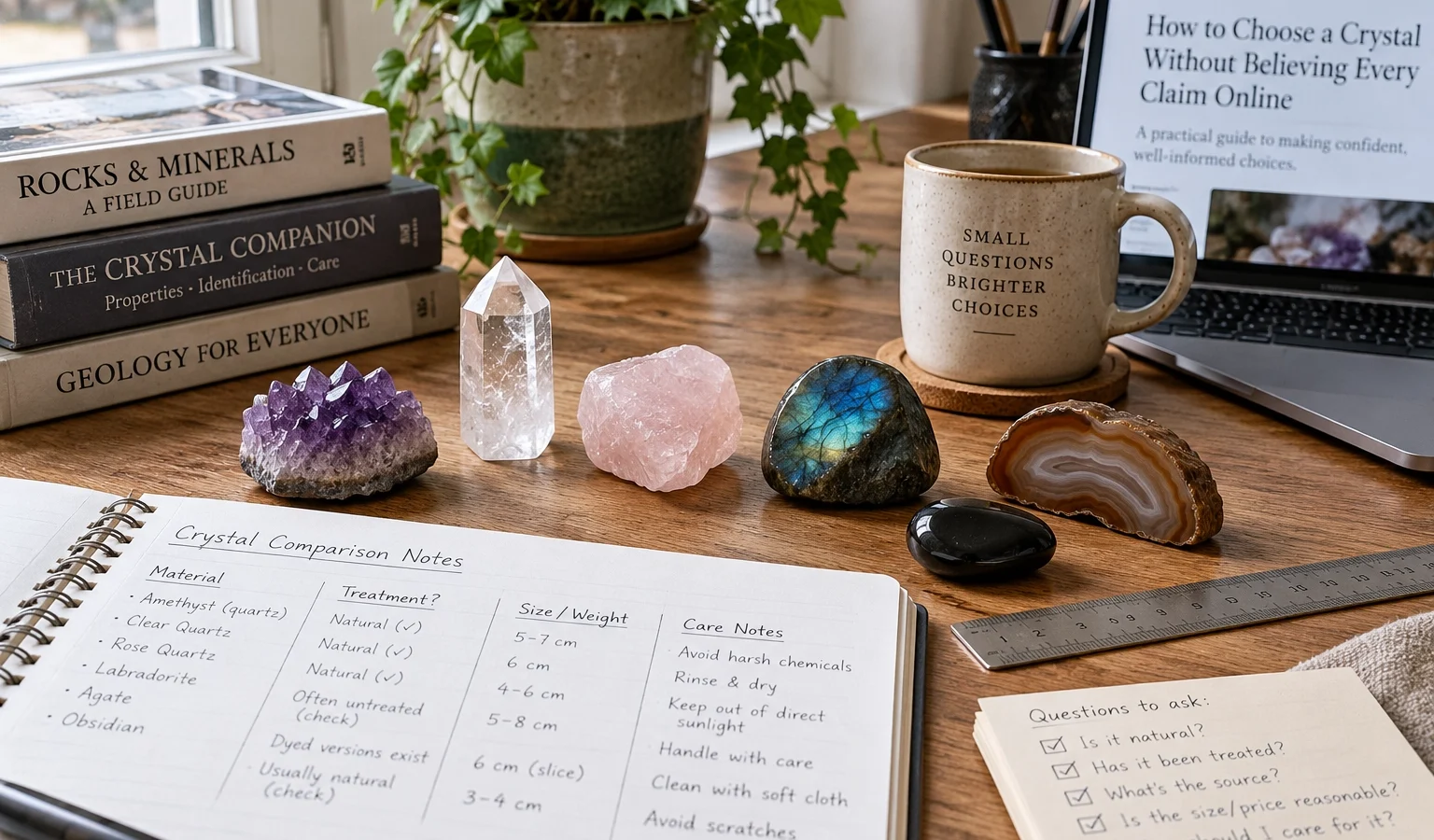
None of those reasons requires you to believe that a stone will cure illness, attract a particular person, guarantee money or protect a house through an invisible force field.
A better approach is to buy with curiosity and ordinary consumer judgement. Ask what the material actually is. Ask whether it has been treated. Notice when a seller moves from symbolism into promises. Decide what the object means to you after you understand what you are buying.
This is a practical guide to doing exactly that.
If you are wondering how to choose a crystal, start with the material itself rather than the promise attached to it.
How to choose a crystal: begin with the object, not the promise
A surprising amount of crystal shopping begins backwards.
A person reads that they “need” a stone for confidence, sleep, love or protection, then searches for whichever object has been assigned that job. The stone becomes a prescription before it becomes an object.
Try reversing the order.
Look first.
Which stones genuinely interest you? Do you prefer transparent quartz, dark polished material, banded agate, pale feldspar or a rough mineral specimen? Do you like the weight of hematite, the colour of amethyst or the strange optical flash of labradorite?
Then learn what the object is.
Only after that should you decide whether a symbolic association is useful to you.
That order is one of the simplest answers to how to choose a crystal without letting marketing decide what you are supposed to need.
This matters because a crystal does not become more meaningful when an online listing gives it thirty-seven compulsory powers. Quite often the opposite happens.
How to choose a crystal by checking what it actually is
“Crystal” is a convenient shop category, not always a precise geological description.
A crystal shop may contain minerals, rocks, volcanic glass, fossilised resin and man-made or treated material in the same display.
That is not inherently dishonest. Everyday retail categories are broader than mineralogical ones.
But a seller should still be able to tell you what an object is being sold as.
Useful questions include:
- What is the mineral or material?
- Is this a trade name or a mineralogical name?
- Is it natural, laboratory-grown, reconstructed or imitation?
- Has its colour or appearance been altered?
- Do you know where it was sourced?
If a listing tells you everything about the stone’s “vibration” but almost nothing about the stone itself, that is not a particularly strong information hierarchy.
Learn the difference between treatment and fakery
Treatment is not automatically deception.
Gem materials have long been cut, polished, heated, dyed, irradiated, filled or otherwise altered to improve appearance or durability. The Gemological Institute of America explains that treatments can change colour or clarity and may affect how a gem should be cared for.
The important issue is disclosure.
Natural citrine, for example, is relatively uncommon, while much citrine in the market is produced by heating amethyst. A buyer may still enjoy the resulting stone. The problem arises when ordinary treated material is presented as something rarer or more valuable than it is.
The same principle applies to dyed agates, coated quartz and other enhanced materials.
Ask:
- Has the colour been treated?
- Is the treatment stable?
- Does it change the care requirements?
- Is the seller using a romantic trade name that hides what the material actually is?
Honest treatment information makes a seller more credible, not less.
When learning how to choose a crystal, treatment disclosure is more useful than a vague promise that a stone is completely natural or unusually powerful.
Natural does not automatically mean better
The word natural carries an unreasonable amount of emotional luggage.
A natural stone may be beautiful, badly cut, fragile, common, rare, ethically sourced or poorly sourced. A laboratory-grown crystal may be chemically and structurally equivalent to natural material but produced under controlled conditions. An imitation may simply resemble another material without sharing its composition.
These are different categories, not a moral ranking.
What matters is whether the object is accurately described and whether the price makes sense for what it is.
If you like a synthetic crystal because it is attractive, there is no metaphysical committee waiting to confiscate your shelf.
Be cautious with “ancient” claims
“Used since ancient times” is one of the most flexible phrases on the internet.
Sometimes it is broadly true. Amethyst, lapis lazuli, carnelian, rock crystal and other materials genuinely have long histories of jewellery, carving, religious use or written symbolism.
Sometimes a modern association has been attached to an old stone and the age of the material is quietly used to make the modern claim sound ancient too.
Those are not the same thing.
If a seller says a stone had a particular meaning in Ancient Egypt, Greece, Rome, medieval England or another named culture, look for a museum collection, translated primary text or reputable historical source.
A chain of crystal blogs repeating one another is not independent confirmation. It is one claim wearing several browser tabs.
How to choose a crystal without mistaking symbolism for a guarantee
Symbolic language is usually easy to keep proportionate.
“Rose quartz is commonly associated with tenderness” is a symbolic statement.
“Rose quartz will make your ex return” is a promise about another person’s behaviour.
“Black tourmaline can be used as a reminder of personal boundaries” is a reflective use.
“Black tourmaline guarantees protection from every harmful influence” is a much larger claim.
“Citrine’s warm colour makes it a popular symbol of confidence and opportunity” is interpretation.
“Citrine attracts money” becomes especially convenient when the person saying it also has citrine to sell.
A useful rule is simple: the more specific, measurable or consequential the promised result, the stronger the evidence should have to be.
| Type of claim | Example | What to ask |
|---|---|---|
| Material fact | “This is heated amethyst sold as citrine.” | Is the mineral identity and treatment disclosed? |
| Historical association | “Amethyst appears in ancient jewellery and texts.” | Is there a museum, primary text or reputable historical source? |
| Personal symbolism | “I use this stone as a reminder to slow down.” | Is the meaning presented as personal rather than universal? |
| Health or outcome promise | “This stone cures anxiety” or “guarantees money.” | What independent evidence supports the claim? |
A crystal can be meaningful without being asked to prove a medical, financial or supernatural claim.
Health claims need a different standard
Health language deserves particular care.
A seller may describe a crystal as calming, comforting or useful in a personal ritual. Those descriptions can refer to subjective experience.
But statements that a stone treats anxiety, regulates hormones, improves circulation, removes toxins, cures pain or replaces medical treatment are health claims.
The National Center for Complementary and Integrative Health advises consumers to look for scientific evidence rather than relying on anecdotes, advertising or claims made by promoters, and not to use unproven approaches as substitutes for effective medical care.
That boundary is useful even if you enjoy crystals.
An object can be part of a calming routine without being the medical mechanism.
Tea can be warm. A notebook can help organise thoughts. A polished stone can be pleasant to hold. A familiar ritual can signal that the working day is over.
None of those observations requires turning the stone into medicine.
How to choose a crystal from a seller who gives useful information
Plain product information is often the most useful.
A good listing often answers ordinary questions:
- What is the stone?
- What size is it?
- Is the photograph of the exact piece or an example?
- Is it rough, polished, carved or set in jewellery?
- Has it been treated?
- Are natural inclusions, cracks or colour variation expected?
- How should it be cleaned or stored?
- Where was it sourced, if that information is known?
Those details are less exciting than “high-frequency portal stone”, but they are much more useful after the parcel arrives.
If you want a practical answer to how to choose a crystal, ordinary information about size, treatment, condition and care should carry more weight than mystical copy.
Do not confuse a certificate with a magic word
For an inexpensive tumbled stone, an independent laboratory report would usually be disproportionate.
For a costly gemstone, rare specimen or jewellery purchase, independent identification can matter much more.
GIA’s coloured-stone reports can identify the type of gemstone, whether it is natural or synthetic, and detectable treatments. The important word is independent: a laboratory report is useful because it separates identification from the seller’s marketing.
A home-printed “certificate of authenticity” created by the same shop does not provide the same level of independent evidence.
Nor does a certificate prove spiritual properties. Gemmological reports assess material characteristics, not luck, protection or emotional destiny.
How to choose a crystal from online photographs
Online crystal colour can be surprisingly theatrical.
Lighting, white balance, saturation, background colour and screen settings can all change what a stone appears to look like.
If you are buying a specific specimen, useful listings show several angles and give dimensions. For higher-value material, ask whether the images show the exact piece.
Be cautious when:
- every stone has impossibly intense colour;
- the same photograph appears across unrelated listings;
- no scale is shown;
- the description avoids discussing natural variation;
- or the photograph is mostly atmosphere and very little mineral.
A candlelit hand holding a glowing purple object may be excellent mood photography. It is not necessarily excellent product documentation.
Price is information, but not proof
An unusually low price can indicate common material, small size, lower grade, treatment, imitation or simply a seller with modest margins.
An unusually high price can indicate rarity and quality.
It can also reflect little more than strong marketing.
Price alone therefore proves very little.
Compare similar materials by size, quality and treatment. If a stone is being sold at a large premium because it has a special commercial name, search the underlying mineral name as well.
Sometimes a mysterious new crystal turns out to be a familiar material with better branding.
Be careful with scarcity language
“Only three left” may be ordinary stock information.
“This stone has appeared in your life because you are ready” is something else.
Fear-based or destiny-based selling makes it harder to evaluate an object calmly.
Common pressure patterns include:
- claiming you have been “drawn” to a product and should not ignore the sign;
- saying failure to buy may block abundance or protection;
- suggesting a more expensive stone is required because your situation is unusually serious;
- creating urgency around a spiritual consequence rather than actual stock;
- or implying that scepticism itself prevents the product from working.
A shop should be able to let you leave the page.
Part of learning how to choose a crystal is recognising when urgency comes from stock information and when it is being created through fear, destiny or spiritual pressure.
How to choose a crystal while asking sensible sourcing questions
Crystals come from mining, cutting, polishing, transport and trade.
Supply chains can be complicated. A small retailer may not know the exact mine for every inexpensive tumbled stone, and pretending otherwise is not an improvement.
Useful questions include:
- Do you know the country of origin?
- Do you know your supplier?
- Can you distinguish documented provenance from an estimate?
- Are treatments disclosed?
- Can you explain what “ethical” means in this listing?
“Ethically sourced” should invite more detail, not end the conversation.
A seller saying “we know the wholesaler but not the exact mine” may be giving you more trustworthy information than a seller offering a perfectly detailed origin story with no supporting evidence.
How to choose a crystal you can actually care for
Some stones are easier to own than others.
Hardness, cleavage, porosity, treatments and sensitivity to heat, chemicals or prolonged light can affect care. A specimen that will live safely in a cabinet has different practical needs from a stone carried in a pocket or worn as jewellery.
Before buying, ask where the object will go.
If you want something for a sunny windowsill, colour stability matters. If you want to wash it frequently, water resistance matters. If you want a ring, durability matters far more than it does for a shelf specimen.
Practical compatibility is a better buying criterion than forcing every stone into every ritual.
That makes care one of the most overlooked parts of how to choose a crystal well.
Pick one meaning, if you want one at all
Once you know what the object is, you can decide what it means.
You might choose amethyst as a reminder to think clearly before acting. Rose quartz may represent gentleness. Smoky quartz may remind you to return to practical facts. A piece of local stone may matter because it connects you to a particular walk or landscape.
You can also choose no symbolic meaning whatsoever.
A mineral is allowed to be interesting because it is a mineral.
If you do use symbolism, one association is often more useful than a catalogue of powers. A clear reminder can become part of a routine. Twenty promises become background noise.
A five-minute check for how to choose a crystal
- Name: What is the material actually called?
- Treatment: Has it been heated, dyed, coated, irradiated, filled or otherwise altered?
- Evidence: Are historical or health claims supported by sources independent of the seller?
- Photographs: Am I seeing the actual piece clearly and at useful scale?
- Care: Is it suitable for where and how I plan to use it?
- Price: Have I compared similar material rather than only this trade name?
- Pressure: Am I buying because I like the object, or because the listing made me afraid not to?
- Meaning: Would I still want it if every supernatural claim vanished from the page?
If the answer to the last question is yes, that is usually a good sign.
In practice, how to choose a crystal comes down to understanding what the object is, what has been done to it, what it costs, what care it needs and whether the claims around it are proportionate.
The Hawthorn & Key approach
At Hawthorn & Key, a crystal does not need a guaranteed outcome to earn a place on a shelf.
Its colour, geology, history, texture, provenance and the private story attached to it are already enough to work with.
We prefer sellers who can say “we do not know” to sellers who fill every gap with an ancient secret. We prefer a disclosed heat treatment to an invented origin story. And we prefer symbolic language that leaves the owner free to think.
The best crystal purchase is not the one with the largest list of powers.
It is the one you understand, genuinely like and can enjoy without being frightened into believing more than the evidence supports.
Sources & Further Reading
- Gemological Institute of America – An Introduction to Gem Treatments.
- Gemological Institute of America – Why Turn to GIA for Gem Grading and Analysis?.
- Gemological Institute of America – Colored Stone Reports & Services.
- Gemological Institute of America – Citrine.
- Gemological Institute of America – An Introduction to Synthetic Gem Materials.
- National Center for Complementary and Integrative Health – Are You Considering a Complementary Health Approach?.