September 9, 2026
Ghosts of York: Roman Soldiers, Narrow Streets and Old Houses
The ghosts of York belong to a city in which history repeatedly appears beneath your feet. Roman stone lies below later houses. Scandinavian occupation survives in archaeology and street names. Medieval walls still shape the centre. Timber-framed buildings lean above lanes used by shoppers rather than butchers. In such a place, stories about the past returning as a figure in a doorway have unusually convincing scenery.
That does not make York’s ghosts historical facts. It makes York unusually good at giving ghost stories convincing scenery.
The ghosts of York are now part of the city’s public reputation, supported by ghost walks, books, visitor accounts and stories attached to inns and houses. Yet the most interesting cases become richer when their layers are separated. There is the documented building, the known history, the first recorded report, the later retelling and finally the modern tourist version. They do not always begin at the same date.
A haunted reputation becomes easier to understand when the building, the historical record, the witness account and the later legend are treated as separate layers.
| Layer | What can be checked | What remains uncertain |
|---|---|---|
| Historic place | Building dates, archaeology, ownership and documented events. | Whether later supernatural stories began at the same time. |
| Witness report | Who reported an experience, when it was recorded and how the account was preserved. | What caused the experience. |
| Folklore | How a story changes across books, guides and repeated telling. | Which details belonged to the earliest version. |
| Tourism | How routes, performances and publicity present the story today. | Whether a popular modern version preserves an older tradition accurately. |
The ghosts of York and the Roman soldiers beneath Treasurer’s House
Among the ghosts of York, the story most closely identified with the city belongs to Treasurer’s House, immediately behind York Minster. The National Trust now cares for the property and preserves accounts of unusual experiences reported there.
The famous episode concerns Harry Martindale, an apprentice heating engineer working in the cellar during the 1950s. Martindale later described hearing a sound before seeing a group of figures dressed as Roman soldiers. According to the account preserved by the Trust, they appeared to pass through the cellar and a wall, and he was badly shaken by the experience.
The story gained one of its most memorable details from the level at which the figures supposedly walked. Their lower legs were initially hidden, as though they were moving on a road surface below the modern cellar floor.
The detail is memorable because York genuinely contains Roman archaeology beneath later levels. That correspondence is not proof. The National Trust presents the episode as a reported encounter and popular urban myth, while the Roman history of the area is independently documented.
What the National Trust archive actually says
Modern summaries sometimes present Martindale as the only witness ever associated with the Roman figures. The Trust’s account is more complicated.
It records an earlier story involving a female guest of former owner Frank Green, who reportedly went to the cellar for wine and encountered a man dressed as a Roman soldier. A former warden was also said to have had an experience before Martindale, while another staff member disclosed an account later.
These reports form one of the better documented traditions among the ghosts of York. They do not amount to independent archaeological evidence of ghosts. Their value for folklore lies in transmission: a particular part of a historic house becomes recognised as the place where a particular kind of figure appears.
Once that association is established, every new report enters a story already in progress.
Roman York beneath the ghost story
York’s Roman foundation is not folklore. The city began as Eboracum, established by the Roman army in the first century AD. Archaeological remains survive across the historic centre, and the area around the Minster sits within this deep Roman landscape.
Treasurer’s House itself has foundations associated with the ancient city beneath its later fabric. That physical history gives the soldier story unusual resonance.
It is tempting to say that archaeology “confirmed” Martindale’s vision. That goes too far. Archaeology can establish Roman occupation, roads, structures and changing ground levels. It cannot establish that a twentieth-century witness saw deceased Roman soldiers.
The responsible formulation is subtler: the reported details became striking because later audiences could compare them with a genuine archaeological setting.
Were the uniforms historically accurate?
Another popular claim says Martindale described equipment that he could not have known and that archaeologists only later recognised as correct. Versions differ over shields, helmets, clothing and whether the figures were legionaries or auxiliary troops.
This is precisely the kind of claim that should be handled cautiously. Martindale’s story circulated for years in interviews and retellings, and details can sharpen as a narrative becomes famous. Establishing what he said at the earliest date is more useful than comparing a late paraphrase with modern reconstructions.
The National Trust preserves his testimony without presenting uniform details as scientific validation.
For folklore, the important point is how “accuracy” becomes part of a legend’s authority. A strange experience becomes more persuasive when listeners are told that an expert later confirmed a detail.
Frank Green: a man who threatened to return
Treasurer’s House contains other ghost traditions. Frank Green, the wealthy industrialist who acquired the house in 1897 and shaped much of the interior visitors see today, gave the property to the National Trust in 1930.
Green was famously exacting about the arrangement of his rooms and objects. The Trust recounts the tradition that he threatened to return and haunt the house if things were moved.
Later staff and visitors have associated unexplained cigar smoke or other sensations with him.
Here the folklore grows directly from documented personality. A meticulous owner becomes, in story, a meticulous ghost. The afterlife reproduces the character remembered in life.
The grey lady and the household scale of haunting
Not every Treasurer’s House story involves Roman spectacle. The National Trust records reports of a grey lady seen in rooms and even stories in which children appeared to react to a woman adults could not see.
These are modern reported experiences rather than episodes tied securely to a named historical resident.
The contrast with the Roman-soldier story is useful. One story gains force from archaeology; another from repetition inside a domestic interior. Both become attached to the same house through different mechanisms.
A “haunted house” is often not one legend but an archive of unrelated stories sharing an address.
The ghosts of York in the Shambles
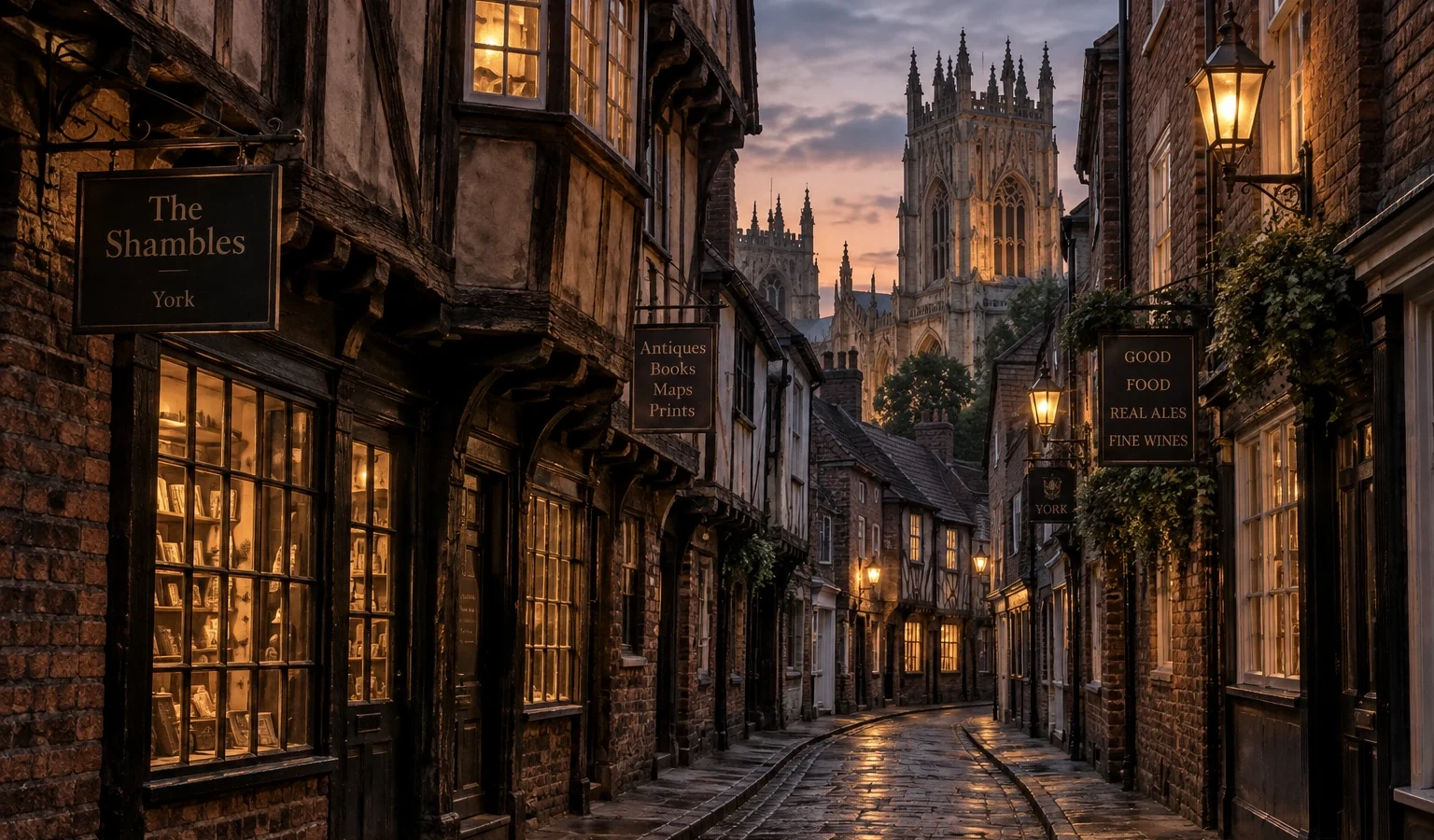
No walk through York’s atmosphere can ignore the Shambles. Its surviving timber-framed buildings and narrow alignment make it one of the city’s most visually distinctive streets. Its historical association with butchers is reflected in its name and surviving shop features.
Modern ghost tourism has added more stories to the ghosts of York around this already powerful setting. Yet visitors should be careful with claims that every famous York lane possesses an unbroken medieval ghost tradition.
A building can be medieval while its ghost story is Victorian, twentieth-century or even more recent. The age of the architecture does not automatically date the legend.
This distinction is one of the simplest and most useful tools in researching haunted places.
Why narrow streets feel haunted
There is a practical side to atmosphere. Narrow streets restrict sight lines. Old buildings create irregular shadows and sounds. A turn in the lane hides approaching pedestrians until the last moment. Upper storeys project towards each other. At night, modern lighting highlights fragments rather than whole façades.
None of this “explains” every reported experience, and folklore research need not diagnose witnesses. It does show why certain urban forms are unusually productive stages for uncanny narrative.
The physical setting suits stories of something briefly seen, partly obscured or disappearing around a corner.
York Minster and the temptation to make every old place haunted
York Minster carries nearly two millennia of site history, from Roman headquarters beneath the cathedral area to the great medieval church and its later restorations.
A place of such age naturally accumulates legends and reports, and the ghosts of York are often attached to buildings whose documented history is already substantial. Sacred history, architectural history and ghostlore should still remain distinct.
Medieval Christian beliefs about saints, souls, purgatory and the dead are not simply early versions of the modern commercial ghost story. They belonged to a different religious framework.
When a modern visitor calls a cathedral “haunted”, that language may overlay much older ideas about memory and the dead without being identical to them.
Clifford’s Tower: real tragedy and the ethics of ghost stories
York also contains places where the documented past is sufficiently terrible without supernatural embellishment. At the site of York Castle, the massacre of members of York’s Jewish community in 1190 is a historical event of profound seriousness.
Places of mass death often attract ghost stories, but responsible folklore writing should not use historical victims merely as scenery for entertainment.
The first obligation is to the documented event and to the people involved. If later supernatural traditions exist, they should be identified as later traditions rather than presented as a dramatic continuation of the tragedy.
Haunted heritage becomes ethically thin when suffering is reduced to a promise of thrills.
Inns and the portability of the York ghost
Historic inns are ideal carriers of ghostlore. They have changing populations, bedrooms, staircases, cellars and long histories of storytelling. A tale can be passed from landlord to staff, from staff to guests and from guidebooks back to visitors.
The ghosts of York also populate pubs and inns in modern collections, although the documentation varies considerably.
For researchers, the useful question is not which inn advertises the largest number of ghosts. It is which stories can be traced. Old newspapers, licensing records, directories, local histories and previous editions of guidebooks can reveal whether a supposedly ancient haunting was known fifty or a hundred years ago.
Sometimes the silence is as informative as the story.
Ghost walks and the making of the ghosts of York
York’s ghost walks are not merely vehicles carrying old folklore unchanged. They are part of the folklore ecology themselves.
Guides choose routes, compress histories, develop performance styles and decide which version of a tale works best at a particular doorway. Audiences ask questions and repeat favourite stories afterwards. Competing tours create different canons of haunted York.
This does not make the ghosts of York false by definition. It means the modern form of their storytelling has a history too.
A twenty-first-century ghost walk may preserve an older legend, revive a forgotten one or help a recent anecdote become tradition.
Why the ghosts of York became part of the city’s identity
York’s reputation is partly historical depth and partly successful storytelling. Roman, Viking and medieval identities are unusually visible and already central to the city’s public image. Ghostlore can move easily among them.
The centre is compact enough to explore on foot. Historic buildings survive in high concentration. Museums and heritage organisations interpret the past. Evening tourism creates an audience ready for stories after other attractions close.
Most importantly, a few exceptionally memorable narratives, especially the Treasurer’s House soldiers, give the ghosts of York a recognisable public identity.
Once that reputation exists, new stories do not begin from zero. They join “haunted York”.
How to investigate the ghosts of York
Start by identifying the exact building and historical claim. Check the National Heritage List for England, local Historic Environment Record, archive catalogues and the site’s own institutional history.
Then find the earliest version of the supernatural story you can. Newspapers are particularly useful for twentieth-century hauntings. Compare wording between editions. Notice when a vague figure acquires a name or when a date becomes more precise in later retellings.
Do not assume that repetition equals independence. Ten websites may all derive from one book.
Finally, preserve uncertainty. “Reported in 1953” is a meaningful statement. “A Roman soldier has walked here for two thousand years” is a much larger claim requiring evidence it is unlikely to possess.
York without the ghosts
One reason the ghosts of York endure is that the city does not depend upon them. Remove every apparition and the Roman archaeology remains. The medieval walls remain. Treasurer’s House retains its documented owners and collections. The Minster remains an extraordinary building. The Shambles retains its urban history.
That documented history allows the folklore to be enjoyed without asking it to prove the city’s past.
The stories can be enjoyed as stories rather than forced to carry the burden of proving the city’s past.
A Hawthorn & Key approach to the ghosts of York
At Hawthorn & Key, the ghosts of York are most compelling when three things are allowed to stand beside one another: the excavated city, the recorded witness and the story that later generations choose to tell.
The Roman road need not prove the Roman ghost. Harry Martindale’s account need not be mocked because it cannot be independently verified. A modern ghost walk need not be mistaken for a medieval source.
York’s real mystery is gentler and more durable: in a city built layer upon layer, people keep finding ways to imagine the earlier layers walking through the present.
Sources & Further Reading
- National Trust, “The ghost stories of Treasurer’s House”, including the Trust’s account of Harry Martindale and other reported experiences.
- National Trust, Treasurer’s House, for the property history and Frank Green interpretation.
- York Archaeological Trust, resources on Roman Eboracum and Scandinavian Jorvik.
- Historic England, National Heritage List for England, for York’s protected historic buildings and monuments.
- English Heritage, history of Clifford’s Tower, including the documented events of 1190.
- York Minster, “Creating the Undercroft”, for the archaeology beneath the cathedral.
- Jennifer Westwood and Jacqueline Simpson, The Lore of the Land, Penguin.
- Jacqueline Simpson and Steve Roud, A Dictionary of English Folklore, Oxford University Press.