
August 20, 2026
The Most Haunted Cities in England: A Folklore-Lover’s Guide
Calling one city “the most haunted” is an irresistible piece of publicity and an impossible piece of measurement. Ghosts do not submit census returns. Stories are collected unevenly, tourism amplifies some traditions more than others, and an old city with a thriving ghost-walk industry will naturally accumulate more recorded tales than a place where nobody has thought to catalogue them.
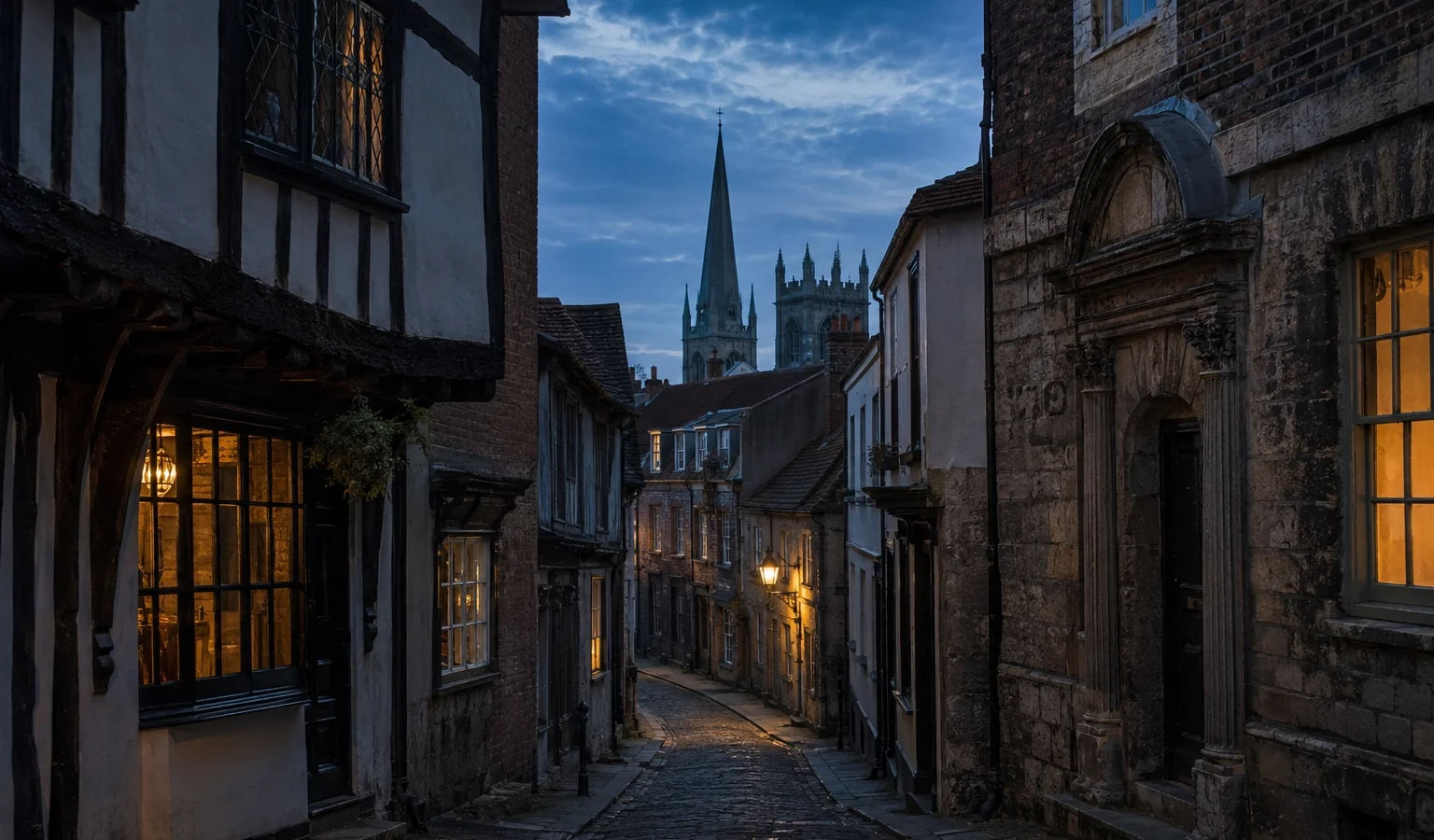
To ask about the most haunted cities in England is therefore not to create a paranormal league table. It is to ask which English cities have especially rich ghostlore, and what that folklore reveals about the way people remember urban history.
York, London, Chester, Norwich, Oxford and several other cities repeatedly appear in haunted reputations because their streets contain unusually visible layers of the past. Roman foundations sit beneath medieval churches; city walls survive beside modern traffic; old inns retain names while their uses change. Ghost stories give those layers characters and plots.
This guide to the most haunted cities in England follows that entanglement carefully. It looks at reputation, place, documentary history and repeated story without pretending that “most haunted” can be measured like rainfall or population.
A haunted reputation is not proof of a ghost. It is evidence that a place has learned how to tell its past in the language of return.
For the wider background to this approach, see our guide to British ghost stories, where haunted places are treated as meeting points between documented history, witness testimony, folklore and atmosphere.
Why the most haunted cities in England are not a simple ranking
A city becomes “haunted” through several different processes. Historic buildings survive. Local stories are collected. Newspapers repeat the dramatic cases. Ghost walks turn scattered anecdotes into a route. Heritage sites preserve visitor and staff reports. Modern tourism then feeds the reputation back into the place.
This makes the phrase most haunted cities in England useful as a cultural question, not as a scientific claim. We can compare the richness of ghostlore, the visibility of historical fabric and the strength of a city’s haunted reputation. We cannot count ghosts.
| City | Why it often appears in haunted reputations | How to read it carefully |
|---|---|---|
| York | Roman, Viking and medieval layers remain highly visible in a compact historic centre. | Separate Roman archaeology from later Roman-soldier ghost stories. |
| London | Palaces, prisons, theatres, churches, stations and old neighbourhoods produce many local traditions. | Treat “Haunted London” as a network of districts, not one single tradition. |
| Chester | Roman walls, medieval fabric and castle stories give ghostlore strong settings. | Staff and visitor reports are folklore evidence, not proof of supernatural cause. |
| Oxford and Cambridge | Colleges preserve long institutional memory and repeat stories through generations of students. | Check college records and the earliest known circulation of each tale. |
| Canterbury, Bath and Winchester | Sacred history, Roman remains, Georgian interiors and royal memory create strong narrative layers. | Keep religious, historical, literary and ghost traditions distinct. |
York: where the past is physically difficult to avoid
York’s claim to haunted fame rests on more than the number of tales told on evening tours. The city has an exceptionally legible historical landscape. Roman Eboracum, Scandinavian Jorvik, medieval York and later periods overlap within a compact centre of walls, churches, lanes and houses.
The best-known modern ghost story is attached to Treasurer’s House, beside York Minster. The National Trust, which cares for the property, records accounts of Roman soldiers said to have been seen in the cellar in the twentieth century. The most famous witness was apprentice heating engineer Harry Martindale, whose reported encounter in the 1950s became a staple of York ghostlore.
The National Trust presents the story as reported experience and urban myth, not archaeological proof of an apparition. That distinction is worth preserving. Treasurer’s House genuinely stands over remains associated with Roman York, which helps explain why the story feels so perfectly fitted to its location. It does not verify the supernatural claim.
York demonstrates a recurring pattern among the most haunted cities in England: a city’s known history supplies the vocabulary in which later uncanny experience is described.
Why York’s narrow streets encourage storytelling
Ghostlore thrives where the historical city remains walkable. A guide can move a group from a medieval lane to a churchyard, an inn and a Roman site without breaking the narrative spell.
The Shambles is real medieval urban fabric, though its present appearance is the result of centuries of change and conservation. York Minster occupies a site with Roman and medieval histories. The city walls make historical boundaries visible. None of these places requires a ghost story to be interesting.
Yet their survival gives stories somewhere to attach. A tale heard while standing beneath an overhanging timber frame is remembered differently from the same tale read in an anonymous room.
For a deeper look at the city’s best-known ghostlore, our forthcoming guide to the ghosts of York follows the Roman-soldier story, the narrow streets and the city’s old houses in more detail.
London: too large for a single haunted tradition
London should not be treated as one folklore district. Its ghost stories belong to palaces, theatres, prisons, churches, stations, old roads and neighbourhoods that were once separate settlements.
The Tower of London provides perhaps the most famous concentration. Its documented history includes imprisonment, execution and royal residence, while later tradition populates the fortress with spectral figures associated with Anne Boleyn and other historical prisoners.
Here chronology matters. A person’s documented death is not evidence that later apparition stories are contemporary with it. Ghost traditions often emerge or become popular long after the historical event they explain.
London’s size also shows how reputation works. A city containing thousands of old buildings will generate a vast archive of anecdotes simply through scale. “Haunted London” is therefore less a unified tradition than a network of local traditions gathered under one famous name.
The Tower and the danger of historical hindsight
Sites of violence attract retrospective supernatural meaning. The Tower’s executions are well documented, which makes later ghost stories emotionally plausible to modern visitors. But folklore research must resist turning plausibility into provenance.
A responsible account asks when a particular apparition was first recorded, whether the story changed, and whether a named ghost was attached to the site only after that historical person became culturally famous.
This method does not diminish the story. It reveals how public memory works. The ghost becomes a way of keeping a historical figure present in a place strongly associated with their fate.
In that sense, London belongs among the most haunted cities in England not because every famous tale is old or proven, but because the capital offers an unusually dense field of history, reputation and retelling.
Chester: Roman walls and later uncanny inhabitants
Chester shares with York the advantage of visible Roman and medieval fabric. Its walls, street plan, cathedral precincts and surviving historic buildings make chronological depth part of an ordinary walk through the city. This visible continuity is one reason Chester so often appears in discussions of the most haunted cities in England.
English Heritage has also recorded modern ghost reports at Chester Castle, including staff experiences. Such institutional recording is useful, but it should be read correctly: a heritage body preserving an account confirms that the account was made, not that its supernatural interpretation has been demonstrated.
That distinction is central to modern ghostlore. Staff testimony, visitor books and oral history can all become legitimate folklore sources. They tell us what people report and how a site’s reputation develops.
Chester’s ghost stories often borrow authority from the city’s real antiquity. The Roman past supplies soldiers; old inns supply former occupants; fortifications supply prisoners and guards. The architecture acts almost as a casting department.
Norwich: churches, lanes and a quieter haunted reputation
Norwich illustrates why lists of the most haunted cities in England can distort the map. It has a remarkable concentration of medieval churches, historic streets and buildings, but its supernatural reputation is less internationally marketed than York’s or London’s.
That does not mean it possesses less folklore. It means folklore visibility depends on publication, collecting and tourism as well as age.
The city invites a different kind of exploration: parish histories, local archives, newspaper collections and oral accounts can reveal stories that have never become national ghost-tour staples.
For the folklore researcher, quieter cities can be especially rewarding because the gap between local memory and commercial retelling is easier to see.
Oxford: learned history and college ghosts
Oxford’s supernatural stories cluster naturally around colleges, libraries, churches and episodes of religious or political conflict. The city’s architecture encourages continuity: a quadrangle can still carry the name of a person who lived centuries ago, and institutional memory preserves anecdotes alongside formal history.
College ghost stories often function like family stories. They identify eccentric former members, explain strange rooms, preserve scandal or turn historical trauma into a recurring presence.
The historian should nevertheless separate university records from later legend. A documented execution, feud or death may provide the historical core, while the apparition attached to it may first appear generations later.
Oxford is a useful reminder that literacy does not make folklore disappear. Highly literate institutions produce folklore of their own, which is why university cities can sit comfortably beside older commercial ghost centres in accounts of the most haunted cities in England.
Cambridge: another university city, different stories
Cambridge offers a parallel case. Colleges preserve long institutional memories, but stories vary from building to building and generation to generation.
Student communities are particularly good environments for legend transmission. Each cohort arrives, learns the geography, inherits stories from older students and passes selected tales onwards. A narrative can feel ancient because nobody currently present remembers its beginning.
This is folklore in a very ordinary sense: repetition with variation inside a community.
When researching university ghosts, college archives and old student publications can be more valuable than modern haunted Britain compilations. They may reveal when a familiar story actually entered circulation.
Canterbury: pilgrimage, cathedral history and supernatural memory
Canterbury’s historical identity is dominated by its cathedral and pilgrimage. The murder of Thomas Becket in 1170 is documented history; the cult, pilgrimage traditions and literary afterlives that followed belong to further historical layers.
A city with such a powerful sacred narrative naturally gathers supernatural stories, but saints, miracles and ghosts should not be collapsed into one category. Medieval religious belief had its own theological frameworks, while modern ghost tourism often reinterprets old sites through a secular language of haunting.
The same building can therefore carry several kinds of extraordinary story without those stories meaning the same thing.
Bath: Roman remains and Georgian interiors
Bath’s atmosphere differs from York’s. Roman archaeology and the later Georgian city create two especially strong historical images, while the thermal springs provide an even older reason for settlement.
Ghost stories here often inhabit elegant domestic and theatrical spaces rather than ruined fortifications. This demonstrates how haunting follows architecture. Georgian houses invite stories of former residents, servants and visitors; theatres generate backstage traditions; ancient water encourages a different body of legend.
The supernatural city is shaped by what survives above ground and what visitors are taught to notice. Bath’s place among the most haunted cities in England therefore depends as much on architecture and storytelling as on the number of individual ghost tales attached to it.
Winchester: royal memory beneath an ordinary city
Winchester’s importance in Anglo-Saxon and medieval England gives it an unusually dense historical memory. Cathedral, castle remains and associations with kings create fertile ground for legend.
Arthurian tradition is particularly instructive. The Great Hall contains the famous Round Table, a real medieval object, but not a table from a historical King Arthur’s court. Its material existence helped Winchester participate in Arthurian cultural memory without proving the legend’s events.
Ghostlore often works in the same way. A genuine object or building anchors a story whose chronology may be entirely different. Winchester shows why the most haunted cities in England are often places where material history and later narrative remain visibly entangled.
The strongest haunted-city stories do not erase history. They give history a figure that can still be met in a street, a cellar, a college stair or a half-lit lane.
What makes a city acquire a haunted reputation?
Age alone is not enough. Many ancient places are not nationally marketed as haunted. Several other conditions help.
First, visible historic fabric gives stories memorable settings. Second, archives and antiquarians preserve anecdotes. Third, tourism turns scattered tales into routes. Fourth, repeated publication establishes a canon: the same five or ten stories become the city’s recognised ghosts. Finally, new witness accounts are interpreted through that existing reputation.
Once a city is known as haunted, ambiguous experiences have a ready-made narrative home. This is why the most haunted cities in England often become more haunted in reputation as more people arrive expecting to hear ghost stories.
Ghost walks are part of folklore too
It is easy to dismiss commercial ghost walks as inauthentic. That would miss an important part of modern tradition.
A guided walk is a form of performance. Stories are selected for timing, place and audience; jokes and dramatic pauses are added; versions compete; memorable details survive. This does not make every historical claim reliable, but it does make the walk itself a legitimate site of folklore transmission.
Researchers should record the difference between a story’s earliest known source and its present performance. Both matter, for different reasons. In many of the most haunted cities in England, the modern ghost walk has become one of the main ways older local stories continue to circulate.
How to visit a haunted city without confusing story and evidence
Begin with the building. Read the heritage listing, museum interpretation or archaeological account. Establish what is documented. Then ask when the ghost story appears.
If a guide says a figure has been seen “for centuries”, look for the earliest printed or archival reference. If a Roman ghost is reported, check whether Roman archaeology is actually present. If a named historical person is said to haunt a house, establish whether that person demonstrably lived or died there.
Most importantly, allow a story to remain folklore when that is what the evidence supports. A legend does not fail because it cannot be turned into a police report. That principle matters especially when visiting the most haunted cities in England, where reputation can easily outrun the surviving evidence.
Why the best haunted cities are really cities of memory
What York, London, Chester, Oxford and the others share is not measurable paranormal activity. They share unusually dense relationships between place and memory.
Old walls make earlier lives imaginable. Street names preserve vanished trades. Archaeology emerges beneath shops. Institutions keep records. Tourism retells selected episodes until they become familiar enough to feel inherited.
Ghosts are one language for speaking about that persistence.
Read carefully, the most haunted cities in England become less a ranked list of supernatural hotspots than a map of how urban history, tourism, local memory and old buildings keep making room for the dead.
A Hawthorn & Key approach to haunted cities
At Hawthorn & Key, we prefer a city whose stories can be followed through layers rather than ranked by supernatural score. The Roman wall can be real, the witness account sincerely recorded and the ghost still unverified. Those statements can coexist.
Visit for the architecture, archives and atmosphere. Listen to the stories. Then notice how carefully a city chooses which parts of its past are allowed to keep walking.
That is why a guide to the most haunted cities in England is really a guide to memory, performance and place.
Sources & Further Reading
- National Trust, “Ghosts of Treasurer’s House”, including the Roman-soldier tradition and Harry Martindale account.
- National Trust, “History of Treasurer’s House”, for the Roman and medieval setting of the York property.
- Historic England, National Heritage List for England, for heritage listings and historic built-environment records.
- English Heritage, “English Heritage unveils mysterious CCTV image and haunting new tales from historic sites”, including Chester Castle material.
- York Archaeological Trust, The Archaeology of York publications, for archaeological publication and city history resources.
- City of York Historic Environment Record, “City Walls”, for York’s historic walls and urban fabric.
- Jacqueline Simpson and Steve Roud, A Dictionary of English Folklore, Oxford University Press.
- Jennifer Westwood and Jacqueline Simpson, The Lore of the Land, Penguin.