September 15, 2026
Blackthorn Folklore: Sloes, Winter and Shillelaghs
Blackthorn folklore is easier to recognise in autumn and winter than in a May hedgerow. Its blue-black sloes, hard thorny wood and association with cold snaps give it a cultural life quite different from hawthorn. The same shrub can still surprise in early spring, when white flowers appear on dark, almost leafless branches. But the strongest traditions around blackthorn do not depend on blossom alone. They belong to blackthorn winter, sloe gathering, the old first-frost rule, walking sticks, Irish shillelaghs and the later magical reputation of a wood that is hard, thorned and difficult to handle.
That combination makes blackthorn unusually easy to romanticise. Modern writing sometimes turns it into a universal Celtic tree of darkness, a standard wand wood or a plant sacred to one ancient deity. Those claims make more sense when they are separated. Botany, seasonal custom, material culture and modern occult symbolism do not all come from the same period.
Blackthorn does not need to be hawthorn’s darker twin. Its own folklore is already distinctive: cold weather, sloes, hard wood, Irish sticks and later magical reinterpretation.
What makes blackthorn physically distinctive
Blackthorn, Prunus spinosa, is a native thorny shrub or small tree found widely in Britain. It forms dense growth, carries hard spines and produces small white flowers before the leaves fully open.
That flowering sequence is one of the easiest ways to distinguish it from hawthorn in spring. Hawthorn usually leafs before it flowers, while blackthorn can look almost bare beneath its blossom.
The comparison matters only briefly here. Hawthorn has its own strong body of May customs and blossom taboos, explored in our article on hawthorn in British folklore. Blackthorn folklore develops along a different line, especially through cold weather, sloes and the uses of its hard wood.
Blackthorn winter: the cold snap named after blossom
One of the most distinctive pieces of blackthorn folklore is the phrase blackthorn winter: a spell of colder weather around the period when the shrub is flowering.
The expression works because blackthorn can bloom while the landscape still feels wintry. White flowers may appear against dark branches at exactly the point when a mild spell has tempted people to believe spring has properly arrived.
It is not a meteorological law. Flowering dates shift with geography and weather, and a cold snap does not arrive because the blossom has opened.
The phrase is useful because it joins two things people can easily notice at once: unexpectedly cold air and a hedge suddenly white with flowers.
Like many weather sayings, it is best read as seasonal observation rather than prediction.
Sloes are the heart of blackthorn’s autumn folklore
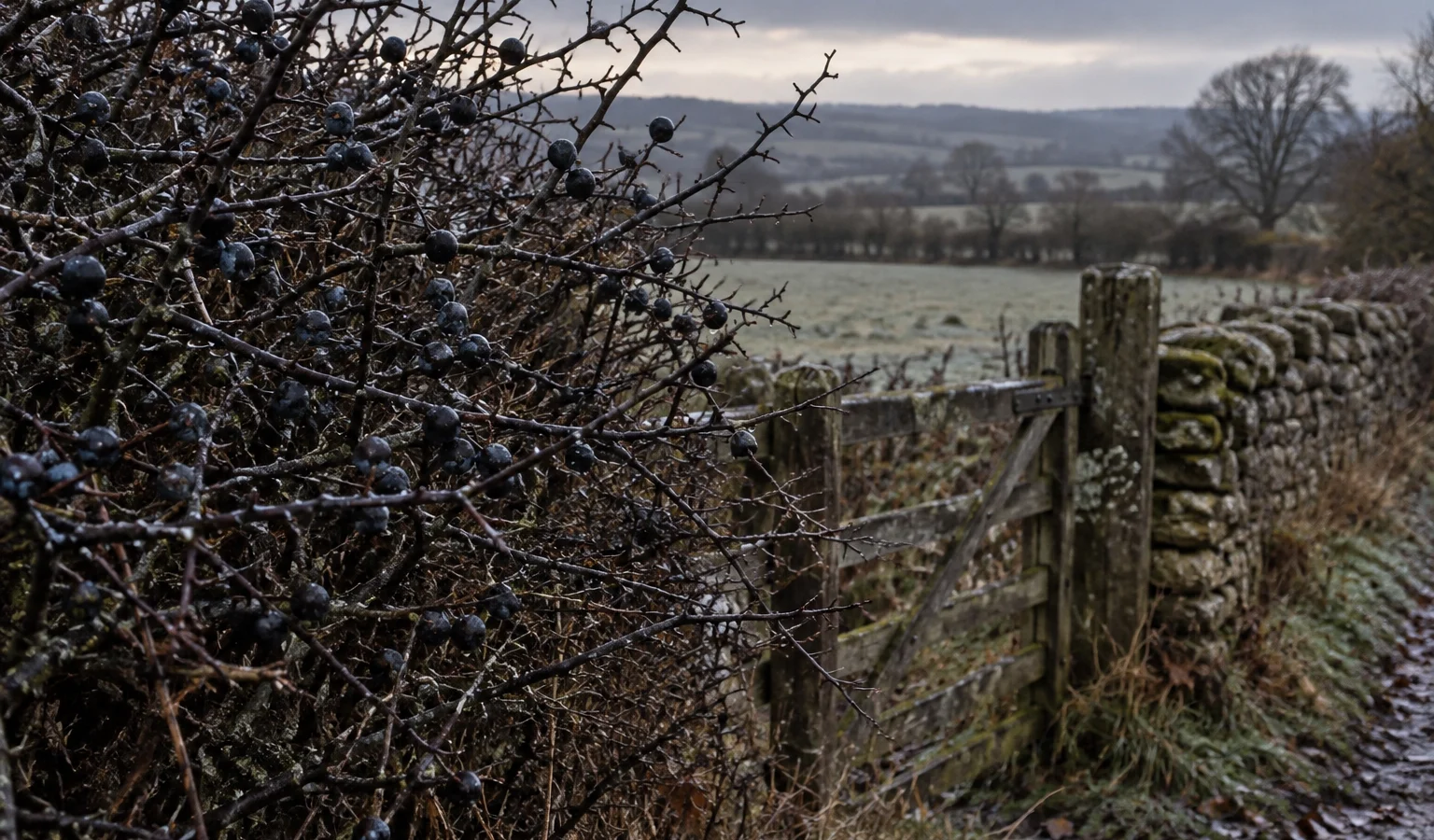
By autumn the flowers have become small dark fruits known as sloes.
Woodland Trust records describe them as purple-black and extremely tart when raw. They have long been used in preserves, wines and other preparations, while sloe gin remains the best-known modern British use.
Sloes give blackthorn folklore a second, and in many ways more distinctive, season. The blue-black fruits remain sharp and astringent when raw, but they have long been gathered for preserves, country drinks and later sloe gin.
That rhythm is one reason blackthorn can carry both spring and winter associations without contradiction.
The first-frost rule
A familiar rule says sloes should be picked after the first frost. The custom makes practical sense because cold softens the fruit and damages the skins. Modern foragers often reproduce the effect by freezing sloes at home.
That does not make the first frost a magical deadline. Flowering and fruiting dates vary with weather and place, and useful fruit may be ready before or after one particular cold night.
What matters for blackthorn folklore is the seasonal habit behind the saying. Sloe gathering ties the shrub to the part of the year when hedges are thinning, mornings are colder and domestic preserving begins to look towards winter.
Sloes belong to ordinary rural culture
Much of blackthorn’s cultural history is domestic rather than occult. People gathered fruit, managed hedges and used the wood. Sloe gin may now be the most familiar example, but the broader pattern is older: a difficult fruit becomes useful through patience, preparation and timing.
That gives blackthorn a character quite different from a purely symbolic tree. Its folklore is rooted in something people actually picked, cooked, steeped and waited for.
Thorns, hedges and later ideas of protection
Blackthorn’s thorns make protective symbolism easy to understand. A dense hedge can physically discourage passage, so later traditions could extend that practical experience into ideas of defence, resistance and hard boundaries.
That symbolism should not dominate blackthorn folklore, however. A hedge used as a barrier does not prove that every historical community treated blackthorn as a supernatural protective plant. The physical function comes first; symbolic meanings vary by source and period.
Blackthorn wood and the Irish shillelagh tradition
Woodland Trust notes that blackthorn wood is hard, tough and suitable for walking sticks and tool parts.
This practical use leads to one of the clearest cultural associations in blackthorn folklore: the Irish shillelagh.
Blackthorn stems can produce strong, characterful sticks, and Irish walking and fighting-stick traditions helped give the wood a distinctive identity.
Its cultural history as a practical stick comes before later magical interpretation.
A strong stick is not automatically a magical staff
The word shillelagh is associated with Ireland and can refer to walking sticks, fighting sticks and later symbolic or decorative objects. Blackthorn became one important material because the wood is hard and the natural stems can produce strong, characterful sticks.
Not every Irish stick was blackthorn, and not every blackthorn stick was a shillelagh. Even more importantly, the material tradition should not be retrofitted into a universal class of ancient magical staffs.
The object already has a substantial cultural history without that addition. A stick may serve as walking aid, weapon, marker of identity, souvenir or symbol before any modern occult meaning is attached to it.
How blackthorn moved from stick wood into magical symbolism
Rods, staffs and wands have genuine histories in European ceremonial magic, divination, healing and later occult movements. Blackthorn’s entry into that world should be treated separately from its practical use as stick wood.
Blackthorn appears in modern magical practice as a favoured wood for staffs and wands, and Woodland Trust itself summarises a long-standing association between blackthorn and witchcraft.
The safer historical claim is therefore not that every traditional blackthorn stick was magical, but that the wood entered later blackthorn folklore and magical symbolism because of its thorns, hardness and existing cultural reputation.
Why blackthorn feels like a convincing magical wood
Modern symbolic systems had plenty to work with.
The bark is dark. The thorns are formidable. The blossom appears early against almost bare branches. The fruit is bitter until prepared. The wood is hard enough for a substantial stick. The plant forms real boundaries.
Each of these characteristics can be turned into metaphor without inventing the physical facts.
| Blackthorn theme | Historical or practical basis | Later interpretation |
|---|---|---|
| Blackthorn winter | Early blossom can coincide with a return of cold weather. | A seasonal image of endurance and uncertain spring. |
| Sloes and first frost | Fruit is gathered in autumn and softened by cold or freezing. | A memorable rule about patience, timing and the turn towards winter. |
| Shillelaghs and walking sticks | Hard blackthorn wood produces strong sticks. | Later symbolic or magical readings may grow around the object. |
| Wands and defensive magic | The wood is hard, thorny and culturally distinctive. | Modern occult practice often emphasises protection, reversal and severity. |
The mistake comes only when the resulting modern correspondence list is described as one unbroken ancient British tradition.
Modern witchcraft often emphasises defence and severity
Contemporary British and Irish magical writing frequently associates blackthorn with protection, strong boundaries, banishing, reversal and sometimes baneful or confrontational work.
The thorns make these meanings intuitively understandable.
Yet modern practice is a living tradition in its own right. It does not need to be made older than the evidence allows in order to be meaningful.
A modern practitioner can choose blackthorn because it represents resilience or a hard boundary while still acknowledging that the symbolic system is modern.
Blackthorn folklore and the problem with the word Celtic
Online blackthorn lore is often labelled simply “Celtic”.
That word can conceal several different cultural histories: Irish stick traditions, Scottish folklore, Welsh material, modern Druidry and twentieth-century occult reconstruction may all be placed under one heading.
They are related only in limited ways and do not belong to one timeless system.
Specific geography is more useful. Irish stick traditions should be called Irish, modern Pagan interpretations should be labelled modern, and British hedgerow customs should be located where the evidence allows.
Ogham-inspired tree lists are mostly modern systems
Blackthorn also appears in modern ogham-inspired and so-called Celtic tree correspondences.
Historical ogham is a real early medieval writing system, and later medieval texts connected some letter names with plants or trees. The standardised modern tree calendar familiar from popular spirituality, however, owes much to much later reconstruction.
Blackthorn can therefore have a place in modern ogham-inspired practice without proving that ancient Britons followed a modern monthly tree zodiac.
The Cailleach association deserves the same care
Some modern Pagan sources connect blackthorn with the Cailleach, the powerful old-woman figure of Gaelic tradition associated with winter and wild landscapes.
The pairing is symbolically persuasive, especially alongside blackthorn winter, hard thorns and seasonal severity.
But claims that blackthorn was universally “sacred to the Cailleach” in ancient tradition are harder to demonstrate.
Both the Cailleach and blackthorn have genuine traditions. The exact pairing should be dated to the sources that actually make it.
Blackthorn is not simply a tree of darkness
Later magical writing often presents blackthorn as severe, defensive or even sinister. That picture is understandable, but it is incomplete.
The same shrub produces conspicuous spring blossom, autumn fruit and dense shelter for wildlife. Those facts do not create a single moral lesson; they simply remind us that the living plant is broader than the symbolic role assigned to it.
For blackthorn folklore, this matters because the strongest modern image is often harsher than the ordinary rural plant from which the stories developed.
Handling and gathering blackthorn
Blackthorn’s thorns can puncture skin deeply, so ordinary care matters more than supernatural warnings. Gloves, sensible handling and attention to broken thorn tips are practical precautions.
Sloes are familiar to foragers, but hedges are not automatically public property. Responsible gathering means knowing where access is lawful, taking a modest amount and leaving fruit for wildlife.
These details belong in an article on blackthorn folklore because they keep the plant connected to real hedgerows rather than turning it into an abstract magical ingredient.
A plant of cold weather, patience and hard wood
If blackthorn needs a broad cultural image, it is better understood through season and material than through a simple label of darkness.
It flowers before the countryside feels fully ready for spring. Its fruit rewards waiting and preparation. Its wood is hard enough to become a serious stick. Later magical systems then build on those physical qualities, emphasising endurance, defence and severity.
That sequence gives blackthorn folklore its own identity without making it the negative mirror of hawthorn.
A Hawthorn & Key approach to blackthorn folklore
At Hawthorn & Key, blackthorn folklore is most compelling when it is allowed to remain different from hawthorn lore. Hawthorn belongs strongly to May blossom, seasonal celebration and household taboo; blackthorn has its own centre of gravity in cold weather, sloes, hard wood and later magical reinterpretation.
The white flower on a dark branch, the thorn that catches a sleeve, the sloe waiting in an autumn hedge and the old walking stick all give later symbolism something real to hold on to.
There is no need to promise that blackthorn possesses measurable magical power. Its cultural life is already rich enough: a plant of edges, weather, work, fruit, caution and reinvention.
Sources & Further Reading
- Woodland Trust, blackthorn species profile, including identification, habitat, wildlife value and traditional wood uses.
- Nature’s Calendar, blackthorn species and flowering records.
- Woodland Trust, seasonal blackthorn and sloe guidance.
- Woodland Trust, British tree folklore material.
- Jacqueline Simpson and Steve Roud, A Dictionary of English Folklore.
- Steve Roud, The Penguin Guide to the Superstitions of Britain and Ireland.
- Roy Vickery, A Dictionary of Plant-Lore.