August 26, 2026
Why Hawthorn Blossom Was Not Always Welcome Indoors
Hawthorn blossom looks as though it ought to belong in a vase. To understand hawthorn blossom indoors, it helps to begin with an old contradiction. The same flowering branches that belonged comfortably to May weather and outdoor celebration could acquire a very different reputation once they crossed the household threshold.
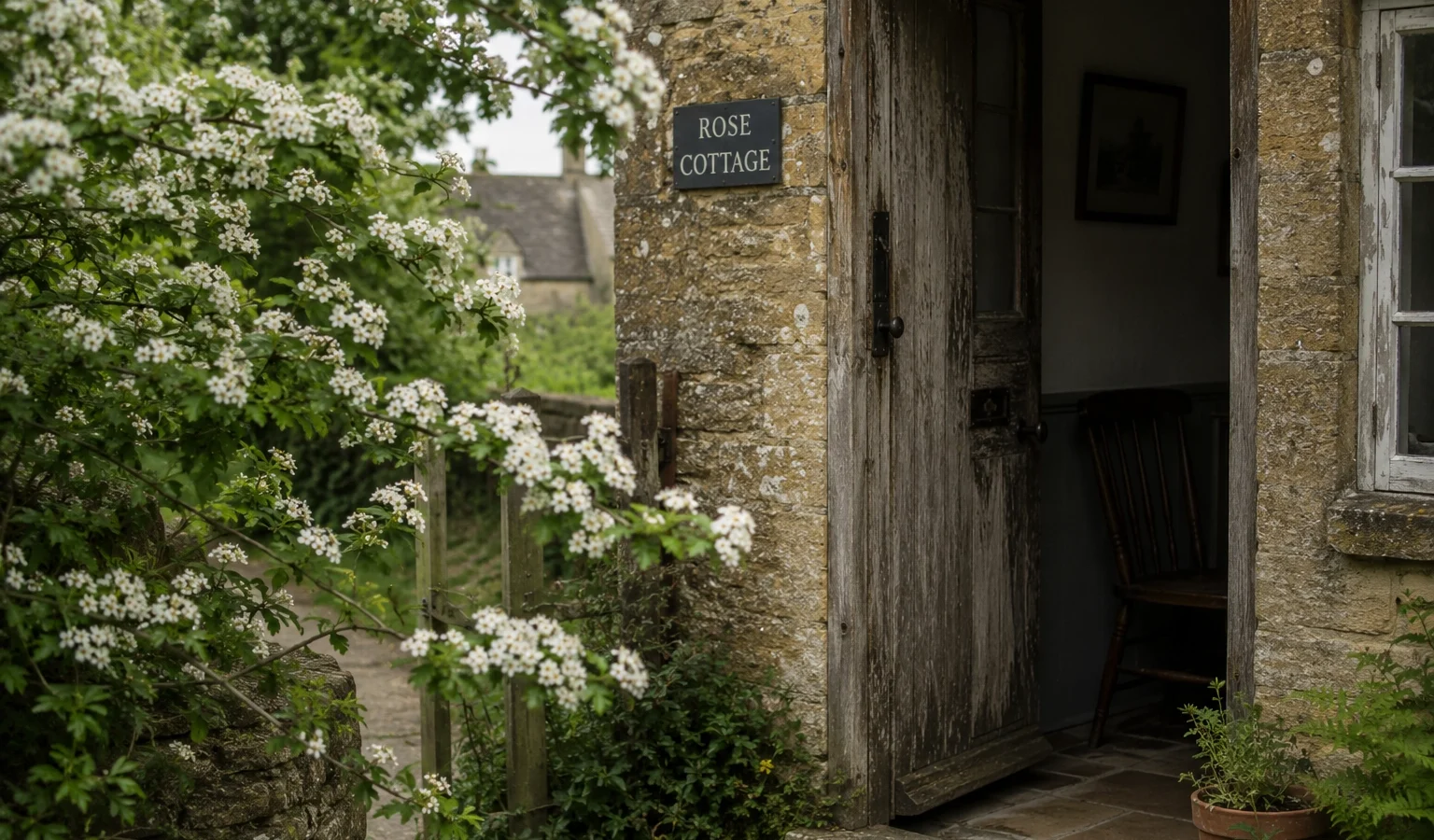
In late spring the tree can cover a hedgerow with white or pale pink flowers, turning a practical field boundary into one of the most conspicuous signs of the season. Yet one of the best-known British beliefs about hawthorn says almost the opposite of what a modern flower-picker might expect: enjoy the blossom outside, but do not bring it into the house.
Later folklore repeatedly describes hawthorn blossom indoors as unlucky. Some versions associate it with illness or death; others simply say that “may” should stay beyond the threshold. The custom is often explained today by the flower’s distinctive scent, but the history is more interesting than a single chemical answer.
The taboo shows how plant folklore can depend not only on what a plant is, but on where it is placed.
Hawthorn could belong to May outside and still be unwelcome at the hearth. In plant folklore, crossing a doorway can change the meaning of the same flower.
“May” means hawthorn as well as a month
Common hawthorn, Crataegus monogyna, is frequently called may or may-tree. The name reflects its close association with late-spring flowering, although real blossom dates vary by place and year.
Woodland Trust’s Nature’s Calendar records hawthorn flowering from early spring into late May and sometimes beyond. The Royal Horticultural Society likewise treats its blossom as a familiar sign of warmer, longer days.
This seasonal identity gave hawthorn an unusually strong place in May customs. Garlands, greenery and flowering branches belonged to outdoor celebration, and hawthorn became one of the plants associated with May Day, courtship and the arrival of summer.
That makes the indoor prohibition more striking rather than less.
Do not confuse May blossom with blackthorn
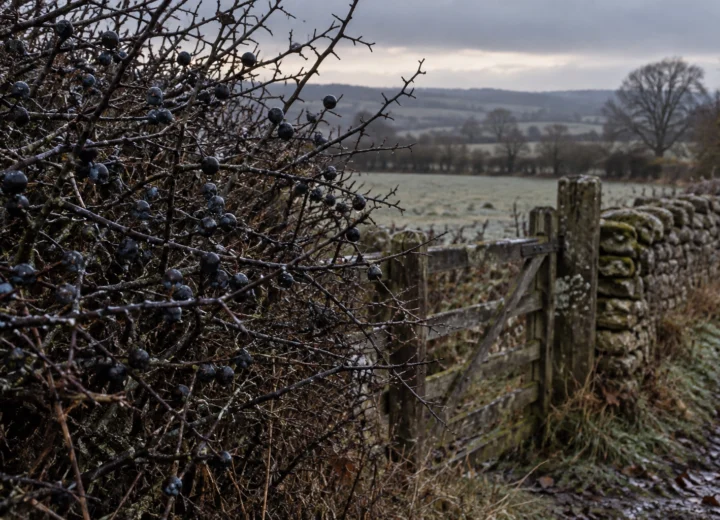
Hawthorn and blackthorn can both cover hedges with pale blossom, but they usually flower in different ways. Woodland Trust guidance notes that blackthorn commonly opens before its leaves appear, while hawthorn normally flowers after its leaves have emerged.
The distinction matters when reading seasonal folklore. A nineteenth-century reference to “may” generally points towards hawthorn, not simply any white-flowering thorn in a hedge. Modern photographs and decorative captions can blur the two, especially when the plants are shown without leaves or fruit.
Botanical identification does not solve every folkloric question, but it prevents a story attached to one species from being transferred casually to another.
Collectors preserved rules as well as stories
Much plant lore survives because antiquaries, folklorists and later ethnographers recorded what people said should or should not be done.
Those records are invaluable, but they also need context. A collector may summarise several informants in one sentence, omit disagreement or choose the most memorable version. A printed warning can therefore look more universal than the living custom ever was.
The responsible approach is to treat repeated records as evidence that a belief circulated, while resisting the temptation to turn circulation into a rule followed by every household.
Why hawthorn blossom indoors creates a folkloric contradiction
Modern symbolic guides often prefer plants to have one stable meaning. A flower is lucky or unlucky, protective or dangerous, sacred or ordinary.
Hawthorn refuses that neatness.
The blossom could take part in seasonal festivity while still being considered inappropriate inside a home. A hawthorn hedge could be valued as a protective boundary while a branch carried across the doorway could acquire a very different reputation. This is why hawthorn blossom indoors cannot be understood through a simple lucky-or-unlucky label.
Our broader guide to hawthorn in British folklore explores the tree’s many roles. The indoor-blossom taboo deserves closer attention because it is a particularly clear example of folklore changing with location.
| Context | Typical association in the material discussed here |
|---|---|
| Hedge or field boundary | Practical landscape, spring flowering and the arrival of May. |
| Outdoor seasonal custom | Garlands, May celebration, courtship and decorative greenery. |
| Fresh blossom inside the home | Later warnings about bad luck, illness or death in some traditions. |
| Printed or artificial hawthorn | Decorative symbolism rather than the same historical question as fresh blossom. |
Why British folklore linked hawthorn blossom indoors with bad luck
Woodland Trust’s current hawthorn material summarises a widespread belief that bringing the blossom indoors could be followed by illness or death. Kew’s Grow Wild project likewise notes that hawthorn blossom indoors was often treated as taboo.
Folklore dictionaries and plant-lore collections record similar warnings in different forms.
It is important to describe these as beliefs rather than as historical proof that misfortune followed a vase of hawthorn. The value of the tradition lies in its persistence and variation, not in testing whether the warning is supernaturally effective.
The smell is impossible to ignore
Hawthorn flowers are highly scented, but “fragrant” does not mean everyone experiences the scent as pleasant.
Descriptions range from sweet and heavy to fishy, bodily or suggestive of decay. The odour becomes more noticeable when blossom is gathered together, especially in an enclosed, warm room.
That sensory experience provides one of the most plausible reasons hawthorn blossom indoors could feel different. A scent dispersed across a hedgerow is not the same as the same scent concentrated beside a bed or table.
Trimethylamine provides a modern clue
Kew and Woodland Trust both discuss trimethylamine in relation to hawthorn blossom. The compound is also produced in processes of organic decomposition and is associated with strong fishy or decaying odours.
This modern chemical observation offers one clue to why hawthorn blossom indoors may have felt uncomfortable or even disturbing to some households, especially when the scent became concentrated.
But it does not prove that trimethylamine created the superstition.
A chemical analysis performed centuries later cannot tell us what every historical household smelled, thought or feared. At most, it shows that the traditional discomfort had a sensory context that modern observers can recognise.
The “Great Plague” explanation should be handled carefully
Popular accounts sometimes say hawthorn blossom reminded medieval people specifically of the Great Plague.
This is memorable, but the wording can create more certainty than the evidence supports. The major London plague outbreak usually called the Great Plague occurred in 1665 to 1666, while hawthorn customs and death associations cannot be reduced to one event.
It is safer to say that the odour of hawthorn blossom indoors could evoke decay, illness or the smell of death, and that later retellings connected this with plague memory.
Folklore often gathers a dramatic explanation after the custom itself is already established.
A smell can reinforce a story without causing it
Suppose a family has inherited a warning not to bring may blossom into the house. If someone ignores the rule and finds the smell unpleasant, the experience confirms the warning emotionally even if nothing supernatural happens.
The next generation then receives both the rule and the sensory evidence that makes it memorable.
This is one way customs persist: a story and a physical experience support one another.
It is also why the old division between “rational” and “superstitious” explanations can be unhelpful. People may have disliked the smell and believed in bad luck at the same time.
Why the household threshold mattered
Traditional household customs often treat the home as a place that must be ordered and protected.
Doors, windows, hearths and chimneys receive particular attention because they are openings. Objects placed above a door, hidden near a fireplace or concealed in a wall can take on meanings related to protection, luck or exclusion.
The same logic helps explain why a flowering branch might be acceptable on a lane yet troubling once carried through the door. In that setting, hawthorn blossom indoors became a question about boundaries as much as about the flower itself.
For the wider pattern, see our article on thresholds in British folk belief.
Outdoor May customs did not automatically authorise indoor use
Seasonal greenery could be displayed on buildings, carried in procession or woven into garlands without every plant becoming an ordinary indoor decoration.
The route from hedge to doorway mattered.
Modern readers sometimes assume that because hawthorn belonged to May Day, it must always have been a lucky flower to place anywhere. The tradition surrounding hawthorn blossom indoors demonstrates why that inference fails.
Folklore does not work like a universal symbolic dictionary. Context creates meaning.
The white blossom also complicates modern colour symbolism
White flowers are often interpreted today as symbols of purity, innocence or marriage.
Those associations certainly exist in British and Christian symbolism, but hawthorn demonstrates that colour cannot determine meaning by itself.
The same pale blossom could belong to May celebration and to warnings about illness or death. Its scent, season and relationship to the domestic threshold mattered more than a general rule about white flowers.
Marriage traditions were not uniform either
Hawthorn’s connection with May and courtship gave it a place in some marriage and love customs.
RHS folklore material includes traditions in which young women watched for first blossom or connected it with dreams of a future husband. Other regional material associates may blossom with bridal festivity.
Yet an indoor taboo could exist alongside these customs.
One community might accept hawthorn in a particular ceremonial context while another household avoided it entirely. “Hawthorn was a wedding flower” and “hawthorn was unlucky indoors” can both describe recorded traditions without either becoming a universal British rule.
Regional folklore matters more than modern summaries suggest
Plant traditions vary by county, period and collector.
A nineteenth-century record from one part of England does not automatically describe Wales or Scotland. An Irish fairy-thorn tradition cannot simply be relabelled as an ancient British belief. A modern spiritual author may combine several regional ideas into one usable system.
Hawthorn is especially vulnerable to this flattening because it appears so often in folklore.
Whenever possible, ask where and when a custom was recorded. Claims about hawthorn blossom indoors become more useful when they retain a date, place and source instead of being presented as one universal British rule.
The taboo was not necessarily about the whole tree
A warning against blossom indoors does not mean people avoided hawthorn wood, hedges or fruit.
Hawthorn was an everyday working plant. Hedges were cut and laid. Wood could be used. Haws entered food traditions. The tree formed real agricultural boundaries.
That practical use is important evidence against exaggerated modern claims that hawthorn was universally untouchable.
The taboo is more precise: certain parts of the plant, in certain places, under certain circumstances, acquired special meaning.
Cutting may blossom and felling a lone thorn are different customs
Another source of confusion comes from mixing the indoor-blossom warning with stories about damaging solitary hawthorns.
Some lone thorns, especially those associated with local legend, sacred sites or fairy belief, could be treated with unusual caution. That is a different category of tradition from bringing a flowering branch into the house.
Both involve hawthorn, but they answer different questions.
One is about what crosses the household boundary. The other is about what should happen to a particular tree in the landscape.
Victorian flower culture did not erase older unease
The nineteenth century produced an enormous appetite for floral imagery, botanical collecting and the so-called language of flowers.
Hawthorn appeared on cards, in decorative art and in romantic seasonal imagery. The British Museum preserves nineteenth-century cards and objects using hawthorn blossom as a recognisable decorative motif.
That visual popularity did not necessarily eliminate household superstition.
People can enjoy the image of a flower while still observing a rule about the physical plant. Folklore and fashionable decoration need not move in perfect agreement.
Printed symbolism can make folklore look more consistent than it was
Flower dictionaries and later occult correspondence books encourage the idea that each plant owns a fixed set of meanings.
Hawthorn might be assigned hope, fertility, love, protection or fairy association depending on the system.
Such books are evidence for the symbolic culture that produced them. They are not automatic summaries of every older rural belief.
The indoor taboo is valuable partly because it preserves the awkwardness that correspondence lists tend to smooth away.
Modern Paganism often welcomes hawthorn symbolically
Contemporary Pagan and witchcraft traditions frequently connect hawthorn with Beltane, fertility, fairies, love and boundaries.
These associations draw on genuine historical and folkloric themes, but modern practice reorganises them into new ritual systems.
A modern practitioner may choose to display hawthorn symbolically while knowing that older household tradition sometimes warned against hawthorn blossom indoors.
That is not a contradiction if the two practices are identified as belonging to different contexts.
You do not need to “test” the superstition
Folklore does not become more historically meaningful because someone deliberately brings hawthorn into a bedroom to see what happens.
The custom can be understood through records, landscape and comparison.
Likewise, there is no need to damage a storied tree to demonstrate scepticism about fairy punishment.
A respectful approach can separate belief from evidence while still recognising that old customs are part of cultural heritage.
There are practical reasons to leave flowering hedges alone
Modern ecology gives hawthorn blossom another kind of importance.
The flowers provide nectar and pollen for insects, and hedges offer shelter and nesting habitat. Later haws feed birds and mammals.
That ecological value is not the historical origin of the indoor taboo, but it creates a contemporary reason not to strip flowering hedges simply for decoration.
Folklore and conservation can sometimes point towards the same restraint for entirely different reasons.
Dried or artificial hawthorn is a different historical question
Modern home décor may use dried botanical material, prints, artificial blossom or stylised hawthorn motifs.
Historical warnings generally concern the living or freshly cut plant, especially its flowers. Extending the folklore of hawthorn blossom indoors automatically to a drawing, ceramic motif or artificial branch is a modern choice rather than something demonstrated by old sources.
This distinction is useful whenever folklore becomes part of interior decoration: the historical custom should not be stretched further than the evidence allows.
The safest interpretation is also the most interesting
Hawthorn blossom was not universally feared, and British households did not all follow one rule.
What survives is a strong and widely repeated strand of folklore in which hawthorn blossom indoors felt less comfortable than blossom left outside in the hedge or used in outdoor seasonal custom.
The scent may have reinforced that feeling. Death imagery may have strengthened it. Household ideas about thresholds may have given it structure. Regional storytelling added its own variations.
No single explanation needs to defeat the others.
A Hawthorn & Key way to read the old warning
The old warning about hawthorn blossom indoors is compelling because it turns an ordinary act, cutting flowers and carrying them home, into a question about place.
Nothing in the tradition requires us to claim that a vase of hawthorn causes illness or supernatural harm. The interest lies in how a familiar hedge plant became subject to different rules on opposite sides of a doorway.
That small contradiction tells us more about folklore than a tidy list of magical correspondences ever could. Hawthorn blossom indoors is a useful case precisely because no single explanation removes the historical ambiguity.
Sources & Further Reading
- Woodland Trust, common hawthorn species profile, for identification, ecology and folklore summaries.
- Woodland Trust Nature’s Calendar, “Why is Hawthorn Known as the May Tree?”, for flowering, the May-tree name and modern summaries of the indoor warning.
- Woodland Trust, “Difference Between Hawthorn and Blackthorn”, for practical spring identification.
- Kew Grow Wild, “Love potions: meadows to myths”, for the indoor-blossom taboo and discussion of hawthorn scent and trimethylamine.
- Royal Horticultural Society, hawthorn plant guide, and RHS, “Trees: myths and folklore”, for seasonal and May associations.
- British Museum, nineteenth-century card featuring pink hawthorn blossom, for hawthorn as decorative material culture.
- Jacqueline Simpson and Steve Roud, A Dictionary of English Folklore.
- Steve Roud, The Penguin Guide to the Superstitions of Britain and Ireland.
- Roy Vickery, A Dictionary of Plant-Lore.