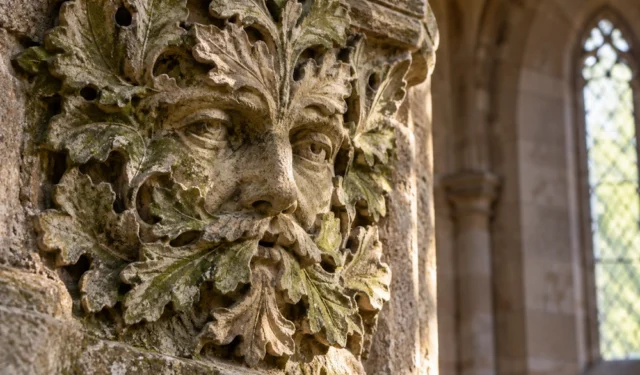
The name suggests an ancient woodland figure, perhaps a survival of pre-Christian religion carved into a Christian building. It is an attractive interpretation, particularly when the stone face appears among saints and angels. Yet the surviving evidence tells a more complicated story. Medieval foliate heads are real and widespread, while the habit of identifying them collectively as the Green Man became established much later.
There were people and festive figures called green men long before the twentieth century. What historians cannot demonstrate is that every medieval leaf-covered face represented those figures, or that the carvings preserve one continuous cult of a pagan vegetation god. The Green Man’s meaning depends partly on the age and setting of the carving and partly on the stories later generations attached to it.
A medieval carving may be old without every meaning now attached to it being equally old.
What is the Green Man? Foliate heads and their forms
There is no single standard design. Art historians often use the more neutral term foliate head for a human or human-like face combined with leaves, vines or other plant forms.
In some carvings the leaves frame a face; in others they seem to grow through it, emerging from the mouth, nose or eyes. The expression may be gentle or grotesque, and the foliage can be carefully recognisable or little more than a pattern of curling stone.
This variety matters. When very different carvings are all given one name, it becomes tempting to assume they all represented the same character and carried the same meaning. Medieval decoration rarely works so simply.
Historic England’s records show foliate or “Green Man” carvings in many architectural contexts: fonts, roof bosses, capitals, window surrounds, porches, monuments and other decorative features. Their locations and dates differ. Some are medieval; some are much later works consciously using an established motif.
The object itself offers firmer ground than a single mythology imposed on every example. Its date, location and surrounding imagery can tell us more than the shared modern label alone.
Medieval foliate heads in churches
Foliate heads were especially prominent in medieval European architectural sculpture. Examples occur from the Romanesque period onwards and became common in later medieval carving.
Church interiors offered many places for imaginative ornament. Capitals, corbels, misericords, bosses and margins could contain animals, monsters, grotesques, plants, human faces and hybrid forms alongside explicitly Christian imagery.
A modern visitor may be surprised to find a grimacing leafy head close to saints, angels or biblical scenes. That surprise often comes from expecting medieval churches to contain only straightforward religious symbols. In reality, their visual worlds could be much broader.
Medieval craftsmen worked with a large vocabulary of foliage. Leaves could signify beauty, growth and abundance, but vegetation also provided an endlessly adaptable decorative structure. Vines could fill awkward spaces. Stems could connect forms. A face emerging from foliage offered both pattern and personality.
None of this makes the motif meaningless. It does mean that the intended meaning may have varied between patrons, buildings and generations of craftsmen.
Where did the name Green Man come from?
The carvings and the name have different histories, and much of the debate begins when the two are treated as inseparable.
The phrase “Green Man” was in use centuries before modern scholarship adopted it for foliate heads. The Library of Congress traces an explicit reference to men dressed in greenery in a play of 1578, where such figures appear as recognisable participants in a civic procession. Related figures subsequently appeared on inn signs. Those records establish a history of the name, although they do not, by themselves, explain medieval church carvings.
The architectural association became especially influential after Lady Raglan published “The ‘Green Man’ in Church Architecture” in Folklore in 1939. The American Folklife Center also records a reference to a church carving as a “green man” by 1932. It is therefore too simple to say that Raglan invented the words or every aspect of the tradition. Her article helped establish a particular identification of an older image with an older name.
Raglan compared leaf-covered church carvings with figures in seasonal processions and proposed an enduring pre-Christian fertility tradition behind them. Her explanation found an audience because it connected unfamiliar church sculpture with recognisable customs. It did not establish that medieval masons intended every foliate head to represent one deity.
Later scholarship has examined the terminology and questioned the wider claim of a single continuous religious tradition. Brandon Centerwall’s study of the name, published in Folklore in 1997, noted how strongly modern understanding had been shaped by Raglan’s choice of label.
Stephen Winick’s research for the Library of Congress adds a useful complication: older green men were sometimes wild men, participants in pageants or figures represented on tavern signs. A name can pass between settings without every object carrying the same meaning. We cannot assume that a medieval mason, a Tudor pageant organiser and a modern visitor all had the same Green Man in mind.
Was the Green Man an ancient pagan god?
The most popular explanation presents the Green Man as a survival of ancient pagan nature worship.
The resemblance invites speculation. A face merges with leaves in a church, while seasonal festivities feature people dressed in greenery. Stories about trees and the return of spring add a further attraction. These images and customs can be compared, but resemblance alone cannot establish that they came from one continuous religious practice.
Such an argument needs a chain of evidence across time, and the surviving record does not supply a secure one.
To demonstrate that medieval carvers were intentionally preserving a specific pre-Christian god, we would need evidence linking the traditions across time: texts, names, ritual descriptions, consistent iconography or other documentation. That evidence is lacking.
Raglan’s theory emerged in a period when folklore scholarship was strongly influenced by ideas of “survivals”: the belief that fragments of ancient ritual remained hidden inside later customs. James Frazer’s The Golden Bough had encouraged generations of readers to look for dying-and-reviving vegetation figures beneath European folklore.
Those ideas were enormously influential, but modern scholarship is generally more cautious about constructing uninterrupted prehistoric religions from much later images and customs.
The Green Man may feel pagan to modern eyes. That feeling should not be rewritten as a documented medieval belief.
What might a Green Man carving have meant?
No surviving interpretation accounts convincingly for every foliate head in every setting.
One possibility is that different foliate heads meant different things. Context would have mattered: where the carving appeared, what surrounded it, who commissioned it and what visual traditions the craftsman knew.
Some faces may have carried moral associations, though we should be careful to present these as possibilities. Vegetation emerging from the mouth might prompt a reading concerned with speech, sin or vitality; other viewers may see the unsettling boundary between human and plant. Grotesque heads elsewhere in medieval churches could function as warnings, comic images, protective imagery or simply inventive ornament.
Other examples may have been primarily decorative. Medieval artists repeatedly combined human, animal and vegetal forms because the hybrid itself was visually effective.
Other meanings may simply be beyond recovery, especially where the carving survives without records of its commission.
This uncertainty can be frustrating if we want a tidy dictionary of symbols. Yet medieval art rarely provides one. A carving does not become meaningless simply because we cannot translate it into a single sentence.
Faces that grow and faces that are trapped
Part of the Green Man’s modern power comes from ambiguity.
When leaves appear to grow from a smiling face, the image can suggest fertility and renewal. When foliage bursts from a grimacing mouth, it can look invasive, as though nature is reclaiming the human body. When the face is almost hidden, it can suggest transformation or loss of identity.
These impressions are real responses to the object, even when they are not documented medieval interpretations.
The distinction is useful. We can say, “This carving makes me think about the boundary between human beings and the natural world,” without claiming, “Medieval people carved this to represent an ancient god of ecological balance.”
Such responses belong to the modern encounter with the carving. They need not be mistaken for its original purpose.
The Green Man in British churches
The presence of foliate heads in churches has often been treated as the great mystery requiring a pagan explanation. But medieval churches were full of imagery that was not a simple illustration of doctrine.
Historic England’s photographic archive identifies a foliate head on the font at St Bartholomew’s Church in Lostwithiel, Cornwall. At Stow Minster in Lincolnshire, the church describes a font bearing a leafy face alongside other carved motifs. Sources differ on the font’s dating, so the carving should not be assigned a precise century without examining the underlying architectural record. Across Britain, related faces appear on bosses, capitals and exterior stonework as well as fonts.
These examples demonstrate that the motif was accepted within ecclesiastical decorative programmes. They do not tell us that church authorities secretly endorsed a pagan cult.
Medieval churches also drew upon classical ornament and workshop traditions; their decoration included grotesques and creatures that cannot always be assigned one doctrinal meaning. There is little reason to regard every unexpected face as a secret act of religious resistance.
Related figures, different histories
Jack-in-the-Green and the problem of resemblance
Modern discussions often connect the architectural Green Man with Jack-in-the-Green, the vegetation-covered figure associated with May celebrations.
The visual resemblance is obvious: both combine a human presence with abundant greenery. Historically, however, they should not simply be treated as the same tradition.
Jack-in-the-Green is well documented as an early modern and especially eighteenth- and nineteenth-century festive figure associated with chimney sweeps and May Day. Medieval foliate heads are much older.
Raglan’s 1939 argument encouraged people to see such figures as survivals of one ancient vegetation tradition. Later scholarship has been more reluctant to draw that continuous line without evidence.
Connections can still be explored as part of the history of ideas. The important thing is to distinguish documented chronology from symbolic resemblance.
| Image or figure | What we can document | What remains uncertain |
|---|---|---|
| Medieval foliate head | Faces combined with vegetation in church and architectural carving | A single original meaning shared by all carvings |
| Green men in processions and on signs | Green-clad figures and the name in early modern records | A direct historical link to every medieval foliate head |
| Jack-in-the-Green | A leafy figure associated with later May celebrations | Unbroken continuity with medieval carving |
| Modern Green Man | Use as a symbol of nature, change and ecological connection | Whether those interpretations were intended by medieval patrons |
The Green Knight is a different story
Sir Gawain and the Green Knight offers another tempting connection. Its mysterious challenger is green, associated with a journey into a winter landscape and caught in a story involving death, survival and return.
The poem’s colour imagery has encouraged comparisons with the Green Man, particularly in modern literary interpretation.
But the medieval poem does not identify the Green Knight with foliate-head carvings, and the architectural category itself was named much later. Similar themes of greenness, wildness and transformation can make comparison fruitful, but comparison should not become identity.
The Green Knight belongs to his own literary context. Foliate heads belong to a broad visual tradition. Their modern meeting tells us as much about the way we organise symbols now as about how medieval people organised them.
How the Green Man became a modern nature symbol
During the twentieth century, the Green Man moved far beyond medieval art history and became a popular emblem of the relationship between human beings and nature. Artists, writers, environmental movements and contemporary spiritual traditions adopted the leafy face as a symbol of seasonal change, ecological interdependence and the persistence of the wild within cultivated life.
In this modern role, the Green Man has gained something medieval foliate heads may never have possessed: a broadly shared mythology.
That mythology is not false simply because it is modern. Cultural symbols are continually remade. Robin Hood became a champion who “robs the rich to give to the poor” more neatly than his earliest ballads suggest; Arthur became a national ideal through centuries of rewriting. The Green Man likewise acquired new meanings.
The historical mistake comes only when modern meaning is projected backwards and presented as proven ancient belief.
Why the face still feels ancient
A carving’s age can shape our response even when its original purpose remains uncertain.
A face, a leaf and the idea of growth are older than any written explanation. Human beings have always lived among plants, depended upon seasons and watched bodies age while vegetation returns. A face becoming foliage therefore touches themes that do not require a specific religious tradition to be powerful.
The physical age of many carvings adds another layer. A weathered stone head in a medieval church really has watched centuries pass. Moss, dust and changing light make the image seem even closer to the landscape it depicts.
Modern viewers can therefore experience the Green Man as a deep symbol without needing him to be the surviving portrait of one prehistoric god.
The stone is medieval, while the questions we bring to it may be distinctly modern.
How to examine a Green Man carving
When encountering a foliate head, begin with the object rather than the mythology.
Look at the date of the building and, if possible, the date of the carving. Is it original or a Victorian restoration? Where is it placed? What other images appear nearby? Are the leaves identifiable? Do they emerge from the mouth or simply surround the face? Is the expression comic, serene or distressed?
Then ask what is documented about the site. A church guide, Historic England listing, cathedral archive or conservation record may reveal when a roof, font or porch was built and whether the carving has been moved.
Those observations offer a sounder basis for considering symbolism and possible connections to other traditions.
Close observation preserves the differences between carvings, even when their meaning remains uncertain.
A Hawthorn & Key approach to the Green Man
At Hawthorn & Key, the Green Man is most interesting when two truths are allowed to coexist. Medieval foliate heads are genuine, widespread and visually extraordinary. The idea of a single ancient British vegetation spirit secretly preserved in all of them is not established by the evidence.
Raglan’s interpretation is itself part of that history, as are later arguments about how the name and image became associated.
We can admire the carvings as medieval objects, study Lady Raglan’s influential twentieth-century interpretation and still understand why the leafy face has become a meaningful modern symbol of our entanglement with the natural world.
There is still something unsettling about a human face disappearing into stone foliage, especially when the person who carved it left no explanation.
Sources & Further Reading
- Lady Raglan, “The ‘Green Man’ in Church Architecture”, Folklore, vol. 50, 1939.
- Brandon S. Centerwall, “The Name of the Green Man”, Folklore, vol. 108, 1997.
- Historic England Archive, foliate head on the font at St Bartholomew’s Church, Lostwithiel.
- Historic England, National Heritage List for England, architectural records documenting church decoration.
- Stephen Winick, Library of Congress, “Introducing the Green Man”, 2021.
- Stephen Winick, Library of Congress, “What Was the Green Man?”, 2021.
- Stow Minster, “The Nave”, for the church’s description of its carved font.
- Carolyn Dinshaw, “Black Skin, Green Masks: Medieval Foliate Heads, Racial Trauma, and Queer World-Making”, in The Middle Ages in the Modern World, British Academy/Oxford University Press, 2017.
- Kathleen Basford, The Green Man, D. S. Brewer.
- Mercia MacDermott, Explore Green Men, Heart of Albion Press.