
June 8, 2026
Hawthorn in British Folklore: The Tree at the Heart of Hawthorn & Key
Hawthorn is one of the most familiar trees in the British landscape, yet its folklore is full of contradictions. It belongs to May Day garlands and flowering hedgerows, but also to boundaries, caution and the old belief that some blossoms are better admired outdoors.
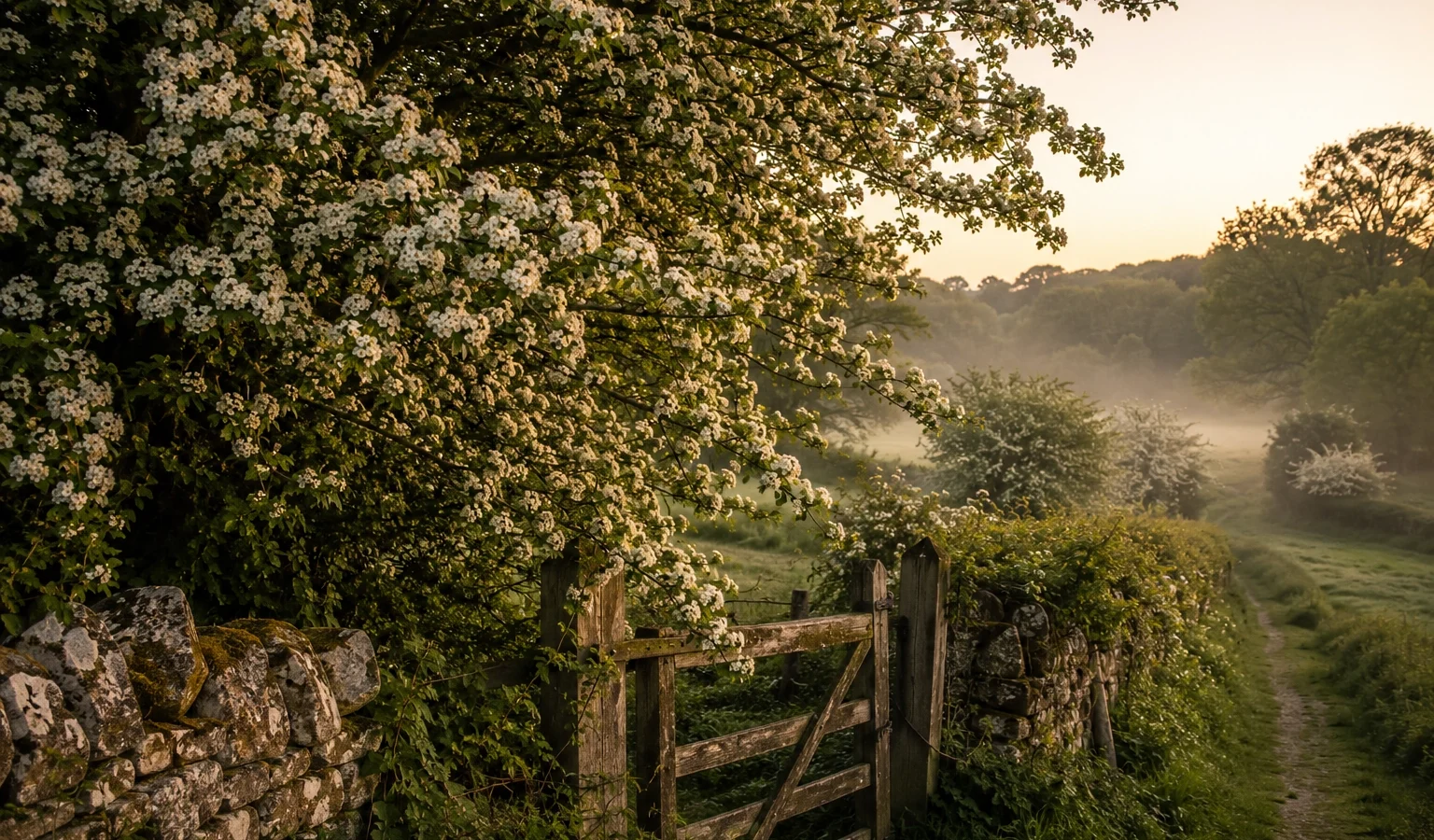
That contradiction is precisely why the tree stands at the heart of Hawthorn & Key. Hawthorn is not a decorative symbol chosen only because it looks beautiful in flower. It carries a deeper character: welcoming but not entirely tame, ordinary but never empty of meaning, rooted in the everyday landscape while retaining a small reserve of mystery.
Hawthorn does not demand belief. It asks for attention.
A tree woven into the British landscape
Common hawthorn, Crataegus monogyna, is one of the most recognisable trees and shrubs of the British countryside. It grows widely in hedgerows, scrubland, woodland edges, gardens and exposed places where a more delicate plant might struggle. The Royal Horticultural Society describes hawthorn as versatile enough to grow as a hedge, shrub or tree across a range of soils and in exposed situations.
There are two hawthorn species native to the UK. Common hawthorn is the more widespread of the two. Midland hawthorn, Crataegus laevigata, is generally more shrublike and is associated particularly with ancient woodland. To the casual walker, the distinction is easy to miss. Both belong naturally to the layered green boundaries of the countryside.
Hawthorn is often noticed first as a hedge rather than a tree. Cut and managed over generations, it becomes a living wall: dense enough to mark the edge of a field, thorny enough to discourage careless passage and generous enough to provide food and shelter for wildlife. Left alone, it can also become a small tree with a broad, irregular crown and a character all its own.
This double life matters. Hawthorn is both boundary and inhabitant, both practical and symbolic. It does not stand apart from ordinary rural life. It grows directly through it.
Why hawthorn is called the May tree
Hawthorn is also known simply as May, May tree or May blossom. The name comes from its traditional flowering season. Woodland Trust’s Nature’s Calendar notes that hawthorn blossom has typically appeared at the beginning of May in England and somewhat later further north, although changing seasonal patterns can bring flowering forward.
For earlier generations, the arrival of the blossom was more than a pleasant detail. It signalled a genuine shift in the year. Winter had loosened its grip. Days were longer. Roads and fields had become more hospitable. The season of growth was no longer merely promised; it was visible.
An old saying captures the tree’s role as a natural calendar:
Cast ne’er a clout till May be out.
The wording varies, and so does the interpretation. The advice is often understood not as a warning to wait until the month of May has ended, but to keep winter clothing close until the May blossom is out. The tree, rather than the printed calendar, gives permission to trust the warmer weather.
That relationship between plant and season helps explain hawthorn’s association with May Day. Woodland Trust records its links with fertility, May garlands, the Maypole and the wreath of the Green Man. The tree belongs to the bright threshold between spring and summer: the moment when the countryside seems to step fully back into life.
The blossom that was not always welcome indoors
Hawthorn blossom is beautiful, but older tradition did not necessarily treat it as a flower for the vase on the kitchen table.
Woodland Trust records a widespread belief that bringing hawthorn blossom into the home could be followed by illness, misfortune or death. The flowers were associated with the smell of decay. Modern botanical explanation adds an unexpectedly physical detail: hawthorn blossom contains trimethylamine, a chemical also formed in decaying animal tissue.
The superstition therefore does not feel completely arbitrary. Hawthorn presents one of folklore’s characteristic combinations: something visually lovely carrying a scent that unsettles the meaning of the flowers. The blossom announces warmth and renewal outside, yet indoors it may feel slightly out of place.
This does not mean that every household in every county followed the same rule. Folklore is rarely so tidy. Hawthorn was also used in seasonal customs and May garlands. Context matters. A branch woven into an outdoor celebration is not quite the same thing as blossom brought casually across the threshold.
The old caution gives hawthorn a quality that is easy to overlook in modern symbolism. It is not simply a cheerful spring tree. Its beauty comes with a boundary.
A tree of thresholds and hedgerows
The key to hawthorn’s character may lie in where it grows.
A hedgerow is never merely a line on a map. It separates one field from another, but it also shelters nests, catches wind, guides a footpath and gives the eye a place to rest. It is both barrier and habitat. The Royal Horticultural Society describes hedges as living boundaries that support spiders, nesting birds, small mammals and other wildlife.
Hawthorn embodies this double function particularly well. Its thorns make the hedge protective. Its blossom feeds insects. Its leaves support invertebrates. Its red fruits, known as haws, provide food for birds later in the year. Woodland Trust states that hawthorn can support more than 300 species of insect, while its flowers provide pollen and nectar for bees and other pollinators. The haws are eaten by birds including redwings and fieldfares.
There is a quiet lesson here. A boundary does not have to be lifeless. The strongest edge in the landscape may also be one of its busiest places.
This is one reason hawthorn fits so naturally within British folklore. Folklore is often interested in the spaces between clear categories: the road and the field, the house and the outside world, winter and summer, the ordinary and the uncanny. Hawthorn grows comfortably in all of them.
The lone hawthorn and the fair folk
Hawthorn’s association with fairies is one of its most enduring folkloric qualities. The details vary across regions and retellings, but the central idea remains familiar: a hawthorn, particularly a solitary tree, may deserve more respect than its size suggests.
The Royal Horticultural Society records hawthorn as a sacred tree in folklore and notes traditions warning that misfortune could follow its destruction. Woodland Trust similarly connects the tree with May Day, fairy queens and older seasonal symbolism.
The lone hawthorn is especially evocative because it looks like a small island of intention in an open field. A hedgerow can be explained by agriculture. A single old tree standing apart from the hedge invites a different kind of attention. Why was it left there? Who decided not to remove it? What stories accumulated because it remained?
In a culture shaped by practical work, leaving a thorn tree untouched may itself become a story. The act of restraint gathers meaning over time. The tree is not necessarily worshipped, and the tale does not need to be read as a literal warning. Yet it preserves an older instinct: not everything inconvenient should be cut down merely because it stands in the way.
As explored in Fairies in British Folklore, the fair folk were not always the miniature winged creatures of children’s books. They often represented a world close to ours but not fully answerable to us. Associating hawthorn with fairies gives the tree the same quality. It stands within the field, but not entirely at our disposal.
May blossom, the Green Man and seasonal return
Hawthorn’s flowering coincides naturally with a time of garlands, village customs and outdoor celebration. Woodland Trust associates the tree with May Day garlands, the Maypole, the crown of the fairy queen and the wreath of the Green Man.
The Green Man is one of Britain’s most memorable foliate images: a face emerging from leaves, carved into churches and other historic buildings, interpreted in many different ways over time. It is tempting to make the symbol too simple, as though every leafy face carries a single ancient message. The history is more complicated than that. Yet the image endures because it speaks to something immediately recognisable: the unsettling abundance of plant life returning after winter.
Hawthorn blossom belongs to that moment of return. It appears not as a single dramatic flower, but in countless small clusters along the hedge. The effect is cumulative. A lane that looked closed and practical becomes briefly ceremonial.
The seasonal meaning of hawthorn is therefore not hidden behind the landscape. It is visible from the road.
The Holy Thorn of Glastonbury
No discussion of hawthorn in British legend is complete without Glastonbury.
Glastonbury Abbey records the tradition that Joseph of Arimathea arrived in Britain and climbed Wearyall Hill. Exhausted, he thrust his staff into the ground. By morning, it had taken root. The Holy Thorn associated with this legend was remarkable because it flowered twice: once in spring and again around Christmas.
The story belongs to Glastonbury’s larger web of legends, which also includes Joseph of Arimathea, the Holy Grail, King Arthur and Avalon. It should be understood as tradition rather than documentary history. That does not diminish its cultural importance. The abbey notes that local people preserved cuttings after the remaining thorn on Wearyall Hill was cut down during the Civil Wars, and descendants were believed to continue the unusual flowering pattern.
A custom of sending a Christmas sprig from a Glastonbury thorn to the sovereign began in the early seventeenth century and continues in modern form. The legend therefore does more than survive in a book. It remains attached to a living seasonal gesture.
The Holy Thorn is a particularly rich example of the way folklore works. A tree becomes a meeting point between place, pilgrimage, seasonal wonder and story. The botanical object and the legendary meaning cannot be separated cleanly, because generations of attention have grown around both.
Thorn, blossom and berry
Hawthorn changes its emphasis as the year turns.
In spring, it is blossom: pale, abundant and strongly scented. In summer, it recedes into the green fabric of the hedge. By autumn, the branches carry clusters of small red haws. The tree that belonged to May garlands now feeds migrating birds and holds colour against the darkening season.
The Royal Horticultural Society notes that hawthorn’s nectar-rich flowers support insects and its autumn haws offer food for birds. Woodland Trust adds that the berries are eaten by redwings, fieldfares and blackbirds, with other birds taking them later if fruit remains into winter.
This seasonal rhythm makes hawthorn a useful corrective to the way symbolic plants are sometimes discussed online. A tree is not a fixed list of meanings. It is a living presence that changes through the year. The blossom, the thorn and the berry do not cancel one another. Together, they create the full character of the tree.
Hawthorn and blackthorn are not the same tree
Hawthorn and blackthorn are often confused, especially when hedgerows burst into white blossom in spring. The names sound related, both plants carry thorns, and both are woven into British hedges. Yet they are different species with distinct appearances and associations.
Woodland Trust offers a useful visual rule. Blackthorn usually flowers before its leaves appear, while hawthorn flowers after its leaves have emerged. Blackthorn generally blossoms earlier in the season and later carries dark sloes. Hawthorn tends to flower closer to May and produces clusters of red haws.
The folklore differs too. Blackthorn is more strongly associated with witchcraft, staffs, harsher weather and the darker edge of the hedge. Hawthorn belongs more naturally to May, fairies and seasonal transition, although its own symbolism is far from uncomplicated.
Learning the difference improves more than plant identification. It helps prevent folklore from becoming a vague mixture of interchangeable “magical trees”. Each species has its own texture, season and place in the landscape.
A symbolic tree without exaggerated promises
Modern interest in folklore often arrives through objects: a print, a pendant, a candle, a journal, a dried botanical illustration or a small token for the home. There is nothing wrong with allowing an object to carry meaning. People have always done so.
But hawthorn should not be reduced to a guarantee. No branch, charm or decorative symbol can promise protection, luck, love or healing. Folklore is richer when it is not made to behave like an instruction manual for controlling the future.
Hawthorn offers something more modest and more enduring. It can remind us that beauty and caution may belong together. That boundaries can shelter life. That the seasonal world deserves notice. That not every old story needs to be believed literally in order to alter the way we walk through a landscape.
This is the approach taken throughout The Hawthorn Archive: curious but not credulous, atmospheric but not theatrical, respectful of old traditions without turning them into promises they were never meant to make.
Why Hawthorn & Key begins with hawthorn
The name Hawthorn & Key brings together two objects with a natural affinity.
A key suggests a threshold: a house, a cabinet, a garden gate, a locked drawer, an old room whose purpose has been forgotten. It may open something, but it also reminds us that not every door should be opened carelessly.
Hawthorn grows at thresholds of its own. It lines paths and fields. It softens stone walls. It marks the changing season. It welcomes insects and birds while keeping its thorns. It belongs to ordinary country roads, yet it carries stories of fair folk, May garlands and blossoms left respectfully outside the home.
Together, hawthorn and key express the character of this journal: old stories held quietly, curious objects chosen with care, and a little more attention paid to the edges of everyday life.
How to notice hawthorn respectfully
Hawthorn does not require a special ritual. The simplest practice is to notice it through the year.
- Look for the leaves before the blossom. In spring, this is one of the easiest ways to distinguish hawthorn from blackthorn.
- Notice where the tree grows. A clipped hedge, a woodland edge and a solitary field tree each create a different impression.
- Leave blossom where it belongs. The old superstition is interesting, but there is also a modern practical reason not to strip branches unnecessarily: the flowers support pollinators and later become fruit.
- Return in autumn. The red haws reveal a different side of the tree and attract birds as the year darkens.
- Treat folklore as an invitation to learn. Record the story, check the source and allow regional differences to remain visible.
There is no need to turn every walk into a search for hidden meaning. Hawthorn is already enough as a living tree: ecologically valuable, visually distinctive and deeply embedded in the British landscape.
The hedge in flower
Hawthorn is easy to overlook because it is common. It stands beside lanes, divides fields and folds itself into the background of the countryside. Yet familiarity is not the same thing as emptiness.
For a few weeks each year, the hedge opens into blossom and the tree reveals why it has carried so many stories. It is bright but thorned, generous but resistant, domestic in its closeness to roads and fields yet slightly unwilling to be brought inside.
Perhaps that is what makes hawthorn such a fitting emblem. It does not offer escape from the ordinary landscape. It asks us to discover that the ordinary landscape was never as simple as it looked.
Sources & further reading
- Woodland Trust — Hawthorn: Mythology, Symbolism and Identification
- Woodland Trust Nature’s Calendar — Why Is Hawthorn Known as the May Tree?
- Woodland Trust — Hawthorn and Blackthorn: What’s the Difference?
- Royal Horticultural Society — Hawthorn
- Royal Horticultural Society — Hedge and Woodland Edge Habitats
- Royal Botanic Gardens, Kew — Hawthorn in Forests of the Future
- Glastonbury Abbey — Myths and Legends: The Holy Thorn