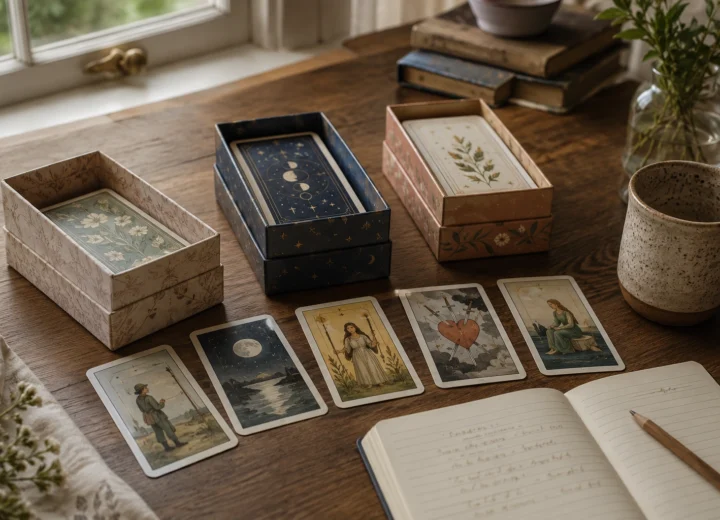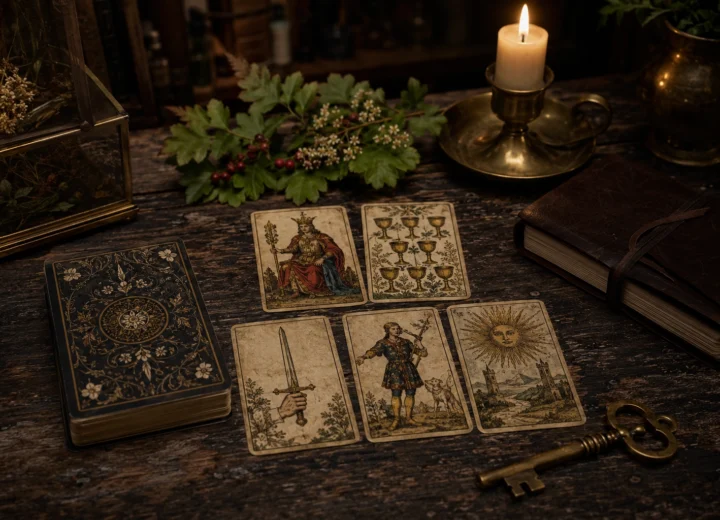
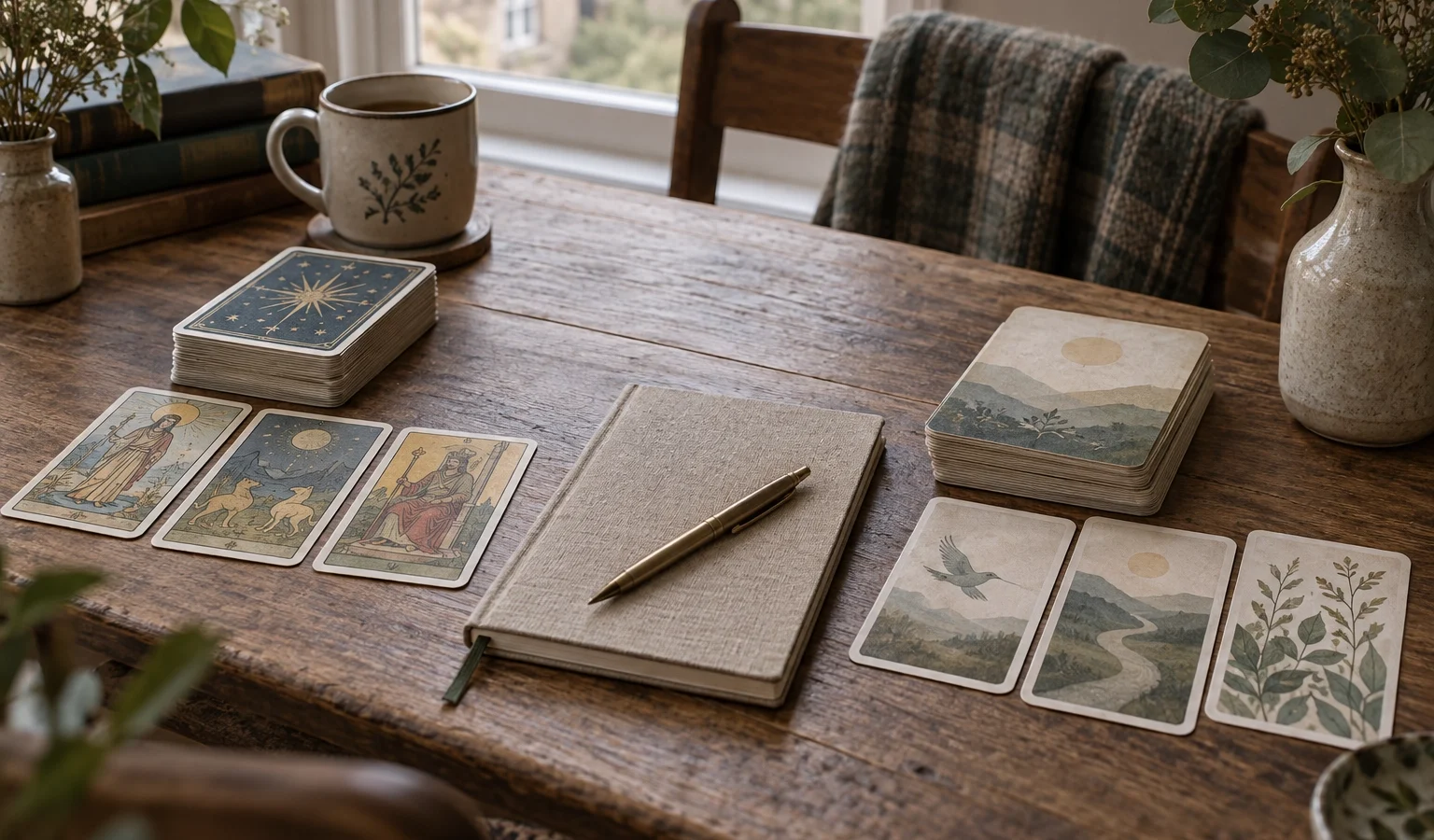
But they are not the same system.
The clearest way to understand tarot vs oracle cards is through structure. Tarot is a recognisable card tradition with an established pattern. A tarot deck normally contains 78 cards divided into Major and Minor Arcana. An oracle deck can contain almost any number of cards and can organise them in almost any way its creator chooses.
The difference is less about which one is more mystical.
It is about structure.
Tarot gives the reader a shared framework. Oracle decks give the creator much more freedom to invent one.
Tarot vs oracle cards begins with structure
The Victoria and Albert Museum traces tarot back to fifteenth-century Europe, where it developed as a card game rather than a divination system.
Modern tarot usually contains 22 trump cards, now commonly called the Major Arcana, and 56 suit cards, usually called the Minor Arcana.
The four suits typically contain numbered cards from Ace to Ten plus four court cards.
This structure is what makes a deck recognisably tarot even when the artwork changes radically. It is the first major distinction in any tarot vs oracle cards comparison.
Oracle decks do not have one fixed structure
An oracle deck may contain 30 cards, 44 cards, 52 cards, 60 cards or another number entirely.
It may use one-word prompts, animals, plants, deities, affirmations, landscapes, literary quotations, emotions or completely original categories.
There is no universal oracle equivalent of the Major Arcana or four suits.
The creator decides the system.
Tarot knowledge transfers more easily between decks
If you learn the basic structure of one Rider-Waite-Smith-based tarot deck, much of that knowledge transfers to another deck in the same tradition.
The Five of Cups will still be the Five of Cups. The Hermit will still occupy the same place in the Major Arcana. The suit relationships remain recognisable.
The imagery may change, but the framework persists.
Oracle knowledge is usually deck-specific
Learn one oracle deck and you may become very familiar with its themes.
Move to another oracle deck and the structure may be completely different.
A card called “Threshold” in one deck may have no equivalent elsewhere.
That freedom can be useful, especially when a deck is built around one clear subject.
It also means the guidebook matters more because the creator is often inventing the vocabulary from the ground up. In practical terms, this is one of the biggest tarot vs oracle cards differences for a beginner.
Tarot vs oracle cards as two different ways of learning
Because tarot has established card names, sequences and suit structures, learning it often feels like learning a language.
You encounter recurring ideas across books and decks.
The Fool, Death, The Tower, Cups, Swords and court cards all carry a history of interpretation.
You can disagree with those interpretations, but you are entering an existing conversation.
Oracle decks often ask you to learn one creator’s language
An oracle deck can be much more personal to its author.
The creator may organise cards around seasons, emotions, plants, myths or a private symbolic system.
This makes oracle decks especially dependent on thoughtful design.
If the system is clear, it can feel immediate.
If it is vague, the cards may reduce to decorative prompts.
Neither system is automatically easier
Oracle cards are often marketed as simpler because they may contain a direct word or short message.
That can make them approachable.
But a vague phrase such as “Trust the Journey” can also be harder to use thoughtfully than a detailed tarot image showing conflict, movement or relationship.
Simplicity of format is not the same as depth of interpretation.
Why tarot can feel more demanding at first
Seventy-eight cards sound like a lot.
Beginners often believe they must memorise a fixed meaning for each one before doing a reading.
That is unnecessary.
The structure helps. Suits, numbers, repeated visual motifs and Major Arcana themes gradually reduce the amount of isolated memorisation required.
Why oracle can feel more immediate
An oracle deck with cards titled Rest, Boundary, Beginning and Patience gives the reader an obvious starting point.
The title itself can provide a starting point for reflection.
This directness can be useful for journalling or short reflective prompts.
The trade-off is that the deck may offer less structural complexity over time.
Tarot vs oracle cards is not prediction vs reflection
One of the common misconceptions is that tarot is for fortune-telling while oracle cards are for gentle reflection.
That distinction does not hold.
Either format can be used predictively, symbolically, creatively or reflectively. Tarot vs oracle cards is therefore not a choice between fortune-telling and self-reflection.
The deck structure does not decide the philosophy of the reader.
Oracle cards are not inherently gentler or more positive
Some oracle decks avoid difficult imagery and focus on affirming language.
Others include grief, shadow, conflict, death, fear or taboo themes.
Likewise, tarot contains difficult cards but does not force catastrophic interpretation.
What matters is how the deck and reader handle uncertainty.
History: tarot has continuity, oracle is a broader category
Because tarot has a documented card history extending back to Renaissance Europe, its imagery can be studied historically. That gives the tarot vs oracle cards comparison an important historical dimension.
We can compare fifteenth-century Italian cards, later French traditions, nineteenth-century occult interpretations and twentieth-century British developments such as the Rider-Waite-Smith deck.
That historical continuity gives tarot a depth that modern oracle decks usually do not share.
Oracle decks have a broader modern ancestry
The modern oracle category draws from many sources.
Some decks resemble older fortune-telling card systems. Some descend from educational or moral cards. Some borrow from Lenormand-style divination, affirmation decks, spiritual publishing or contemporary art practices.
There is no single origin story for all oracle cards, which is why tarot vs oracle cards should not be treated as a comparison between two equally fixed historical systems.
Lenormand is neither tarot nor generic oracle
Lenormand cards are often placed beside oracle decks in shops, but they have their own recognisable system.
A standard Petit Lenormand deck contains 36 cards with established symbols such as the Rider, Clover, Ship, House and Tree.
Readers interpret combinations and positional relationships in a way quite different from standard tarot.
Calling every non-tarot deck “oracle” can hide these distinct traditions.
Playing cards are another separate branch
Ordinary playing cards have long histories of divination and cartomancy.
A standard 52-card deck is not tarot and not necessarily an oracle deck.
Its suit structure is related historically to European card traditions, but the reading systems developed around playing cards deserve their own context.
Tarot is only one branch of a much broader history of card divination.
Artwork and guidebooks work differently
One of the pleasures of tarot is seeing how different artists interpret the same card.
How does one deck depict The Hermit compared with another?
What changes when the Three of Swords loses the familiar heart-and-swords image?
Because the card identities remain stable, artistic variation becomes part of interpretation. In tarot vs oracle cards, tarot therefore makes comparison across artists unusually easy.
Oracle decks can immerse you in one theme
A well-made botanical oracle may explore one plant per card.
A folklore oracle may move through creatures, places or seasonal motifs.
An emotional-awareness deck may focus entirely on states of mind.
The deck does not need to cover a universal symbolic world.
It can choose a narrow field and explore it deeply.
The guidebook plays a different role in each format
With tarot, you can often use an external beginner guide because the basic cards are shared across decks.
With oracle, an external book may not exist.
The creator’s guidebook may be the only source explaining why a particular symbol or phrase appears.
For that reason, a poor oracle guidebook can limit the whole deck.
Tarot readers can often rely less on one guidebook
Once you know a tarot system, a new deck can often be explored through the images alone.
You already know where each card sits in the larger structure.
The guidebook adds the artist’s perspective rather than supplying the entire grammar.
That portability is one of tarot’s strengths.
Tarot vs oracle cards for reflection and journalling
Because oracle decks often use direct themes, they can work well for writing.
Draw a card titled Boundary and ask where a boundary is unclear.
Draw a card titled Rest and ask what you are treating as urgent that may not be urgent.
The value lies in the question, not in assuming the card knows your life better than you do. Used this way, tarot vs oracle cards becomes a question of which symbolic format helps you think more clearly.
Tarot can offer more ambiguity
A tarot card usually contains several competing elements.
The image may show movement and resistance at the same time, abundance mixed with dependency, solitude mixed with wisdom.
That ambiguity can be useful for reflection because it resists simple slogans.
Not every card resolves into one positive message.
Oracle decks can become too reassuring
Many contemporary oracle decks are built around encouragement.
Encouragement can be useful, but it should not be the only response a deck allows.
But if every card says that everything is unfolding perfectly, the deck may become less useful for honest reflection.
A strong reflective tool should allow discomfort, contradiction and uncertainty.
Tarot can become overly dramatic
The opposite problem appears when readers treat Death, The Devil or The Tower as fixed predictions of catastrophe.
That approach can make tarot frightening rather than useful.
Historical card names and striking images should be interpreted in context.
A difficult card can indicate change, attachment, disruption or uncomfortable truth without predicting literal disaster.
Which should you choose?
Choose tarot if you enjoy systems
Tarot may suit you if you like:
- learning an established structure;
- comparing interpretations across books and decks;
- working with suits, numbers and recurring imagery;
- building long-term familiarity with the same 78 cards;
- studying art and historical development.
Choose oracle if you prefer a narrower theme
Oracle may suit you if you like:
- direct prompts;
- a specific subject such as plants, seasons or folklore;
- short journalling exercises;
- working closely with one artist or author’s symbolic system;
- less initial structural study.
You can use both without turning them into one system
Some readers draw tarot for the main structure of a reading and one oracle card as a final prompt.
Others keep the systems separate.
There is no historical rule requiring either approach.
If combining decks helps you think clearly, use them together. There is no need for tarot vs oracle cards to become a permanent either-or choice.
If it creates noise, keep them apart.
A bigger spread is not automatically better
Combining tarot and oracle can tempt beginners to keep drawing cards until a comfortable answer appears.
That weakens reflection.
Set a limit before you begin.
One tarot card and one oracle card can generate more useful thought than twelve cards pulled to override an uncomfortable message.
Tarot vs oracle cards and personal responsibility
Cards can help you name concerns, imagine possibilities or notice assumptions. Whether you prefer tarot or oracle, tarot vs oracle cards does not change the need to keep responsibility for consequential decisions with yourself.
They cannot guarantee what another person will do or what the future will contain.
This matters especially for health, legal, financial or relationship decisions.
For consequential choices, the cards should remain prompts rather than substitutes for judgement, evidence or professional advice.
Use prompts rather than commands
Instead of “The card says I must leave my job,” try:
“This card makes me notice how exhausted I am by the current arrangement.”
Instead of “The oracle promises a new relationship,” try:
“This prompt makes me think about what I want from connection.”
The second form preserves your agency.
Artwork can matter more than category
A tarot deck with confusing imagery may be less useful to you than a clear oracle deck.
A thoughtfully designed oracle deck may offer more depth than a tarot deck chosen only because tarot seems more serious.
Format matters, but so does the quality of the artwork, writing and symbolic system.
Your first deck does not settle the question permanently
You can begin with tarot and later add oracle cards.
You can start with an oracle deck and eventually want more structure.
You can decide that card reading is not useful to you at all.
There is no spiritual progression you are required to complete.
Tarot vs oracle cards: a simple comparison
| Feature | Tarot | Oracle |
|---|---|---|
| Typical size | 78 cards | Varies widely |
| Fixed structure | Yes, broadly | No universal structure |
| Major / Minor Arcana | Usually yes | No requirement |
| Transferable learning | Often high | Usually deck-specific |
| Historical continuity | Strong documented card tradition | Varies by deck and system |
| Guidebook dependence | Moderate | Often high |
| Best for | Structured symbolic study | Theme-based prompts and custom systems |
A Hawthorn & Key approach to tarot vs oracle cards
At Hawthorn & Key, tarot vs oracle cards is most useful as a comparison between two different kinds of symbolic tool rather than two competing sources of certainty.
Tarot offers a historical structure that can be studied across decks. Oracle cards offer freedom for a creator to build a narrower or more direct symbolic language.
Neither format needs supernatural guarantees to be interesting.
Choose the one that helps you look more carefully, ask better questions and keep responsibility for the final interpretation where it belongs: with you.
Sources & Further Reading
- Victoria and Albert Museum, A History of Tarot Cards.
- The Metropolitan Museum of Art, Before Fortune-Telling: The History and Structure of Tarot Cards.
- British Museum collections, for historic playing cards and related material.
- Helen Farley, A Cultural History of Tarot.
- Arthur Edward Waite, The Pictorial Key to the Tarot, read as an early twentieth-century primary source.