August 30, 2026
How to Choose Your First Tarot Deck
Your first tarot deck does not need to choose you. If you are trying to choose your first tarot deck, begin with something practical: a deck whose imagery you can read, whose structure you can learn and whose physical format you can use comfortably.
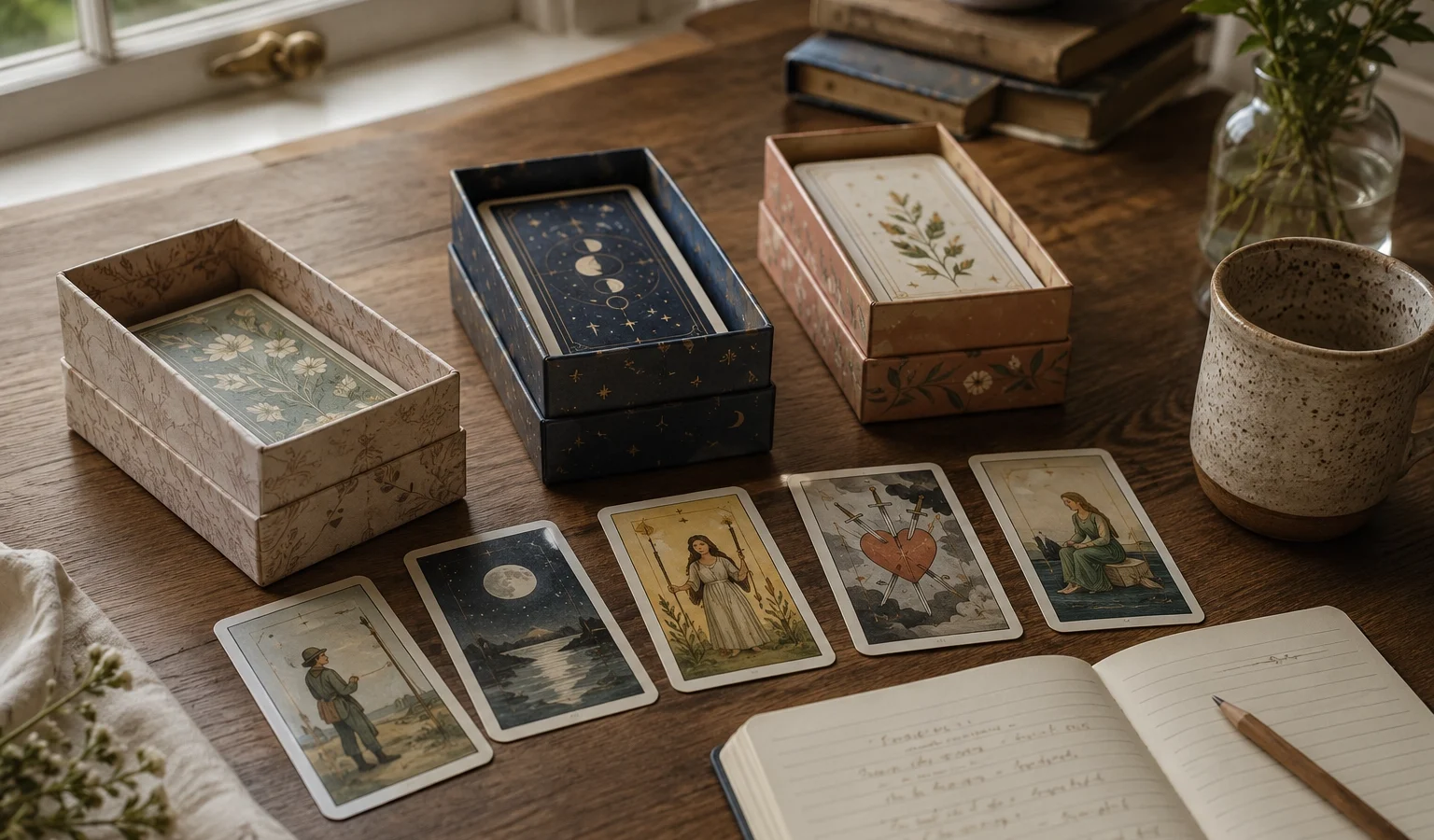
You do not have to receive it as a gift, wait for a mysterious sign or buy the oldest-looking pack in the shop.
A tarot deck is a set of cards with a visual system. The best first deck is usually the one whose imagery you can actually read, whose structure is clear enough to learn and whose physical format is comfortable enough to use.
That sounds less romantic than the idea of a destined deck.
It is also much more useful.
Start with what tarot actually is before you choose your first tarot deck
Modern tarot decks usually contain 78 cards: 22 trump or Major Arcana cards and 56 Minor Arcana cards divided into four suits.
The Victoria and Albert Museum notes that tarot began in Europe as a card game, with surviving examples from fifteenth-century Italy.
Its later association with fortune-telling and occult interpretation developed centuries afterwards.
This history matters because it reminds us that tarot has never had only one correct form or purpose. It also means you do not need to choose your first tarot deck according to one modern rule about what a beginner is supposed to buy.
Choose your first tarot deck with a familiar structure in mind
If your aim is to learn tarot from books, courses or online reference material, a deck that follows a widely recognised structure will make the process easier.
The Rider-Waite-Smith system is the obvious example.
First published in London in the early twentieth century, it was created through the collaboration of Arthur Edward Waite and artist Pamela Colman Smith.
Its influence on modern tarot design is enormous.
Pamela Colman Smith’s illustrated Minor Arcana changed how decks could be read
Earlier tarot traditions often used pip cards in which a numbered card showed repeated suit symbols rather than a full narrative scene.
In the Rider-Waite-Smith deck, Smith illustrated the numbered Minor Arcana with figures, landscapes, gestures and situations.
The V&A highlights this as one of the deck’s most important innovations.
For a beginner, those scenes provide visual clues before card meanings are memorised.
That is why Rider-Waite-Smith-style decks are often easier to learn from
Open a beginner tarot guide and you will frequently find interpretations built around Rider-Waite-Smith imagery.
If your deck follows similar compositions, colours or symbolic relationships, the explanation in the book will usually map onto the card in your hand.
This does not make Rider-Waite-Smith the only legitimate tarot. It simply makes it one of the easiest systems to use when you choose your first tarot deck and want plenty of learning material.
It makes it a common language.
You do not need the original artwork if you dislike it
Many modern decks reinterpret Rider-Waite-Smith compositions with different art styles, cultural settings, colour palettes and character designs.
If the original deck feels visually distant, another deck built on the same underlying system may be easier to connect with.
The important question is whether you can still recognise the card’s structure.
A beautiful deck is not helpful if every image has become an unrelated illustration.
Ask whether the Minor Arcana are fully illustrated
This is one of the most useful checks for a first deck.
Some tarot traditions use pip-style Minor Arcana. A Five of Cups may show five cups rather than a scene involving a figure and emotional context.
Pip decks are not inferior.
They simply require a different reading style and often more knowledge of number, suit and tradition.
Beginners who want to read visually may prefer fully illustrated cards.
Tarot de Marseille is historically important but may demand a different learning method
Marseille-style tarot is one of the major historical tarot traditions.
Its numbered Minor Arcana are generally arranged as suit symbols rather than scenic illustrations.
Readers often work more heavily with number, suit, visual rhythm and established interpretive systems.
If that appeals to you, there is no reason not to begin there.
Just choose learning material written for that tradition. If Marseille is the system that interests you, you can begin there rather than treating Rider-Waite-Smith as compulsory.
Thoth tarot is another influential system
The Thoth Tarot, associated with Aleister Crowley and artist Frieda Harris, has its own symbolic vocabulary, titles, correspondences and visual language.
Some beginners love its dense imagery.
Others find it difficult because introductory material often assumes familiarity with astrology, ceremonial magic or esoteric symbolism.
The question is not whether it is “too advanced”.
The question is whether you enjoy the kind of study it asks for. A beginner can start with the Thoth tradition, but the supporting material should suit that choice.
Choose your first tarot deck by system before decoration
A useful first question is:
Do I want to learn Rider-Waite-Smith, Marseille, Thoth or another clearly defined system?
| System | What a beginner will notice | Best fit |
|---|---|---|
| Rider-Waite-Smith | Fully illustrated Minor Arcana and abundant learning material. | Visual learners who want the broadest beginner support. |
| Tarot de Marseille | Pip-style numbered cards and greater emphasis on number and suit. | Readers interested in historical systems and structured study. |
| Thoth | Dense esoteric symbolism and a distinctive visual language. | Beginners who actively enjoy correspondences and deeper symbolic study. |
Once that is settled, compare artwork within that structure. This is usually the cleanest way to choose your first tarot deck without letting packaging or trend-driven artwork decide everything for you.
This is usually more productive than choosing entirely by colour, packaging or theme.
Artwork matters when you choose your first tarot deck
You will spend a great deal of time looking at the cards.
Choose images that hold your attention. When you choose your first tarot deck, visual readability matters more than whether the artwork looks mysterious enough.
You do not have to find every card beautiful.
In fact, a deck in which every difficult card has been softened into pleasant decoration may give you less to work with.
Tarot benefits from contrast.
A useful first deck should give you something to observe, not something you are expected to believe in on command.
Look at the difficult cards before buying
Do not judge a deck only by The Star, The Sun or The Empress.
Look at Death, The Devil, The Tower, Three of Swords, Five of Pentacles and Ten of Swords.
How does the artist handle difficulty?
Does the imagery create reflection, or does it rely on shock?
A first deck should give you enough emotional range to learn without making every challenging card feel like a threat.
Check whether the court cards are distinguishable
Pages, Knights, Queens and Kings can already be confusing for beginners.
If a deck makes the court cards visually almost identical, learning them becomes harder.
Look for clear differences in posture, setting, movement or role.
You want visual information, not four decorative portraits that could be swapped without anyone noticing.
Readability matters more than visual complexity
Some decks contain layers of astrology, Hebrew letters, alchemical symbols, plants, animals and geometric forms.
That can be rewarding.
It can also become visual noise when you are still learning the basic card sequence.
A first deck should invite attention rather than punish ignorance.
Card size matters when you choose your first tarot deck
Large cards display artwork beautifully.
They can also be awkward to shuffle if you have small hands or limited hand mobility.
Mini decks are portable but may make detailed imagery difficult to see.
If possible, check the dimensions before ordering.
A deck you avoid shuffling because it hurts your hands is not a good practical choice. Physical comfort belongs in the decision.
Card stock changes the experience
Very thick card stock can feel luxurious but become difficult to shuffle.
Very thin cards may bend quickly.
Glossy finishes can stick together under some conditions. Matte finishes may mark more easily.
There is no universally perfect card stock.
Comfort matters more than the language of “premium”.
Borderless cards are not automatically better
Some readers prefer borderless images because the art feels larger and more immersive.
Others like borders because they visually separate cards in a spread and can include titles or numbering.
For beginners, readable card names are often helpful.
Design trends should not decide for you.
Make sure the card titles are in a language you can use comfortably
A deck imported for its artwork may have titles in another language.
That can be interesting, especially if you want to learn traditional French or Italian terminology.
It can also add unnecessary friction.
When you are learning 78 cards, clarity is useful.
The guidebook matters more than many buyers expect
Some decks come with only a tiny leaflet of keywords.
Others include a substantial book explaining imagery, spreads and the creator’s interpretive choices.
If a deck departs from familiar symbolism, a good guidebook becomes especially important.
A deck should not require you to reverse-engineer the artist’s private system. A substantial guidebook gives you a clearer path into the imagery and the creator’s choices.
Do not assume every “beginner deck” is actually beginner-friendly
Marketing labels are not standards.
A deck may call itself intuitive while removing most traditional imagery.
Another may advertise simplicity while using keywords that are so vague they teach very little.
Look at several sample cards and the guidebook structure rather than relying on the word “beginner”.
You do not need a deck that represents everyone in exactly the same way
Modern tarot art often reimagines bodies, genders, families, ages, cultures and relationships.
That can make a deck feel more accessible and contemporary.
Choose imagery that allows you to think rather than forcing you to spend every reading translating a visual world that feels entirely alien.
Representation is a practical reading issue as well as an aesthetic one.
At the same time, cultural symbolism deserves context
Some decks borrow religious, Indigenous, Asian, African, Celtic or other cultural imagery very freely.
Before choosing such a deck, ask whether the creator explains the sources and context.
Aesthetic borrowing without understanding can turn complex traditions into decoration.
A thoughtful guidebook should make its influences visible.
Animal and botanical decks can work well if the system is still readable
You do not need human figures on every card.
Animals, plants and landscapes can carry narrative information effectively.
The challenge is whether the card still communicates difference between loss, conflict, growth, rest, movement and relationship.
A deck of seventy-eight equally serene woodland scenes may be beautiful and difficult to read.
Theme should support interpretation
There are tarot decks built around folklore, cats, herbs, mythology, horror, literature, architecture, fashion and almost every imaginable visual theme.
A theme is useful when it gives you additional ways to understand the cards.
It is less useful when it merely replaces familiar imagery with themed objects.
Ask whether the theme adds meaning or only branding.
Your first deck does not need to be rare
Limited editions, gilded edges and collector packaging can be enjoyable.
They are not necessary for learning.
A deck you are afraid to shuffle because it is expensive or difficult to replace may become an object you own rather than a tool you use.
For a first deck, replaceability can be an advantage.
Counterfeit decks are a real practical problem
Popular tarot decks are frequently copied and sold through marketplaces without the creator’s permission.
Counterfeits may use low-resolution artwork, unusual card sizes, poor printing and QR-code guidebooks instead of the original book.
When possible, buy from the publisher, creator or a reputable bookseller or specialist retailer.
That also supports the people who made the deck.
You do not need to wait for someone to gift you a deck
The belief that a first tarot deck must be received as a gift is a modern rule of uncertain origin.
It is not necessary for historical legitimacy or successful reading.
If you want to learn tarot, you can buy your own deck.
There is no evidence that purchasing it yourself damages the cards or your ability to use them.
You also do not need the deck to “call” to you
People sometimes describe being strongly drawn to a particular deck.
That can be a pleasant way of talking about aesthetic preference.
It does not need to become a supernatural requirement.
You are allowed to compare reviews, dimensions, artwork and price like any other object you intend to use regularly.
Try before you choose your first tarot deck if you can
A physical shop, library event, tarot study group or friend’s collection can let you handle different decks.
Notice card size, shuffle feel and how quickly you can identify images.
Online flip-through videos can also help, provided you remember that screens may alter colour and scale.
Seeing all 78 cards is much more useful than seeing the box cover. It is one of the simplest ways to make the choice on evidence rather than marketing.
Use your learning style as a guide
If you learn visually, choose strong scenes.
If you enjoy systems, you may prefer a deck with clear numerology, elemental and astrological correspondences.
If you learn through writing, choose a deck with a substantial guidebook.
If you dislike memorisation, highly illustrated Minor Arcana can reduce the initial burden.
Choose your first tarot deck for the way you plan to use it
Do you want to journal alone?
Read a daily card?
Study tarot history?
Use three-card spreads for reflection?
Your answer matters more than whether a deck is fashionable. The best choice is one matched to the kind of reading and study you actually intend to do.
A deck for reflective reading does not need to promise prediction
At Hawthorn & Key, tarot is best approached as a symbolic and reflective practice rather than a machine for guaranteed forecasts.
A useful deck should help you notice patterns, language, assumptions and possibilities.
It should not pressure you to treat every card as a fixed message about the future.
Your first deck can therefore be chosen for clarity rather than mystique.
Look for cards that generate questions
A strong image gives you something to ask.
What is happening here?
What is the figure avoiding?
Where is attention directed?
What seems stable? What seems temporary?
A first deck becomes useful when the cards lead naturally into observation.
Do not buy several decks before learning one
Tarot collecting can become a hobby in its own right.
There is nothing wrong with that.
But buying five beginner decks does not necessarily make learning faster.
One deck used repeatedly will teach you more than a shelf of decks opened once.
Give the deck time before deciding it is wrong
Some imagery makes sense only after several weeks of use.
A card that initially seems confusing may become one of the most useful once you understand the deck’s visual grammar.
Do not demand instant intimacy.
Learning a deck is partly learning how one artist thinks.
But do not force a deck you dislike
If the artwork repeatedly irritates you, the card stock is physically uncomfortable or the symbolism feels impossible to follow, choose another deck.
There is no virtue in struggling with a tool that does not suit you.
Preference is not failure.
A practical first-deck checklist
- Is it a 78-card tarot deck rather than an oracle deck?
- Which system does it follow?
- Are the Minor Arcana fully illustrated?
- Can you read the card titles easily?
- Do the difficult cards feel thoughtful rather than sensational?
- Are the cards comfortable to hold and shuffle?
- Is there a useful guidebook?
- Can you see enough sample cards before buying?
- Is the edition legitimate rather than counterfeit?
- Can you afford to use it without treating it as a fragile collectible?
A simple way to choose your first tarot deck
If you have no strong preference, the simplest way to choose your first tarot deck is to start with a standard Rider-Waite-Smith deck or a clearly Rider-Waite-Smith-based deck with fully illustrated Minor Arcana and a good guidebook.
Learn with it for several months.
Then explore Marseille, Thoth or more experimental decks once you know what you want from a different system.
This is not a rule.
It is simply the path with the most available learning support.
A Hawthorn & Key approach to how you choose your first tarot deck
At Hawthorn & Key, the way you choose your first tarot deck is less about fate than about attention.
Choose cards you can see clearly, hold comfortably and return to without feeling that you must perform a particular kind of spirituality.
Learn the deck’s history. Notice the artist. Read the guidebook. Ask questions of the images before demanding answers from them.
A deck does not need to arrive by destiny to become meaningful.
Meaning grows through use.
Sources & Further Reading
- Victoria and Albert Museum, A History of Tarot Cards.
- The Metropolitan Museum of Art, Before Fortune-Telling: The History and Structure of Tarot Cards.
- British Museum, collections relating to Rider-Waite-Smith tarot cards.
- Arthur Edward Waite, The Pictorial Key to the Tarot, read as an early twentieth-century primary source.
- Helen Farley, A Cultural History of Tarot.