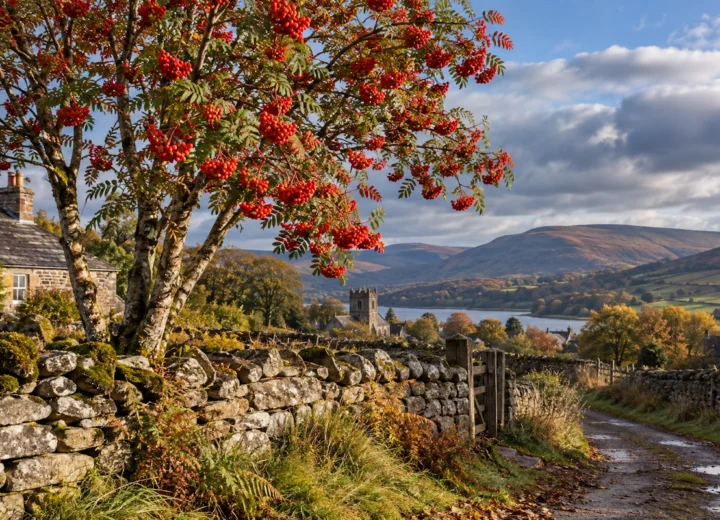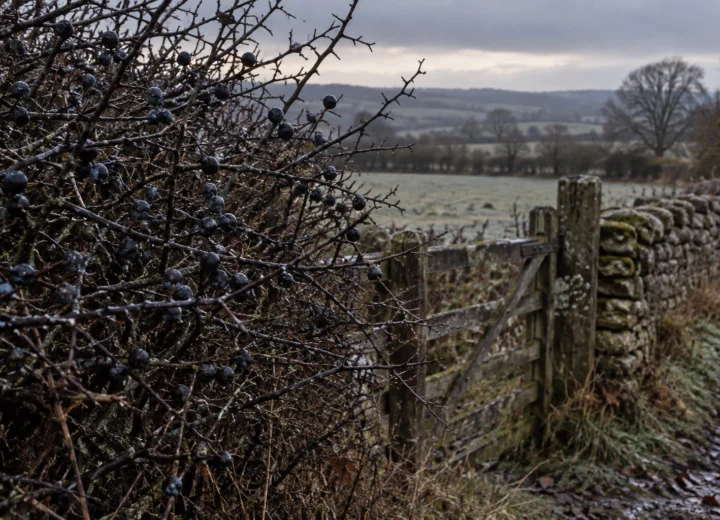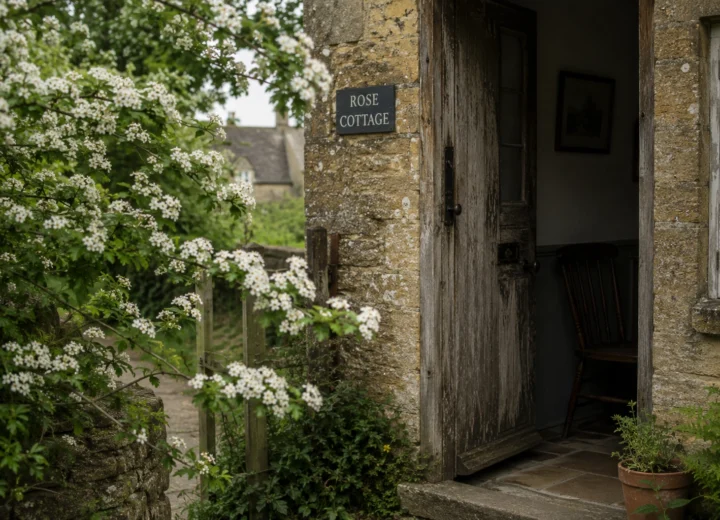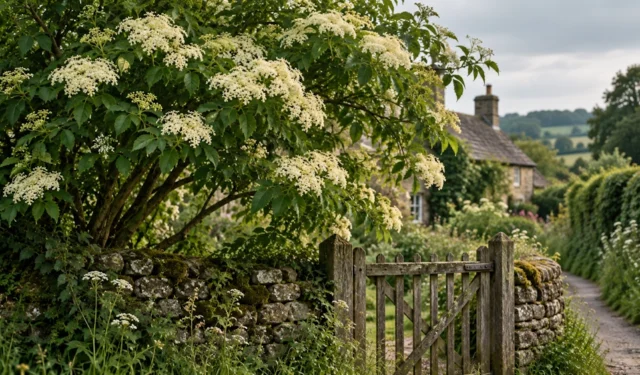
Common elder grows in hedges, woodland margins, old yards and neglected corners, often in places where gardens meet untended ground. Its pithy stems and irregular outline can look unremarkable beside an old oak or a churchyard yew. In early summer, broad heads of creamy flowers stand above the leaves; by late summer they give way to clusters of dark berries.
British and northern European sources give elder a reputation that shifts with place and use. A plant near the door might be considered protective, although burning its wood could be thought unlucky. The same household might gather flowers and berries while taking care with the branches. Stories associate elder with witches and with precautions against witchcraft, sometimes within the same regional tradition.
In many of these accounts, the question is how people approached a plant they valued and sometimes feared. Permission, avoidance and protection formed a changing set of local customs rather than one rule followed across Britain.
Elder folklore begins with an ordinary British tree
Common elder, Sambucus nigra, is widespread across Britain. Kew’s species account describes a shrub or small tree found in hedgerows, woodland, scrub, waste ground, railway embankments and graveyards. Those everyday habitats explain why elder appears so often in stories set around houses and paths.
Its compound leaves normally have five to seven leaflets. Fragrant flowers appear in late spring or early summer, and dark purple-black fruits follow later in the season. Both stages make the plant easy to notice once you know its shape.
The hedgerow and yard are part of the setting for elder folklore. This is often a plant encountered during chores and seasonal work rather than on a distant walk through ancient woodland.
Elderflowers in the kitchen
Elderflower cordial is a familiar British drink, and the scent of flowering elder has long been part of the early-summer kitchen. That domestic familiarity sits alongside the warnings preserved in traditional accounts.
Kew records drinks, fritters and other preparations made from elderflowers. Flowers attracted attention because they could be gathered and used, and the custom placed the supposedly uncanny tree squarely within ordinary household life.
Families had practical reasons to keep elder nearby. Its usefulness did not prevent stories about dangerous or disrespectful treatment from circulating.
Elderberries and the changing seasons
In late summer, the flowers give way to clusters of purple-black berries. Birds feed on the fruit, while people have traditionally used properly prepared ripe berries in preserves and drinks.
Modern writers sometimes turn the change from white blossom to dark fruit into a fixed allegory of life and death. That may be a satisfying contemporary reading, although it should not be presented as a single ancient British doctrine. Elder folklore accumulated in different local settings, often for quite practical reasons.
Food history and plant safety
The plant’s culinary history needs a careful qualification. It is unsafe to assume that every part of a familiar food plant can be eaten directly from a hedge.
Royal Horticultural Society guidance warns that elderberries should be cooked before eating and that many parts of the plant are harmful if eaten. Kew also describes cyanogenic compounds and other naturally occurring toxic constituents. Flowers have established culinary uses, but identification and suitable preparation still matter.
Traditional recipes are evidence of historical food culture, not proof that an unidentified plant or an improvised preparation is safe.
The discussion here concerns cultural history rather than instructions for foraging, cooking or treatment.
Hollow stems and everyday craft
An elder twig contains a soft pith that can be pushed out, leaving a narrow hollow tube. This made the plant useful even when nobody wanted its fruit or flowers.
Kew describes small pipes and musical instruments made in this way. The Woodland Trust’s account also records a traditional explanation of the English name, linking the hollow stems with blowing air into a fire.
Children used them for toys and simple blowpipes. The ease with which elder could be worked helps explain why a literal prohibition on every act of cutting would be hard to reconcile with its documented uses.
Why elder folklore warned against careless cutting
Older warnings are sometimes retold today as a blanket rule that elder must never be cut. The history of tools, toys and household harvests suggests a more local and conditional picture.
In many tellings, the difficulty lies in cutting without acknowledgement or permission. Such customs deserve attention as regional practices, with their dates and wording checked where records allow.
The tension between everyday use and caution makes elder folklore distinctive. The plant remained useful, but some ways of handling it were treated as matters of etiquette.
The Elder Mother and Danish tradition
The figure now commonly called the Elder Mother gives that etiquette a character. In some stories, a spirit lives in the tree and should be asked before branches are taken.
The Woodland Trust explicitly connects the Elder Tree Mother with Danish tradition, including the warning that she might trouble someone who cut without asking. Kew’s account of elder traditions discusses the protective and vengeful aspects of the spirit in a broader European context.
Later spiritual writing sometimes presents her as an ancient goddess universally known throughout Britain. The evidence is more uneven than that.
The named Elder Mother is particularly prominent in Scandinavian material; British sources also preserve warnings about cutting and burning elder. Those related ideas should not be flattened into one uninterrupted ancient belief.
Permission as local etiquette
Whether people imagined a resident spirit or repeated a customary formula, asking before cutting marked the act as something that needed acknowledgement. A useful plant could still be treated with caution.
It is difficult to reduce the practice to one motive. Fear, gratitude and inherited habit may all be involved, and the emphasis changes from source to source.
A modern reading of the custom
A modern reader might take the old custom as an invitation to consider whether a branch needs cutting at all.
That interpretation can encourage restraint and attention to a living plant. It need not depend on belief in a supernatural reply, and it should be identified as a contemporary interpretation of an inherited custom.
We cannot assume that earlier households approached elder with the vocabulary or aims of modern conservation.
The taboo against burning elder
The Woodland Trust records a striking warning in elder folklore: burning the wood was said to bring the Devil into view. The same source also records the belief that an elder planted beside a house would keep the Devil away.
Other collected versions warn against placing elder on the hearth. Such accounts are best read as evidence that the wood was regarded differently from ordinary fuel.
Can a practical explanation account for the warning?
The pith of younger stems is an observable feature, but it does not establish why the burning taboo developed. Historical people used different woods for different purposes, and the fuel preferences of one place cannot explain every version of the warning.
An explanation based on unsuitable fuel remains a hypothesis unless a particular source supports it.
A tree that both invited and repelled the Devil
For readers looking for one meaning, the paired Devil traditions are particularly awkward. The tree is considered a protection when planted, yet dangerous when burned.
It is better to ask which community repeated each warning than to invent a universal symbolic rule. Contradictory uses are common in plant lore because traditions travel, change and acquire new explanations.
| Recorded or later tradition | Context | How to interpret it |
|---|---|---|
| Asking permission before cutting | Elder Mother lore, especially associated with Denmark | A customary relationship with the tree, not evidence of a spirit |
| A tree planted by a house | Protective household belief | A recorded use of elder in domestic folklore |
| Warning against burning the wood | Stories about bad luck or the Devil | A taboo with varying explanations |
| Seeing fairies beneath elder | Midsummer tales | A seasonal folklore motif, not an observed phenomenon |
Elder folklore around houses and thresholds
Protective planting is one of the most memorable parts of elder folklore. The tree could stand by a house or near a farm entrance, a visible part of the household’s imagined protection.
British household customs often pay attention to doors, windows, chimneys and property boundaries. In that context, a tree by the entrance makes sense as a local marker of security, whether or not anyone expected it to act physically.
Protection against witchcraft
Labels such as “witch tree” can conceal different kinds of story. A plant might be described as dangerous because of its connection with witchcraft, or useful precisely because it was thought to guard against it.
For comparison, rowan folklore includes protective crosses and the use of red thread. The two plants do not share a single set of rules, but both were caught up in concerns about harm and household safety.
General statements that elder was sacred to witches often leave the most interesting questions unanswered: who used the term, where and when, and with which particular practice in mind?
The Judas legend and elder in Christian folklore
A Christian legend repeated in European folklore identifies elder as the tree from which Judas Iscariot hanged himself. This is a later association, not information supplied by the biblical text.
The story should not be treated as botanical evidence. Kew’s older cultural account questions whether elder grew in the region, but its current Plants of the World Online distribution lists Palestine within the species’ native range. Botanical range alone cannot identify a particular tree in a religious narrative.
What we can say securely is that the elder version belongs to the later history of European Christian storytelling.
Jelly ear and an old common name
The jelly ear fungus, Auricularia auricula-judae, commonly grows on dead elder wood. An older English common name, Judas’s ear, preserved the association with the hanging legend.
Here a religious story became part of natural-history language. Someone who knew the fungus by its older name could encounter the legend without reading a folklore collection.
Why graveyards changed the tree’s reputation
Kew includes graveyards among the places where elder grows. Its appearance around burial grounds made it available for stories already concerned with mortality and unease.
That association is cultural. Elder grows where conditions suit it; a graveyard setting does not supply evidence that the plant carries supernatural significance.
Elder on disturbed ground
Elder readily appears on disturbed ground, from old yards and railway edges to neglected corners of towns. Its seeds are dispersed by birds, making it a frequent and sometimes unexpected neighbour.
This habit helps explain its presence in so many ordinary places that later acquired stories.
Ideas of resilience or the crossing of boundaries are modern interpretations of its behaviour rather than meanings we can safely assign to every historical tradition.
Elder folklore at Midsummer
The Woodland Trust also records a Midsummer belief that standing beneath elder might allow someone to see fairies. The detail connects the tree to a season when its flowers are conspicuous and evenings are long.
Such stories belong to the wider tradition of imagining certain nights as times when encounters with the otherworld become possible.
The Midsummer motif gives elder folklore a seasonal setting distinct from the everyday rules about gathering branches or keeping a tree near a house.
Why the traditions cannot be combined into one doctrine
The temptation to combine all of these stories into one system is understandable. They involve the same plant, after all, and several of them share an atmosphere of caution.
Yet the Elder Mother, the Midsummer fairies, the Judas legend and the warning against burning are not all drawn from one region or one moment in history.
Keeping their individual contexts makes the plant’s varied reputation easier to understand.
Elder in the history of household remedies
Elder also has a long history as a medicinal plant. Flowers and berries appear in traditional preparations, although uses recorded in earlier medical writing are not equivalent to clinical evidence of effectiveness.
Kew describes these historical uses as well as safety limitations. Readers interested in treatment should rely on current medical guidance rather than trying to reconstruct a remedy from folklore.
Illness, misfortune and protective custom
For some earlier households, illness, misfortune and alleged witchcraft could sit uncomfortably close together. A blessing or charm might be used alongside remedies for complaints that would be approached differently today.
It is possible that elder’s medicinal reputation encouraged people to consider it protective in other settings, though the link would need to be demonstrated for any particular local custom.
Why a modest tree acquired so much lore
Elder is usually a shrub or small tree rather than a source of monumental timber. Its shoots are pithy and its branches can be brittle, yet generations of people found uses for it.
Kew explicitly cautions that elder is not a good tree to climb because of the weakness of the wood.
Its place in folklore depended on proximity and everyday experience. People noticed the elder by the gate, path or shed because they encountered it repeatedly.
How to read elder folklore today
A modern retelling may turn the old permission custom into an absolute warning that bad things will follow anyone who cuts elder without asking. That is a statement of belief, not a demonstrated consequence.
A historically careful reading records where the rule came from, how it was told and what behaviour it sought to shape. A reader may still appreciate its ethic of restraint without adopting the supernatural threat.
Observing elder without harvesting it
Before gathering from any wild plant, identification, access rights and local conservation rules matter. Elder is common, but that alone does not make every tree suitable for harvesting.
Proper handling is especially relevant to elderberries, given the risks associated with uncooked fruit and other parts of the plant.
An interested reader can learn a great deal by identifying a flowering elder and observing how it grows beside a garden or hedge, without removing anything.
A Hawthorn & Key approach to elder folklore
At Hawthorn & Key, elder folklore is best read through the plant’s ordinary life and the changing rules attached to it. Local customs were often concerned with practical choices: where a tree grew, whether its branches were cut and what happened at the household hearth.
Its flowers entered the kitchen, its hollow stems became useful objects, and its presence by a house could be considered reassuring. Elsewhere the same species acquired unsettling associations with spirits, forbidden burning or death. Those differences are part of the history worth preserving.
What survives is a body of customs that asks for context. A story about asking permission before cutting elder can be read with interest while recognising that the account tells us about people and their relationship with a familiar tree.
Sources & Further Reading
- Royal Botanic Gardens, Kew: Sambucus nigra species profile, habitat, historical uses and precautions.
- Kew Plants of the World Online: current native distribution of Sambucus nigra.
- Royal Botanic Gardens, Kew: Elder power, folklore and the Elder Mother.
- Woodland Trust: Elder, identification, uses and traditional beliefs.
- Woodland Trust: British Trees, Folklore and Mythology, including the Danish Elder Tree Mother.
- Royal Horticultural Society: How to grow Sambucus, including safety guidance for berries.
- Jacqueline Simpson and Steve Roud, A Dictionary of English Folklore (2000).
- Steve Roud, The Penguin Guide to the Superstitions of Britain and Ireland (2003).
- Roy Vickery, A Dictionary of Plant-Lore (1995).