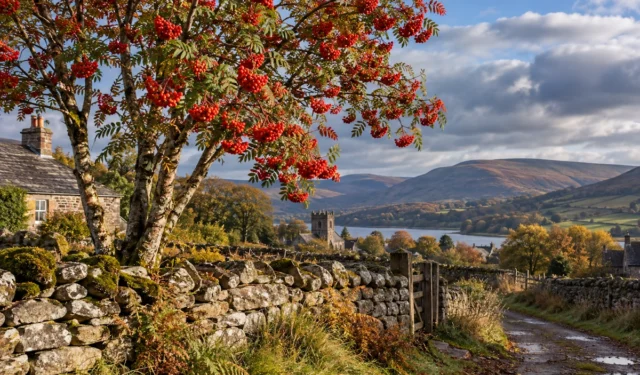
In upland Scotland, on rocky ground, at woodland edges and in gardens, those berries are difficult to miss. British tradition noticed them too. Rowan became one of the best-known protective trees in the islands, associated with houses, cattle, churchyards, pockets, red thread and small crosses used against witchcraft or other feared forms of misfortune.
Yet rowan folklore is broader than a single label. Rowan is also a mountain tree, a bird tree, a fruit tree and a familiar ornamental species. Its protective reputation was regional, practical and material: people used pieces of wood, berries and crosses in particular places and at particular times.
Rowan does not need one universal magical meaning. Its folklore is more useful when the tree, the object, the place and the recorded custom are kept distinct.
Rowan folklore begins with the real tree
Rowan, Sorbus aucuparia, is often called mountain ash, but it is not a true ash. The name comes from a superficial resemblance between the feather-shaped leaves of rowan and those of ash.
Woodland Trust describes rowan as a native tree common in the wild, especially in the Scottish Highlands, though it is also widely planted in towns, gardens and parks.
Its pinnate leaves are made up of paired leaflets with a terminal leaflet at the end. Creamy-white flowers appear in spring and develop into clusters of bright fruit later in the year.
Knowing the plant matters because rowan folklore attaches to a real species, not to a generic “magical red-berry tree”.
The berries made rowan visually memorable
Rowan’s red fruit is central to its popular image.
Woodland Trust records repeatedly connect the colour red with the tree’s protective folklore. In older European belief, red could be treated as a powerful colour against harmful enchantment, and rowan berries offered that colour naturally and abundantly.
Later explanations sometimes add the small five-pointed mark visible at the end of the berry, interpreting it as another protective sign.
Whether every historical user understood the berry in exactly that way is doubtful. What is clear is that red fruit became one of the most recognisable visual features of rowan folklore.
Rowan folklore and protection around the home
Rowan was planted near houses and farms in the hope that it would protect the people, animals and property associated with them.
Woodland Trust notes traditions of rowan near houses and, in Wales, in churchyards. Similar associations occur in Scotland, Ireland and northern England, although the details vary.
A living tree beside a house differs from a portable charm. In rowan folklore, the planted tree marks a location and becomes part of the imagined architecture of safety, even though the boundary is botanical rather than built.
Rowan crosses turned a tree into a small object
Some of the clearest material evidence for rowan folklore survives in museum collections.
The Pitt Rivers Museum holds late nineteenth-century rowan loops and crosses from northern England. Its records describe them as protective objects used against witchcraft, bad luck and other feared influences. Small crosses could be hung at doors, placed near fireplaces, attached to animals or carried by people.
The Museum of Witchcraft and Magic in Boscastle preserves related examples, including a rowan cross bound with red material and historical information about Yorkshire charms.
| Form of rowan use | Recorded setting | What the evidence supports |
|---|---|---|
| Living tree | Near houses, farms and some churchyards | A protective planting tradition in particular regions |
| Cross or loop | Doors, fireplaces, farm buildings and animals | Material charms used against witchcraft, bad luck or feared harm |
| Red-thread cross | Pockets, clothing and seasonal customs | A portable protective charm documented in several British regions |
| Wooden rod | Divination and practical folk practice | A separate use of the same species, not one universal rowan system |
These objects are especially valuable for understanding rowan folklore because they move the subject away from vague claims and towards things that can be measured, dated and compared.
Red thread became part of the object
RHS educational material records a tradition found from Scotland to Cornwall in which rowan crosses were bound with red thread and carried in pockets or sewn into coats.
The combination is easy to remember because the red thread echoes the conspicuous colour of the fruit on the living tree.
It is tempting to treat this as proof of one universal British colour doctrine. A safer interpretation is that red repeatedly appears in protective custom and became particularly well suited to rowan because the tree already produces conspicuous red fruit.
Our detailed article on rowan, red thread and protective charms examines that material tradition more closely.
May Eve, cattle and the seasonal use of rowan
Protective practices were not performed at random.
On the Isle of Man, rowan crosses were associated with May Eve and May Day protection. Pitt Rivers research records equal-armed crosses made from rowan twigs and placed over entrances or worn for protection.
Elsewhere, rowan could be placed in cattle buildings or used around livestock at seasonal moments when animals were thought especially vulnerable.
This matters because rowan folklore can depend on timing as much as material. A twig used on one night of the year is not necessarily an everyday object.
Cattle and milk were serious concerns
Modern readers can make protective folklore sound decorative, but many older practices addressed economic anxieties.
A cow that stopped giving milk, an animal that sickened or a herd that behaved strangely could threaten a household’s livelihood. In periods when misfortune was sometimes attributed to witchcraft or the evil eye, protecting livestock was not a frivolous concern.
Rowan therefore appears in traditions involving byres, cattle and milk. The tree’s protective reputation belonged partly to the working farm.
That practical setting is easy to lose when rowan folklore is reduced to a quaint cross displayed outside the working context of farms, byres and dairy production.
Thresholds, pockets and churchyards
Doors and fireplaces appear repeatedly in rowan lore because they are entrances.
A cross over a door or a loop near a hearth participates in the same broader pattern seen with horseshoes, ritual-protection marks and concealed objects: openings receive special attention.
Rowan charms brought botanical material into a broader habit of paying special attention to entrances and thresholds.
Our article on doors, windows and chimneys in folk belief places these practices within the wider history of household thresholds.
A pocket charm makes protection mobile
Rowan was not only fixed to houses or barns.
Museum records describe forked twigs, crosses and small pieces carried in pockets or sewn into clothing. Once the charm is attached to a person rather than a building, the logic changes: the protection moves with the wearer.
This is one reason rowan folklore belongs to the history of amulets as well as to the history of plants and rural custom.
For the wider context, see our article on portable folk belief and pocket charms.
Churchyards gave rowan another kind of boundary
Woodland Trust notes a Welsh tradition of planting rowan in churchyards.
A churchyard is already a culturally charged boundary: consecrated ground, burial place, village landmark and space between the living community and its dead.
A protective tree in such a place can accumulate several interpretations at once. It may be read through Christian, local or later folkloric meanings depending on the source.
It is better to preserve those layers than to declare the planting automatically pagan or magical.
Rowan folklore, landscape and ordinary uses
Rowan grows well in upland and exposed places where many larger trees struggle.
Its common name “mountain ash” reflects that association. In Scotland especially, rowan can appear as a small but conspicuous tree on rocky ground and hillsides.
Modern symbolic writing often turns this toughness into resilience or protection, adding another layer to rowan folklore.
That interpretation is understandable because the ecological fact is visible. But endurance as a symbolic meaning should still be described as interpretation rather than an ancient universal doctrine.
The fruit belongs to birds as much as to folklore
Rowan berries are an important autumn food for birds including thrushes, fieldfares, redwings and waxwings.
Birds also disperse the seeds, helping rowan appear in rocky places, woodland edges and other sites far from a parent tree.
This ecological relationship gives the tree a dynamic presence in the landscape. A rowan may seem to have appeared in an unlikely place because a bird carried the seed there.
Folklore can make such trees feel chosen or significant, while ecology gives us another explanation for how they arrived.
Rowan fruit also entered human food traditions
The berries are bitter when raw, but Woodland Trust notes that they can be cooked and used for jelly.
Food use reminds us again that a plant associated with protection was not separated from ordinary domestic life.
The same fruit could be watched for seasonal colour, gathered for the kitchen and interpreted symbolically.
Those uses do not need to validate one another. Culinary usefulness does not prove magical efficacy, and folklore does not make a food preparation medicinal.
Divining rods and other strands of rowan folklore
Woodland Trust records rowan wood among materials used for divining rods.
Divination has a long and complicated history in Britain, covering practices that range from learned astrology to popular methods for finding water, minerals, lost property or answers to personal questions.
Within rowan folklore, a divining rod therefore belongs to a different category from a protective cross, even if the same tree supplied both.
The same species can appear in several practices without those practices forming one coherent historical system.
Lightning and storms added another protective theme
Some folklore collections describe rowan as protection against lightning or storms, extending the tree’s reputation from witchcraft to natural danger.
Again, the historical point is not that rowan can physically divert lightning. The belief shows how a successful protective reputation can expand: once a plant is trusted against one kind of threat, it can be recruited against another.
This is common in amulet traditions. The same object may be credited with several forms of protection depending on the household, collector or later owner.
Dairy work kept rowan close to everyday labour
Rowan also appears in customs involving milk, churns and cattle.
When dairy production failed, historical communities could explain the problem through animal health, weather, handling or supernatural interference. Rowan wood and crosses entered that world as protective materials.
The setting matters. These were not abstract rituals performed in isolation from work. They belonged to barns, byres, milk vessels and the economic importance of healthy animals.
That practical context makes rowan folklore more human: the charm was often less about mystical curiosity than about trying to protect food, income and household stability.
Names, witchcraft and the changing reputation of rowan
Rowan has accumulated alternative names associated with witches and magical practice, alongside the more ordinary “mountain ash”.
Such names show how visible the protective and supernatural associations of rowan folklore had become.
They should not be read too literally. A “witch tree” can be a tree used against witchcraft, associated with witches, or simply described by a later collector through that language.
Folklore names often preserve that ambiguity rather than resolving it.
Protection against witches and association with witches can coexist
This is a recurring pattern in folk belief.
A plant can be strongly linked with witchcraft precisely because it is thought to resist witchcraft. Later audiences may then assume it “belongs to witches” in the opposite sense.
Rowan demonstrates why labels need context. A nineteenth-century protective loop, a modern witchcraft wand and a living rowan beside a farmhouse can all involve the same species while expressing very different relationships to magic.
Modern witchcraft and older rowan folklore
Contemporary Pagan and witchcraft practice frequently treats rowan as a protective tree and uses its wood, berries or symbolic image in ritual. Modern rowan folklore therefore includes both inherited material and newer systems of interpretation.
Unlike purely invented correspondence, this modern emphasis has substantial older folklore behind it.
What changes is the systematisation. Scattered customs from Scotland, northern England, Cornwall, the Isle of Man and elsewhere are often arranged into one coherent modern set of meanings.
That synthesis can be meaningful, but it should not erase regional history.
The red berry is now almost a logo for rowan folklore
Modern books and shops often foreground the berry because it photographs beautifully and makes the tree easy to recognise.
Museum-inspired modern charms may string dried berries with red thread or combine them with newer magical symbols.
These objects belong to a living tradition: they borrow from documented folklore while also introducing contemporary design choices.
A museum shop object made today is evidence for today’s folk-magical culture, not automatically for nineteenth-century practice.
Regional rules matter more than universal claims
Woodland Trust records a Scottish taboo against cutting down rowan, but such statements should remain geographically specific.
Rowan wood was also used for practical objects, so the species was plainly cut in many contexts.
As with hawthorn, particular trees and regional customs could receive more respect than a universal slogan suggests.
“Never cut rowan” is therefore less useful than asking where the warning was recorded and what kind of tree or situation it concerned.
Protective belief is not proof of supernatural power
Museum evidence can demonstrate that people made and carried rowan charms. Folklore collections can show that protective beliefs circulated. Tree records can document planting near houses or in churchyards. Together, these sources give rowan folklore a strong historical record without proving a supernatural mechanism.
None of those sources can demonstrate that rowan physically prevented witchcraft, bad luck or illness.
The distinction is essential to the Hawthorn & Key editorial approach: beliefs are historically real even when their supernatural mechanism is not established.
A modern garden rowan does not need to become a ritual object
Rowan remains popular as a garden and street tree because it is relatively slender, visually attractive and valuable to wildlife.
A modern reader may choose it because of family tradition, autumn colour, bird value or personal symbolism.
There is no need to turn every planted rowan into a ritual object.
Folklore can add cultural depth to a tree without dictating how it must be used.
A Hawthorn & Key approach to rowan folklore
At Hawthorn & Key, rowan folklore is compelling because it survives not only as words but as objects: loops, crosses, red thread, pocket charms and remembered planting customs.
The bright fruit makes the symbolism easy to see, but the real story is more grounded. People attached pieces of a familiar tree to doors, coats and animals at moments when they wanted reassurance against uncertain harm.
That history does not establish that the charms worked, but it does show why rowan mattered to the people who planted, carried and preserved it.
Sources & Further Reading
- Woodland Trust, rowan species profile and tree-folklore material.
- Pitt Rivers Museum, rowan loops and crosses used as protective amulets.
- Royal Horticultural Society, trees, myths and folklore, including rowan and red-thread crosses.
- Museum of Witchcraft and Magic, rowan cross collection record and related rowan charms.
- Jacqueline Simpson and Steve Roud, A Dictionary of English Folklore.
- Steve Roud, The Penguin Guide to the Superstitions of Britain and Ireland.
- Roy Vickery, A Dictionary of Plant-Lore.