The pixies of the West Country are now easy to imagine as cheerful little figures from souvenirs and children’s books, but older stories are less tidy. Pixies may dance, help with work, reward kindness or play tricks. They may also confuse travellers, interfere with butter, ride horses at night or punish someone who treats their places with contempt.
What matters most is often not their appearance but the relationship in the story: people and moorland, hospitality and mockery, confidence and disorientation.
West Country pixy lore is usually more interested in what the beings do than in fixing exactly what they look like.
Pixies of the West Country belong especially to Devon and Cornwall
Fairy traditions occur across Britain, but pixy, pixie, piskey and related forms are particularly associated with Devon, Cornwall and parts of Somerset.
This does not mean that everyone in the South West once believed in an identical race of beings with fixed rules. Regional folklore is full of local spellings, variants and changing descriptions.
The important point is cultural geography. By the nineteenth century, collectors were already treating the pixies of the West Country as a recognisable regional tradition, and modern heritage bodies continue to preserve that lore as part of the South West’s intangible culture.
Cornwall Council, for example, now explicitly includes folklore and oral tradition within its work on Cornish intangible cultural heritage. Dartmoor National Park likewise presents pixies as part of the moor’s inherited legend landscape.
| Recurring motif | What happens in the story | Grounded reading |
|---|---|---|
| Pixy-led traveller | A familiar route becomes confusing and the traveller circles or loses direction. | Regional folklore gives a personality to disorientation, mist and difficult terrain. |
| Unseen helper | Work is completed, food is prepared or farm tasks are helped along. | The story explores reciprocity, gratitude and the limits of human control. |
| Night-ridden horse | A horse is found tired, sweaty or with a tangled mane. | Ordinary signs are interpreted as traces of unseen activity. |
| Dance or enchanted place | A hillside, ring, pool or well becomes associated with pixy activity. | The story attaches memory and caution to a particular landscape feature. |
Dartmoor, mist and the experience of being pixy-led
It is difficult to separate the pixies of the West Country from landscape, and Dartmoor provides one of the clearest examples.
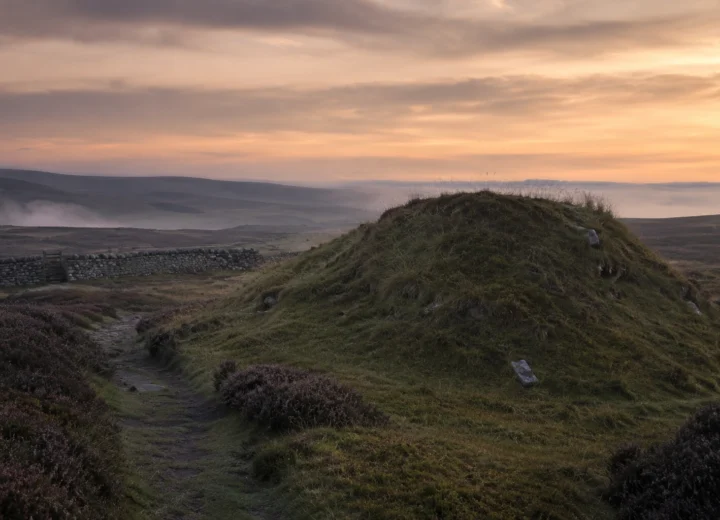
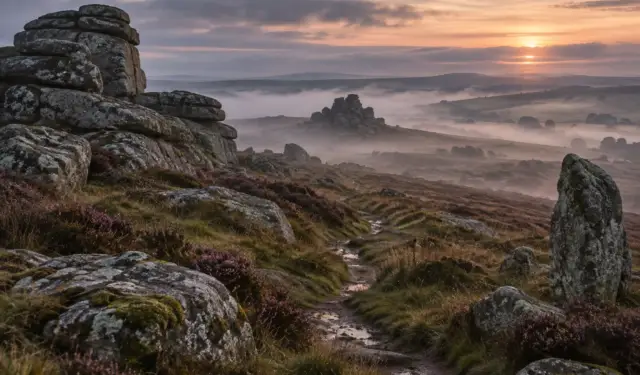
The National Park describes a landscape shaped by more than ten thousand years of human activity, with granite tors, open moor, deep valleys, prehistoric remains, old tracks and rapidly changing weather.
That landscape creates practical uncertainty. Fog can erase distance. Rough ground slows travel. Walls, streams and tors can become confusing when visibility changes.
Folklore gives that uncertainty a personality: the traveller is not merely lost but has been led. This is one of the most distinctive motifs associated with the pixies of the West Country.
What did it mean to be pixy-led?
To be pixy-led was to become confused about direction, often in a place the traveller expected to know.
William Crossing, one of Dartmoor’s most important nineteenth-century chroniclers, collected stories in which people wandered in circles and attributed the experience to pixy interference. His Tales of the Dartmoor Pixies, published in 1890, preserves the motif at a moment when traditional explanations were already being treated with both affection and scepticism.
Crossing records the familiar remedy of turning an item of clothing inside out. Yet he also recounts a case in which young travellers tried exactly this after becoming lost in dense mist and still failed to find the route until a search party reached them.
That detail is valuable. Even inside a folklore collection, the old explanation sits beside the very ordinary danger of Dartmoor weather.
Turning your clothes inside out
The inside-out garment is one of the best-known remedies for being fairy-led in British and Irish tradition.
It is tempting to explain it with a neat symbolic rule: inversion breaks enchantment because it reverses ordinary order.
That may be a useful modern interpretation, but it should not be presented as a single documented historical theory shared by all tellers.
In practice, the motif survives because it is memorable. A person who feels disoriented performs a simple reversal and hopes to reset the situation.
As folklore, it says something important about confusion: when the world feels turned around, turn something around deliberately.
Fice’s Well and a landscape that remembers being lost
Sabine Baring-Gould recorded a Dartmoor tradition attached to Fice’s Well near Princetown.
In the story, John Fitz and his wife are pixy-led on the moor. After wandering, they drink from a spring and recover their sense of direction. Fitz then marks the well in gratitude.
The stone structure and date belong to the physical history of the place; the pixy story belongs to its later narrative life.
That distinction matters. A real inscription does not prove supernatural leading. What it does show is how readily old landscape features become anchors for stories about navigation, water and rescue.
Pixies of the West Country as helpers, tricksters and punishers
The pixies of the West Country are not only misleading figures. Dartmoor National Park also preserves stories in which they act kindly.
In the tale of the bed of tulips, pixies visit the garden of a generous old woman and use the flowers as cradles for their babies. After her death, a less sympathetic successor destroys the flower bed and behaves harshly towards birds. The pixies punish his garden while honouring the old woman’s grave with flowers.
The story is not a field report about tiny beings sleeping in tulips. It is a moral tale about generosity, hospitality and the treatment of living things.
The pixies give the moral a memorable character inside the story.
Kindness is usually conditional
Like the hobs and brownies of household folklore, pixies may help people who behave well and withdraw help when curiosity or disrespect enters the relationship.
William Crossing describes pixies assisting with farm and household work: threshing, churning and cleaning. He also records the familiar rule that prying into their work may end the assistance.
This is not evidence of one universal fairy code. It is a recurring narrative pattern in stories about the pixies of the West Country.
The unseen helper is generous while independent. Once a human tries to inspect, own or control the relationship, the benefit disappears.
Mischief is more characteristic than simple evil
Pixies are often described as mischievous, but that word can hide a wide range of behaviour.
A trick may be comic: a person loses their way and arrives home late. It may be inconvenient: butter refuses to come in the churn. It may become frightening when a traveller is led towards boggy ground or night falls before they recover the path.
Older rural storytelling did not always draw a clean line between prank and danger.
The same landscape that produces an amusing story in daylight can be hazardous in fog.
Why pixy-led traveller stories endure
Getting lost can be unsettling because it is not simply a matter of not knowing where you are. It is also the discovery that your confidence about the landscape was wrong.
A familiar track no longer behaves as expected. The hill you thought was to the west appears ahead. You recognise a stone you are certain you passed half an hour ago.
That experience almost asks to be narrated as agency. Something has confused you.
Pixy-leading gives the mistake a character and a motive, which helps explain why the pixies of the West Country became so closely associated with bewilderment and lost travellers.
The moor itself should not be romanticised into danger
Dartmoor is not an empty supernatural wilderness.
The National Park emphasises that it is a deeply human landscape, shaped by farming, settlement, mining, roads, commons and ritual activity over millennia.
The idea of a timeless untouched moor can be as misleading as a literal fairy map. Stories of the pixies of the West Country belong to landscapes that were farmed, travelled, worked and named.
Pixy stories belong to people who knew, used and worked this landscape. They are not stories imported onto an empty stage.
How collectors preserved and reshaped West Country pixy lore
The Devon and Exeter Institution holds important South-West heritage collections that show how strongly nineteenth-century writers helped preserve and reshape pixy lore.
Anna Eliza Bray’s A Peep at the Pixies appeared in 1854, building on her earlier writing about Devon, the Tamar and the Tavy. The Institution notes that Bray’s work helped place Devon pixies firmly within wider British fairy imagination.
This is a useful reminder that the pixies of the West Country often reach modern readers through named collectors and authors rather than through an untouched chain of oral tradition.
They did not simply freeze oral tradition like a photograph. They selected, edited and sometimes moralised it for particular readers.
Anna Eliza Bray and folklore in print
Bray’s pixies often carry clear moral lessons. Greed, vanity and disrespect receive consequences; kindness and humility are rewarded.
That does not automatically mean the morals were invented by Victorian authors. Oral folktales had long carried social lessons.
But print can sharpen those lessons.
Once a story is written for children or a national audience, messy local variants may become cleaner narratives with clearer endings.
William Crossing’s sceptical affection
Crossing is especially useful because he can preserve a story while gently doubting its literal explanation.
In one passage he suggests that reported pixy dances seen after rural celebrations may owe something to ordinary vegetation, darkness and the “spirits” consumed by the observer.
That tone allows him to preserve the story without demanding unquestioning belief or dismissing the people who told it.
For Crossing, the story can remain culturally interesting even when an ordinary explanation is available.
Pixy places, dangerous ground and the ethics of respect
Stories of the pixies of the West Country often attach the beings to particular pools, stones, hills, wells or patches of ground.
Later retellings can turn these into a list of “fairy portals”. That language is usually much more modern than the traditions themselves.
A better reading asks what the story does for the place.
It may discourage careless behaviour. It may explain why a pool should not be polluted, why a track deserves attention or why a certain patch of ground is treated differently.
In 2025 Cornwall Council began gathering examples of living intangible heritage, explicitly including folklore and local knowledge. That modern heritage approach treats stories as part of community identity without requiring officials to authenticate supernatural claims.
Pixies and dangerous ground
Stories of misleading spirits frequently gather around moors, bogs and difficult paths.
It would be too simple to say the pixy was invented merely as a safety warning. Folklore has more than one function.
Still, the practical connection is difficult to ignore. A tale that says “people lose their way here” carries useful information even when its explanation is supernatural.
Traditional stories can encode attention without functioning like modern signage.
Devon, Cornwall and the local identity of pixies
Devon and Cornwall both have strong traditions of the pixies of the West Country, but local vocabulary and stories differ.
There is no need to choose one county as the “true” home of the creature.
West Country folklore developed through neighbouring speech communities, travel, print, collectors and shared landscape types. Stories crossed county boundaries while remaining locally distinctive.
The temptation to award an origin point usually says more about modern branding than old storytelling.
The spelling matters less than the locality
Pixie, pixy, piskey and other regional spellings appear in collections.
They should not automatically be treated as evidence for separate species.
Spelling can reflect dialect, collector preference or later standardisation. What matters more is where a story was recorded, who told it, when it entered print and what behaviour the being displays.
Why the tiny winged pixie is misleading
The modern visual image of the pixies of the West Country often owes more to illustration, fantasy and children’s culture than to early regional descriptions.
Older tales frequently care less about wings than about action.
The pixies lead, dance, churn, steal, reward, confuse or vanish. Their physical appearance may be secondary.
This is common in folklore. Behaviour is often more stable than anatomy.
Horses, dancing and the signs left by morning
Some West Country pixy stories move beyond lost travellers and household work into the farmyard itself.
Crossing records traditions in which horses were said to be ridden or troubled at night, sometimes being found tired or with tangled manes by morning. Other tales place pixies dancing on hillsides or in rings after dark.
These motifs are useful because they turn ordinary evidence into narrative clues. An exhausted horse, flattened grass or an unexplained tangle becomes a sign that something happened while people slept.
Again, the folklore should not be mistaken for veterinary or botanical explanation. Horses sweat, manes knot and grass forms circles for many ordinary reasons. What matters historically is the interpretive habit: the countryside was read as if small disturbances might be traces of unseen neighbours.
This makes the pixy less like a fantasy character and more like a way of noticing the aftermath of an event whose cause was not directly witnessed.
Pixies of the West Country in tourism and regional identity
As Devon and Cornwall became increasingly visited and represented through guidebooks, rail travel, postcards and holiday culture, the pixies of the West Country became part of the region’s public identity.
That process can soften a troublesome being into a mascot.
It can also preserve vocabulary that might otherwise fade.
Tourism keeps the pixie visible, but it can also make a varied regional tradition look more uniform and harmless than many older stories suggest.
What West Country pixy stories do with uncertainty
Many of the strongest pixy stories begin when ordinary certainty breaks down.
A traveller cannot explain the route. A churn does not behave. Work is completed without a visible worker. Flowers flourish in the wrong place. A pool or stone seems to carry a rule nobody wants to test.
Folklore does not merely answer uncertainty. In stories of the pixies of the West Country, it gives uncertainty a shape that can be remembered and retold.
A grounded way to read pixy-led stories today
There is no reason to choose between two caricatures: “pixies literally caused every lost traveller” or “the stories are worthless because mist exists”.
The ordinary explanation and the cultural story can be held apart.
Dartmoor fog is real. Navigation errors are real. The phrase pixy-led is also real as a regional way of describing bewilderment.
Understanding one does not require erasing the other.
A Hawthorn & Key approach to the pixies of the West Country
At Hawthorn & Key, the pixies of the West Country are most compelling when they remain tied to place. They belong to mist, farms, paths, wells, gardens and the stories people used to make those places memorable.
We do not need to promise that turning a coat inside out will break an enchantment. It is enough to understand why generations remembered the gesture, and why a traveller circling the same granite hollow in thick Dartmoor fog might feel that the landscape itself had begun to play a trick.
Sources & Further Reading
- Dartmoor National Park – Dartmoor Legends
- Dartmoor National Park – “The Legend of the Bed of Tulips”
- Dartmoor National Park – The Dartmoor Story
- Devon and Exeter Institution – “Pixy-Led: The Survival of Folklore in Anna Eliza Bray’s Tales”
- William Crossing, Tales of the Dartmoor Pixies (1890).
- Sabine Baring-Gould, A Book of the West: Devon (1899) and A Book of Dartmoor (1900).
- Cornwall Council – Intangible Cultural Heritage