This variety belongs to the history of the word. People in Lancashire, Yorkshire and neighbouring districts used boggart in different ways, and their stories did not always agree about what could be seen, what remained invisible or where the disturbance came from. A collector might call the being a goblin, while a local speaker might use the name for something closer to a ghost.
There is a particular pleasure in following these stories back to their places. A boggart that follows a farmer from house to house behaves quite differently from the creature once said to inhabit a secluded Manchester clough. Both, however, tell us something about the uncertainties that people attached to domestic life and familiar ground.
What was a boggart in northern folklore?
The word has often been translated as goblin, but that definition leaves out much of the evidence. Folklorist Simon Young’s The Boggart: Folklore, History, Place-names and Dialect (2022) examines printed stories, place-names, dialect and remembered speech. The material points towards a flexible northern term for solitary supernatural beings rather than one creature with a fixed body or set of habits.
Young’s research is especially useful because it looks beyond the tales most often reprinted in folklore books. A word overheard in conversation, attached to a field or remembered from a childhood warning can carry information that a polished ghost story does not. The people using it may have had little interest in deciding whether their boggart belonged to a formal class of fairies.
Accounts of boggarts in Northern England can therefore resemble stories of household spirits, animal apparitions or wandering ghosts. The resemblance does not establish that every tradition had the same origin. A useful question is what the word meant to a particular community at the time a particular account was recorded.
What Lancashire collectors recorded
John Harland and Thomas Turner Wilkinson’s Lancashire Folk-lore, published in 1867, remains one of the most accessible collections of regional material. Its contents distinguish a section on “Boggarts, Ghosts, and Haunted Places” from another on “House Boggarts, or Labouring Goblins”. The division gives a fair impression of how widely the name could travel.
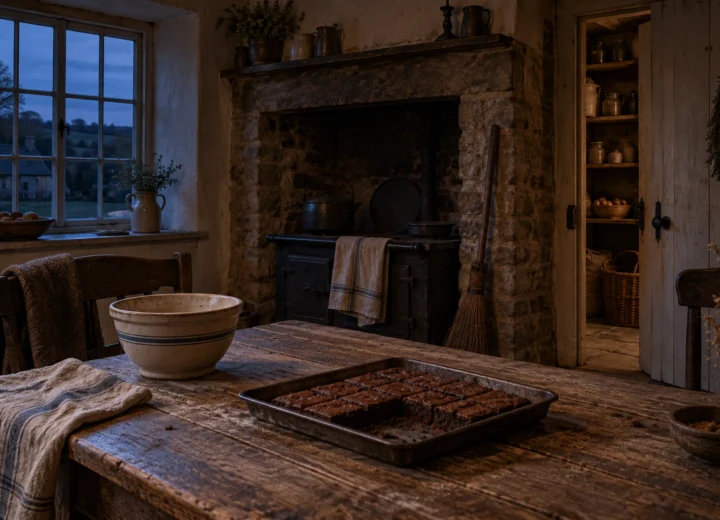
The house-boggart section describes a reputed presence at Syke Lumb Farm, near Blackburn. In a good humour, the creature was said to help with farm work. When offended, it caused trouble with milk, cream, horses and the ordinary tasks of the yard. Harland and Wilkinson recorded a tale about a working household, with livestock and stored food at the centre of the disturbance. The full 1867 collection can be read in Project Gutenberg’s edition.
These reports tell us that such stories circulated and were considered worth preserving. They do not establish that unseen creatures actually milked cows or overturned carts. The distinction matters particularly when a nineteenth-century collector writes with confidence about an incident that may have reached the page through several tellers.
Farm work made the stories recognisable
A dairy or barn depended on routines that could easily go wrong. Butter might fail to come, animals might escape, and tools or food might be misplaced. The boggart furnished a character for disturbances that were otherwise frustratingly ordinary. At the same time, a story about a helpful or offended presence offered plenty of room for arguments about carelessness, gratitude and respect.
The detail is worth retaining. A vague account of “mischief” tells us little about where the story was told. An account involving churning, fodder and horse harnesses carries the marks of working life in rural Lancashire.
House boggarts, hobs and brownies
Domestic boggarts stand close to the household beings known elsewhere as hobs or brownies. In these traditions an unseen helper may work at night, take offence at a slight or become too troublesome for the family sharing the building. The boundary between a useful servant of the household and an unwelcome nuisance can be surprisingly narrow.
The name boggart often sounds more threatening than brownie, although the behaviour overlaps. That makes the difference a matter of local vocabulary and individual stories rather than a reliable biological distinction between imagined species. Our account of hobs and brownies explores the household side of these traditions in more detail.
The boggart that refuses to be left behind
One well-known tale has a family preparing to abandon a farm because of a persistent boggart. The cart is loaded, a neighbour asks where they are going, and a voice from the belongings announces that the boggart is coming too. The household’s plan to escape collapses with the discovery that its unwelcome companion intends to move along with it.
The humour depends on a familiar problem being carried to an unreasonable conclusion. Anyone who has tried to leave an unhappy domestic arrangement behind can appreciate the discomfort of finding that it follows. The tale needs no elaborate description of the creature’s face, clothing or powers. Its voice from inside the cart is enough.
Why the details differ
Stories of boggarts moving household objects, disturbing bedding or interfering with food are not identical to stories in which a brownie demands consideration for its work. Some collectors grouped them together; others drew sharper distinctions. Boggarts in Northern England were shaped by those local choices of name and emphasis. Keeping the variation visible is more faithful to the evidence than merging every account into a standard creature profile.
When the boggart leaves the house
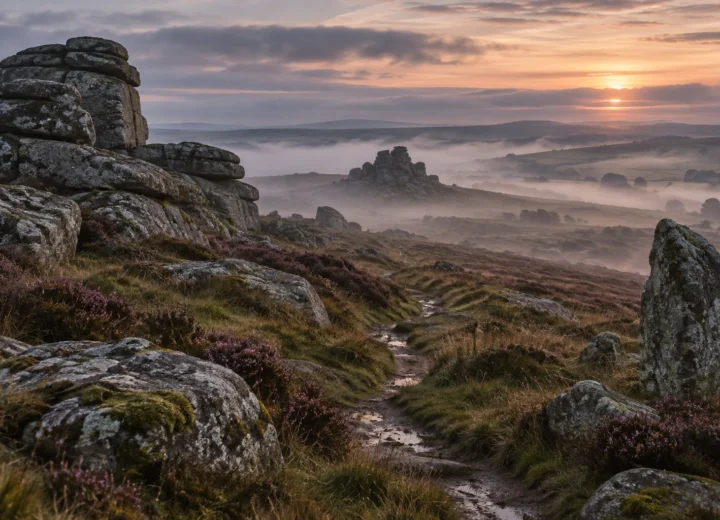
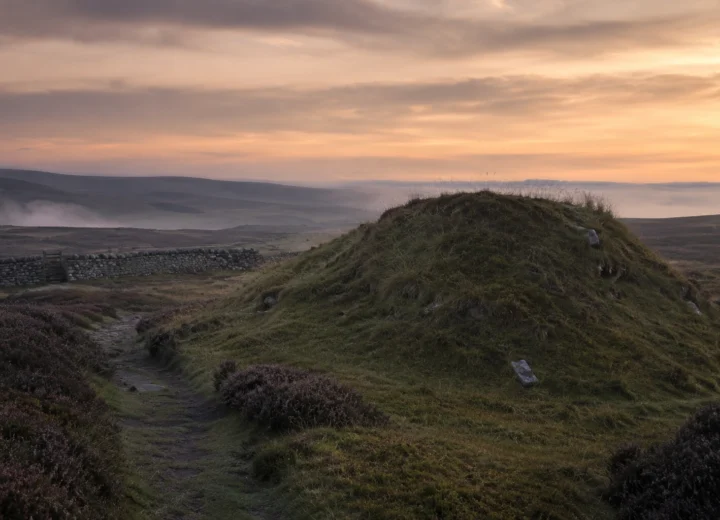
In other stories, the presence has no particular connection with domestic work. It belongs to a road, field, bridge, clough or patch of awkward ground. A traveller might encounter something strange there, or the place might already have a reputation strong enough to make people avoid it after dark.
Northern landscapes offer plenty of settings for this kind of tale. Narrow paths descend towards streams, wooded gullies conceal what lies beyond the next bend, and marshy ground can be difficult to judge in poor light. A local boggart story may draw attention to such features without preserving any single historical incident.
Where household tales are concerned with labour and relationships, place-bound tales often centre on a particular route or landmark. The presence is remembered because the location is remembered. That relationship becomes especially clear in the history of Boggart Hole Clough.
Boggart Hole Clough and the Manchester landscape
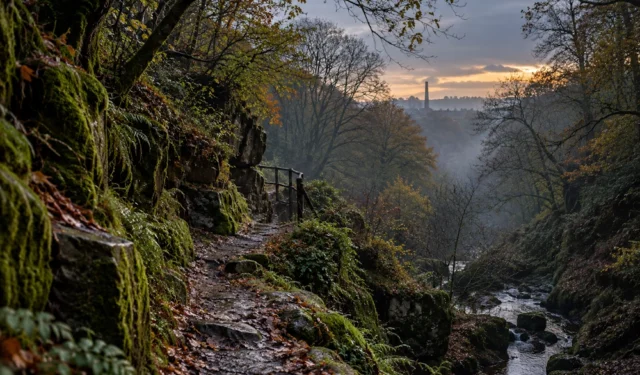
Boggart Hole Clough, in Blackley, is now part of Manchester’s public park landscape. Its wooded banks and enclosed ground preserve the sort of topography that could sustain a haunting story even as the surrounding district changed.
In Traditions of Lancashire (1829), John Roby described the clough near what was then the village of Blackley. His account imagined an uncanny presence in a dark hollow among trees and mossy stone. The description survives in a Folklore Society discussion of Dr Ceri Houlbrook’s research into the area’s supernatural reputation.
The particular scene comes to us through literary description rather than evidence for an apparition. Roby’s language helped make the place evocative to readers. Yet the location itself is real, and the name gives researchers a way to follow the tradition through maps, older publications and later local memory.
What happened when the city arrived?
The nineteenth-century countryside around Blackley was gradually absorbed into Manchester’s expanding urban landscape. Roads and houses appeared, while Boggart Hole Clough continued to be known by its old name. The former rural setting became a public place used for recreation.
Houlbrook’s study asks what becomes of a boggart when its reputed home changes around it. The question is worth asking because a place-name can survive long after the beliefs associated with it have faded or been reinterpreted. Children may learn the word from the park before hearing any of the stories that made it memorable.
For anyone interested in boggarts in Northern England, Boggart Hole Clough offers an unusually tangible example. There is a landscape to visit, an early printed account to examine and a later urban history to compare. Each belongs to the story without proving the supernatural explanation.
Did boggarts live in marshes?
Wet ground and hollows are part of the wider northern vocabulary of supernatural fear, but boggarts cannot reasonably be assigned one preferred habitat. Many of their best-known stories take place in farms and houses. Others belong to wooded gullies or roads. A boggart could also be attached to a particular name without any detailed account of its appearance.
Water-related figures such as Jenny Greenteeth and Grindylow provide useful comparisons, although they have histories of their own. A Folklore Society lecture by John Clark examines the Grindylow’s links with the dangerous marl-pits of Lancashire. Such traditions suggest ways in which frightening names could become attached to hazardous places.
That does not mean every creature story was invented as a practical warning. Some were told for pleasure, some were used to frighten children, and some persisted because a place already had a reputation. The actual origin of an individual story may be impossible to recover.
The danger of making every creature a safety lesson
It is easy to imagine a parent warning a child away from a pond by naming a monster that lived there. We should still look for evidence that a particular warning was used in that way. Local folklore can be comic, disturbing or deliberately mysterious even when a sensible explanation for the landscape exists.
Boggarts, bogeys and frightening names
Words such as bogey, bogeyman and bugbear sit near boggart in English discussions of uncanny presences. They have overlapping associations with fright and childhood warning, though the exact linguistic histories should not be flattened into one confident family tree.
A name can be powerful even without a complete narrative. A warning about a dark lane may contain no description of the creature waiting there. A child told to keep away from a clough might never hear where its boggart came from, what it ate or whether it could be seen in daylight.
Such fragments are easy for later collectors to overlook. Full legends make better reading, but ordinary speech helps explain why a supernatural word remains part of local culture. Young’s attention to dialect and remembered usage is especially useful here.
The changing shape of a boggart
Some accounts describe a boggart as animal-like, others as human or ghostly, and still others give no visible form at all. This variety poses a problem for illustrators and fantasy writers who must give a creature a recognisable design. Historical folklore had no such obligation.
Modern fiction can borrow the name and invent consistent rules for its own purposes. Those inventions deserve to be read as modern storytelling. They should not quietly replace what earlier speakers in Lancashire or Yorkshire may have meant.
What makes a boggart different from a Barghest?
Both names occur in accounts of northern supernatural beings, and their stories sometimes overlap with frightening animal appearances. The Barghest is particularly associated with Yorkshire traditions of ominous, often dog-like or shape-changing beings. Boggart was applied more broadly in the Lancashire material examined by Young and other collectors.
It is better to compare individual reports than to assume that two similar-sounding names refer to identical beings. We may find an animal apparition in each tradition, but the name, source, setting and reported behaviour still matter. The Barghest deserves its own discussion rather than being folded into a general boggart account.
How nineteenth-century collecting shaped the tradition
The materials available to modern readers owe much to writers such as Harland, Wilkinson and Roby. They recorded regional stories at a time when industrial growth, new roads and changing patterns of work were transforming northern England. Without their books, a considerable amount of local detail might be harder to trace.
Their editorial decisions also affect what survives. A collector might select an entertaining anecdote, supply a polished narrative or arrange several kinds of being under a convenient heading. Some writers explained folklore through the popular theories of their own century. The resulting books are historical sources with authors and audiences, rather than transparent recordings of beliefs that remained unchanged for hundreds of years.
A useful example appears in the very title House Boggarts, or Labouring Goblins. It offers the reader a familiar label, while the cases beneath it are more variable. Newer scholarship can compare those publications with dialect evidence, place-names and oral recollections, allowing the older material to be read with greater precision.
What the evidence can tell us
| Kind of evidence | What it can establish | What remains uncertain |
|---|---|---|
| Nineteenth-century printed tale | A story appeared in a recorded form by a particular date | How much earlier it circulated, or how much an editor changed it |
| Place-name containing boggart | The word became associated with a location | Whether a particular encounter gave the place its name |
| Dialect or childhood recollection | How a person or community used the word | Whether everyone in the district understood it alike |
| Modern fantasy depiction | How later culture has reinvented the boggart | Whether its rules reflect a specific older tradition |
There is enough evidence for a substantial history of boggarts in Northern England without requiring a single, reliable account of an apparition. The word’s regional uses are themselves worth investigating.
Why boggarts survived industrialisation
The survival of the boggart in northern memory did not depend on rural life remaining unchanged. People moved, older lanes became streets, and fields disappeared beneath expanding towns. A supernatural name could remain attached to a park or a family story even when the circumstances that made it familiar had altered.
Boggart Hole Clough shows one route through which a legend could acquire a new life. Readers of Roby imagined a secluded dell; later visitors encountered an urban park. The same name could invite different expectations in each period. It was possible to enjoy or remember the story without sharing the beliefs of earlier generations.
At the domestic level, the change may have been less visible. A boggart story could still provide a joke about an obstinate household nuisance or a useful warning about what lurked outside after dark. Humour and apprehension helped the word travel into settings very different from the farmhouse in which a collector first encountered it.
How to read a boggart story today
Start with the place and the source. Is the event said to have happened in a house, on a road or beside water? Does the boggart perform work, make noises, follow someone, appear in animal form or remain invisible? Then ask when the account was written down and whether the teller supplied the name or the collector did.
When reading about boggarts in Northern England, it also helps to watch for details that do not fit a familiar modern picture. A household helper may have little in common with a nocturnal shape on a moor, even though both were given the same regional name. The mismatch is part of the historical evidence.
At Hawthorn & Key, the most revealing boggart stories are often those that retain a recognisable place or a specific difficulty of ordinary life. A farm’s failing churn, a troublesome housemate that refuses to move out, or a hollow whose name survives the expansion of Manchester can each sustain a story without demanding belief in a single species of unseen creature.
Sources & Further Reading
- Simon Young, The Boggart: Folklore, History, Place-names and Dialect, University of Exeter Press, 2022.
- Simon Young, The Boggart Sourcebook, University of Exeter Press, 2022, companion collection of texts, names and memories.
- John Harland and Thomas Turner Wilkinson, Lancashire Folk-lore, 1867, including the sections on house boggarts and haunted places.
- The Folklore Society, The Suburban Boggart: The Survival and Revival of a Manchester Monster, presentation by Dr Ceri Houlbrook, 2022.
- The Folklore Society, Fantastic Beasts and Where to Find Them: The Search for Grindylow, presentation by John Clark, 2026.