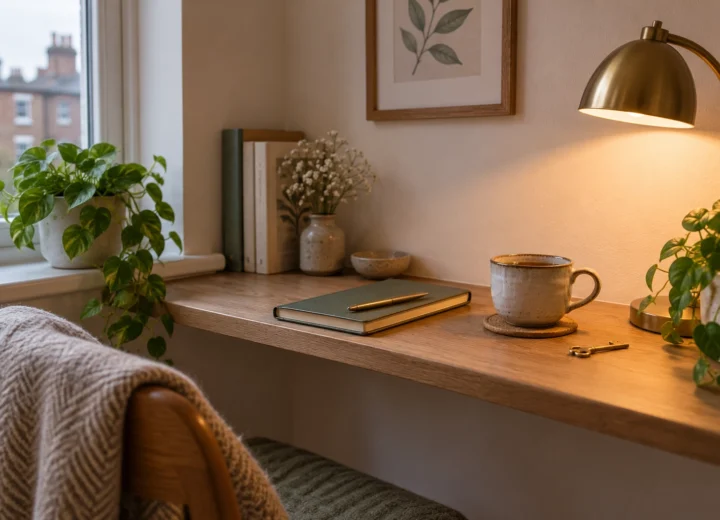
The point of an evening ritual for closing the day is to give those loose ends somewhere to go. A few ordinary actions can make the transition visible: put work away, record what genuinely needs attention tomorrow, change the lighting and settle into something quieter. There is no requirement to make the day seem more successful than it was or to arrive at bedtime in a perfect state of calm.
“That is enough for today. The unfinished things have a place to wait.”
What an evening ritual is meant to do
An evening ritual is a small sequence you choose to repeat. The repetition gives familiar actions a particular meaning. Closing a laptop is an ordinary movement; closing it after writing down tomorrow’s first task can become a recognisable signal that work has ended for now.
It is easy to spoil the idea by adding too much. If the routine requires a detailed performance review, a long journal entry and a plan for becoming a more efficient person by breakfast, it may begin to feel like another assignment. A closing ritual works best when it can be followed on a tired Tuesday, with washing up still in the sink and an imperfect day behind you.
Researchers have studied rituals in quite different contexts. Michael Norton and Francesca Gino examined ritualised actions following losses and found changes in participants’ reported grief and sense of control. Another study by Kathleen Vohs and colleagues investigated how rituals affected the enjoyment of food and drink. These studies help explain why a repeated sequence may feel meaningful, although neither establishes that an evening routine will treat insomnia or produce a guaranteed psychological effect.
Step 1: give the workday a physical ending
Begin your evening ritual with an action that can actually be finished. Shut the laptop, put papers in a drawer, clear the part of the table used for work or switch off the desk lamp. Choose something that fits your home rather than inventing a new piece of equipment to buy.
The action needs to be reasonably definite. Moving from work email to personal email may change the subject without changing the pace. Packing a notebook into a bag, however, makes the transition harder to overlook. If you work at the kitchen table, even clearing enough space to eat supper can serve as a boundary between two different uses of the same room.
When your office is also your living room
Home working makes this especially useful. You may have no door to close between the desk and the sofa, and the computer can remain in full view long after you stop using it. Covering the monitor, turning the chair away or putting the work bag out of sight offers a simple alternative to leaving a half-finished day spread across the room.
There will be evenings when something genuinely urgent needs attention. The boundary can be reopened when necessary. Its purpose is to prevent every ordinary unfinished task from claiming the same urgency.
Step 2: write down what can wait until tomorrow
One short note may be the most useful part of an evening ritual for closing the day. Use a notebook, a sheet of paper or a simple note on your phone. Record the unfinished matter and, where possible, the first action needed when you return to it. Then put the note away.
For example, “deal with the supplier” leaves a large, rather shapeless task waiting in your head. “Check the revised invoice and reply by 11 am” gives tomorrow a starting point. The intention is practical: you have made a record, so you no longer need to keep rehearsing the task merely to avoid forgetting it.
Keep the notebook from becoming a second office
If the note develops into forty minutes of scheduling, move the planning to another time. Three short entries may be plenty. Record what is unfinished, identify the next useful action and note anything that must not be forgotten. You can organise the rest when you are working again.
The evening ritual is complete when you close the notebook. You do not have to resolve every item written in it before the day is allowed to end.
Step 3: change the light and the pace of the room
Light is a particularly simple household cue. After work, turning off bright overhead lighting and switching on a shaded lamp can make a familiar room feel different. You can also close the curtains, put away the work mug or move to a quieter chair. None of these actions needs a ceremonial explanation.
Some people like a candle as part of an evening ritual. If you use one, keep it in a suitable heat-resistant holder on a stable surface, away from paper, curtains, children and pets, and extinguish it before leaving the room or going to bed. London Fire Brigade recommends flameless LED candles as a safer alternative. A lamp is perfectly adequate if you would rather avoid an open flame.
Step 4: choose an activity with its own natural ending
After putting work away, choose something that belongs to the evening rather than to the working day. Tea can be useful because making it, drinking it and washing the cup form a complete sequence. Reading for a short while, taking a shower, folding laundry with the radio on or writing a few sentences in a personal journal can work just as well.
There is no single correct activity. For someone who spends the day at a computer, a book may feel restful; for someone who has spent hours on their feet, sitting quietly may be all that is wanted. If caffeine affects your sleep, choose a caffeine-free drink rather than treating tea as a compulsory element of the evening ritual.
A small object can mark the change
You might keep a brass key on the shelf where you leave your work things, place a smooth stone beside the notebook or put tomorrow’s note into a wooden box. Such objects acquire personal meaning through use and association. There is no need to suggest that they change the room through an invisible force.
For those interested in the history and ordinary purpose of repeated symbolic actions, our guide to personal rituals looks at the subject in more detail.
How long should an evening ritual take?
A practical evening ritual might take five minutes on a difficult day or fifteen when you have more time. It does not need an elaborate timetable. The following example shows how a short closing sequence might fit together, but you can remove any step that does not suit your circumstances.
| Stage | Ordinary action | Reason to include it |
|---|---|---|
| Work ends | Put the laptop or papers away | Give the active part of the day a visible finish |
| Loose ends | Write tomorrow’s first task | Keep unfinished matters in a reliable place |
| Room changes | Switch to softer lighting | Mark a shift in the household’s pace |
| Quiet interval | Make a drink or read a few pages | Spend a little time doing something outside work |
| Close | Wash the cup or shut the book | Finish the sequence without another task |
On an exhausting evening, closing the laptop and writing one line may be enough. A useful routine leaves room for those variations.
Do not force a cheerful interpretation of a difficult day
Some days are disappointing, exhausting or simply unpleasant. An evening ritual for closing the day does not require a gratitude list, an uplifting conclusion or an attempt to discover what the experience was secretly teaching you.
There are evenings when the most accurate account is that work was difficult and tomorrow will involve dealing with the consequences. You can acknowledge that without keeping yourself on duty all night. If you find a short written conclusion helpful, record what happened in plain language and leave the detailed thinking for another time.
The three-line close
For people who prefer a little structure, a short journal entry can use these questions:
- What is finished?
- What is waiting for tomorrow?
- What do I need this evening?
Answer briefly. On one night you may want quiet and a book; on another you may need to talk to somebody or deal with a family responsibility before sitting down. The questions are prompts, not a test of how successfully you have relaxed.
What if you work shifts or have an irregular schedule?
The phrase evening ritual can be misleading for shift workers, carers and anyone whose working day ends at an unusual hour. The same idea can be used in the morning or afternoon. What matters is the transition from active obligations towards personal time or rest, not the position of the hands on a clock.
Keep the sequence suitable for the hour and your household. A bright kitchen light may be welcome after a night shift if you are preparing breakfast, while a quiet room may make more sense if you are going to sleep. You do not need to force a conventional evening scene onto a life that follows a different timetable.
An evening ritual is not a treatment for insomnia
An evening ritual may provide a satisfying end to the day, but it should not become a test that you pass only if you fall asleep quickly. Sleep problems can have different causes, and a ritual cannot diagnose or resolve them. Its purpose here is a practical and symbolic boundary around work and responsibility.
The NHS guidance on insomnia includes advice about sleep habits and explains when to seek medical help. If difficulties persist for months or affect daily life, it makes more sense to seek appropriate advice than to keep adding new rules to your evening ritual.
What if you miss your evening ritual?
Nothing needs to be made up the next day. If you return home late, feel ill or have a chaotic household evening, skip the routine or do the one part that seems useful. Repeated personal habits can be helpful without becoming obligations that make you anxious when they are interrupted.
That flexibility is especially relevant if you have turned the routine into a rigid checklist. When keeping the checklist begins to matter more than settling the day, simplify it. A closing action should be available when needed and easy to leave alone when it is not.
The place of ordinary ritual in the home
An evening ritual often grows out of objects and activities already present in the room. A familiar cup, a notebook kept in a drawer, a lamp beside the reading chair or a small cleared space on a sideboard can provide enough continuity. There is little reason to buy an entire set of decorative equipment for a routine intended to make life simpler.
Our article on seasonal shelf ideas explores the same preference for using familiar household objects and changing them carefully over time. If a quiet corner would be useful, the guide to creating a ritual corner in a small home looks at space and arrangement without requiring a dedicated room.
A Hawthorn & Key approach to closing the day
At Hawthorn & Key, an evening ritual for closing the day belongs comfortably among small domestic traditions. Closing a notebook, changing the light or washing the last cup gives an otherwise ordinary transition a recognisable shape. The custom can be personal, modest and adapted to the way a household actually functions.
There may still be unfinished work tomorrow. For tonight, it has been written down and put somewhere sensible. The room can be used for other things.
Sources & Further Reading
- Michael I. Norton and Francesca Gino (2014), Rituals Alleviate Grieving for Loved Ones, Lovers, and Lotteries. Research on rituals after loss, not a study of sleep.
- Kathleen D. Vohs, Yajin Wang, Francesca Gino and Michael I. Norton (2013), Rituals Enhance Consumption. Research on ritualised action and involvement in ordinary experiences.
- NHS, Insomnia. Guidance on persistent sleep problems and when to seek help.
- London Fire Brigade, Candles: Fire Safety at Home. Safe use of candles and flameless alternatives.