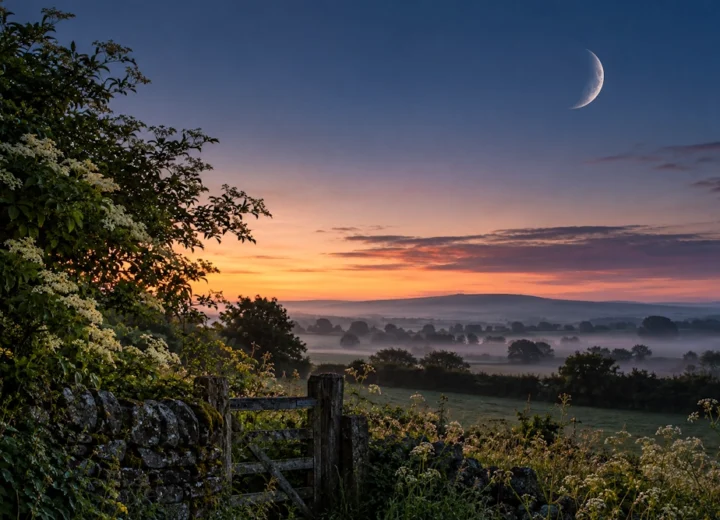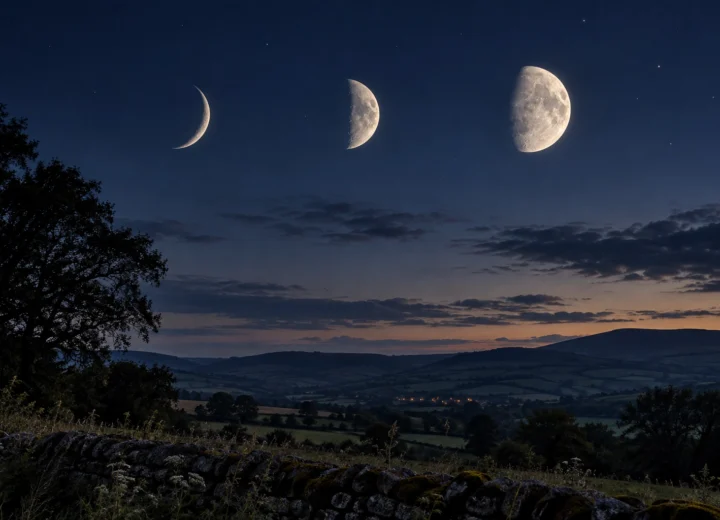
It is easy to understand why the full Moon accumulated stories. It is the most visually commanding point in the lunar cycle and one of the easiest phases to notice without planning.
Yet visibility is not the same as supernatural power. The full Moon belongs to measurable astronomy, while full Moon symbolism belongs to history, folklore, medicine, popular culture and modern personal practice. Those layers are most useful when they are kept distinct.
The full Moon can be culturally meaningful without being treated as a force that guarantees insight, abundance, disturbed behaviour or magical results.
What the full Moon is astronomically
A full Moon occurs when the Moon is on the opposite side of Earth from the Sun in our sky. The hemisphere facing Earth is then fully illuminated by sunlight.
NASA and Royal Museums Greenwich describe the full Moon as one point in the approximately 29.5-day cycle from new Moon to new Moon.
The exact full Moon is an instant rather than an entire night, although the lunar disc can look essentially full for a day or two around that moment.
A full Moon rises around sunset
Because a full Moon lies roughly opposite the Sun in the sky, it rises around sunset and sets around sunrise.
This is why it dominates a whole night in a way that a crescent does not.
A new Moon is in the daytime sky and usually invisible. A waxing crescent appears for part of the evening. A full Moon can remain conspicuous for hours.
That long period of visibility helps explain why the phase became culturally prominent.
Why a full Moon can feel unusually bright
The difference between a nearly full Moon and a full Moon can feel more dramatic than the small change in illuminated area might suggest.
Part of this comes from the way light is reflected from the lunar surface when Sun, Earth and Moon approach alignment. Shadows cast by lunar surface features become less prominent from our viewing angle, and the disc appears strikingly bright.
For a person outside at night, the practical result is obvious: full moonlight can change how much landscape is visible.
Before street lighting, moonlight mattered more
Modern cities make it easy to underestimate the practical value of a bright Moon.
Before widespread artificial lighting, moonlight could make travelling, working outdoors or returning home after dark easier. Almanacs and calendars that tracked lunar phases therefore recorded something with practical consequences as well as symbolic interest.
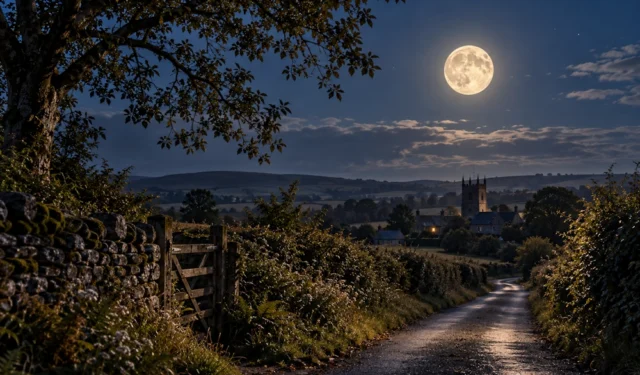
A bright full Moon over an unlit road was not merely atmospheric. It changed what a traveller could see.
Full Moon symbolism has never had only one meaning
Modern phase charts commonly reduce full Moon symbolism to words such as completion, abundance, illumination or manifestation.
Those meanings are understandable, but history offers a less tidy collection.
The full Moon has been connected with timekeeping, tides, fertility beliefs, medicine, madness, monsters, harvest, weather lore, religious observance and simple admiration.
Different periods and communities did not agree on one fixed interpretation.
| Theme | Observable basis | Cultural or symbolic reading |
|---|---|---|
| Completion | The lunar disc appears fully illuminated | Culmination, review or acknowledgement |
| Illumination | Moonlight makes the night landscape more visible | Clarity, revelation or closer attention |
| Tides | Sun, Moon and Earth alignment contributes to spring tides | Later metaphors of emotional intensity or flow |
| Behaviour and sleep | The full Moon is highly visible and culturally memorable | Long-standing beliefs exist, but research does not support one simple universal effect |
Completion has a visible basis
The fully illuminated disc naturally lends itself to ideas of culmination.
That makes culmination an obvious form of full Moon symbolism. Something that began invisibly at new Moon has become fully visible.
As a personal practice, this can support a useful question: What is now clear that was less clear two weeks ago?
The question can be worthwhile without believing that the Moon has completed the process for you.
Illumination is another obvious metaphor
Full moonlight makes the night brighter, so revelation and illumination became natural parts of full Moon symbolism.
Again, metaphor should not be confused with prediction.
A full Moon does not force secrets to emerge or guarantee sudden insight. But choosing a bright recurring night for reflection can create a deliberate moment to look at something more closely.
The metaphor is persuasive because it begins with a strong physical image.
Full Moon folklore, health and the history of lunacy
The old connection between the Moon and disturbed behaviour is preserved in language.
The English word lunatic, now rightly avoided as a description of mental illness, derives from Latin luna, the Moon. Royal Museums Greenwich notes that belief in a connection between full Moon and extremes of behaviour was historically widespread among both the public and some medical thinkers.
Older theories sometimes imagined the Moon moving the fluids of the brain as it moves the tides.
This history is important to full Moon symbolism, but it is not evidence that older medical theories were correct.
Modern research does not support a simple behaviour rule
Studies of crime, psychiatric admission and unusual behaviour have repeatedly failed to establish the simple universal pattern popular folklore predicts.
Royal Museums Greenwich summarises large analyses that found no relationship between lunar phase and psychiatric crises.
The survival of the belief tells us something about expectation and storytelling. A strange incident on a full-Moon night is memorable, which helps explain why full Moon symbolism can remain culturally strong even when a simple behavioural effect is not supported.
Sleep research is more complicated
Claims about sleep deserve a more careful answer.
Some controlled or clinical studies have reported differences in sleep around full Moon. Other larger studies have found no significant relationship, and researchers have warned that lunar-sleep results can be difficult to replicate and interpret.
The reasonable conclusion is that sleep research should remain separate from symbolic claims. Full Moon symbolism does not become biological proof simply because some studies have reported an association.
If you consistently sleep badly, medical and behavioural factors deserve more attention than a phase calendar.
Tides are real; tides of emotion are metaphor
The Moon genuinely contributes to ocean tides.
Around new and full Moon, Sun, Moon and Earth are more closely aligned, producing spring tides with a greater range between high and low water.
That physical relationship does not prove that the Moon pulls human emotions in the same way. In full Moon symbolism, emotional tides are metaphor rather than a demonstrated physical mechanism.
A coastal tide table and a mood diary describe different kinds of evidence and should not be treated as interchangeable.
Full Moon names and seasonal traditions
Modern British media regularly use names such as Wolf Moon, Pink Moon, Strawberry Moon and Beaver Moon.
Royal Museums Greenwich notes that many of the names now popular in English-language calendars derive from Native American traditions as filtered through colonial American usage and later popular culture.
They should not automatically be presented as ancient British names. Modern full Moon symbolism often mixes traditions from different places and periods.
Britain has its own seasonal and lunar traditions, but the neat twelve-name list circulated online has a more complicated cultural history.
Harvest Moon is a different kind of name
The Harvest Moon is the full Moon closest to the autumn equinox.
Its practical reputation relates partly to the timing of moonrise on successive evenings, which can provide useful early-evening light around harvest season at northern latitudes.
This makes the Harvest Moon a particularly good example of observation, seasonal work and later full Moon symbolism meeting in the same phrase.
Full Moon folklore in stories and popular culture
Popular culture now treats the full Moon as the automatic trigger for werewolf transformation.
European werewolf traditions are much older than modern cinema, but the rigid full-Moon transformation rule is heavily shaped by later literature and film. It belongs to the later history of full Moon symbolism rather than to one unchanged ancient British belief.
British folklore certainly contains shape-shifting creatures, phantom hounds and strange night beings. It is better to study those traditions on their own terms than to force every night creature into the modern Hollywood lunar timetable.
The bright Moon makes a good stage for stories
The visual conditions of moonlight also matter to the way stories are told.
Moonlight creates strong shadows, turns familiar colours pale and makes movement at the edge of vision harder to judge. A person walking at night may recognise a gatepost, tree or animal only after a few seconds of uncertainty.
That does not explain every ghost or supernatural tradition.
It does help explain why moonlit landscapes are so effective in storytelling and why full Moon symbolism remains visually persuasive.
The full Moon is also a photographic event
Modern lunar culture is shaped by cameras as much as by almanacs.
Photographers plan Moon rises behind landmarks, hills and city skylines. Long lenses make the Moon appear large relative to distant buildings, while social media amplifies dramatic images every month.
This repeated visual culture can make each full Moon feel like a special event even though full Moons occur roughly once every 29.5 days.
Quiet ways to work with full Moon symbolism
If you want to mark the phase, you can do almost nothing.
Stand outside for five minutes. Notice where the Moon rises. Look at the shadows. Write one paragraph. Make tea and sit near a window.
The point is not to create the most photogenic ritual table.
A recurring natural event can be meaningful without becoming a performance. Quiet full Moon symbolism can be as simple as using the night as a regular moment for attention.
Try a what-is-visible-now journal page
A simple full-Moon reflection can use four questions:
- What has become clearer this month?
- What has actually been completed?
- What looked important two weeks ago but matters less now?
- What needs acknowledgement before I move on?
These questions use full Moon symbolism as metaphor while keeping the answers grounded in ordinary life.
Celebration does not require claiming abundance
Full-Moon symbolism often uses the word abundance.
For some people that language is useful. For others it becomes another demand to want more.
A full Moon can instead mark enough: a meal that was cooked, a bill that was paid, a chapter that was finished, a difficult week that ended, a garden that survived the weather.
In that kind of reflection, recognition matters more than acquiring or manifesting something new.
If you use candles, ordinary fire safety still applies
A candle may make a reflective evening pleasant, but it is not made safer by being part of a ritual.
Use a stable holder, a heat-resistant surface and ordinary fire precautions. Keep flame away from dried plants, paper, curtains, children and pets. Never leave it unattended.
There is no need to burn written worries, herbs or oils in order to “release” them.
You do not need to charge objects in moonlight
Modern crystal and witchcraft communities often place stones, jewellery, Tarot decks or water in moonlight to “charge” or cleanse them.
This is a contemporary symbolic practice rather than a scientifically demonstrated transfer of lunar energy.
If an object is placed outdoors, practical concerns still apply: rain, frost, theft, animals and materials that can be damaged by moisture.
Symbolic use does not remove the need for ordinary material care.
Full Moon symbolism in modern witchcraft
Contemporary witchcraft commonly uses full Moon symbolism for culmination, divination, celebration, cleansing and heightened ritual attention.
These practices are real parts of modern culture.
They should not be described automatically as one unchanged ancient British tradition. As discussed in our guide to historical and modern witchcraft, present-day practice often combines older sources, revival, reconstruction and new invention.
The full Moon in the wider lunar cycle
Full Moon symbolism makes more sense when the phase is not isolated from the rest of the lunar cycle.
Our beginner’s guide to Moon phases places it between the waxing and waning halves of the lunation. Our guide to the waxing Moon uses gradual increase as a metaphor for effort and refinement.
Full Moon is therefore not an ending so much as a turning point. The cycle continues immediately into waning.
Do not blame the Moon for a difficult night
Expectations can influence which nights and incidents we remember most clearly.
If someone already believes that full Moon causes arguments, poor sleep or strange behaviour, events that fit the belief are likely to stand out.
Keeping a neutral diary can be revealing: record sleep, mood and unusual events without checking the lunar phase first, then compare later.
A good folklore habit is to notice how stories are made as well as what they say.
A Hawthorn & Key approach to full Moon symbolism
At Hawthorn & Key, full Moon symbolism is most interesting as a meeting point of astronomy, landscape and story.
It genuinely brightens the night, belongs to a measurable lunar cycle and helps shape tides. Around those facts, people have built medicine, fear, festival, poetry, monster stories and modern ritual.
A grounded approach does not remove the Moon’s atmosphere; it simply keeps astronomy, historical belief and personal symbolism in their proper contexts.
A bright disc above a dark hedge is already remarkable without requiring it to promise a result.
Sources & Further Reading
- Royal Museums Greenwich, “Can the Moon affect our health and behaviour?”, plus Royal Observatory material on lunar phases and full Moon dates.
- NASA Science, “Moon Phases”.
- Met Office, “Tides”, for spring tides and Sun-Moon-Earth alignment.
- Royal Museums Greenwich, “What are the names of full moons throughout the year?”, for modern popular Moon names and their cultural provenance.
- British Library medieval almanac catalogues containing lunar calculations and calendrical material.
- Scientific literature on lunar phase and sleep, including both positive findings and larger studies reporting no significant association.
- Steve Roud, The Penguin Guide to the Superstitions of Britain and Ireland, for British superstition in historical and regional context.