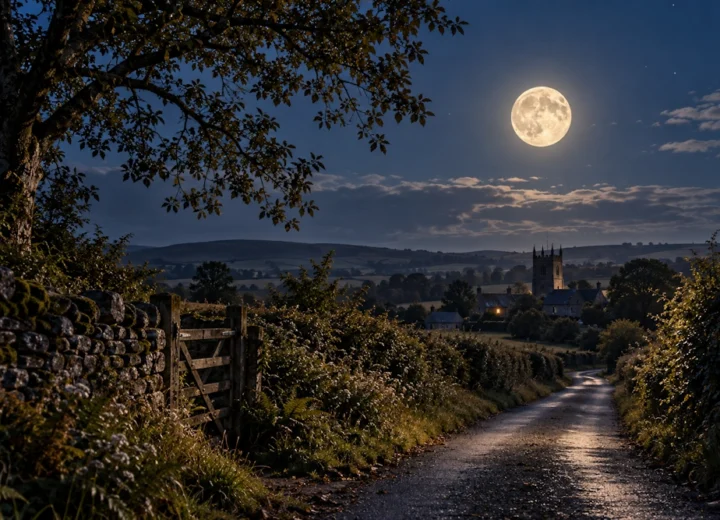
For people who enjoy observing the sky, this is a familiar part of the lunar month. In contemporary symbolic practice, it has acquired associations with finishing work, reducing commitments and making room for rest. Those associations can be appealing, especially when the diary is full and every new week seems to demand another project. They are interpretations of an astronomical event, however, rather than instructions issued by the Moon.
There is plenty to explore in the image of a gradually diminishing light. It invites a question that ordinary life rarely asks: which things would benefit from being smaller, simpler or left alone for a while?
What does the waning moon mean in astronomy?
Waning describes a decrease in the visible illuminated portion of the Moon as seen from Earth. The Moon does not physically shrink, nor does its surface become less capable of reflecting sunlight. Its changing position relative to Earth and the Sun alters how much of its sunlit hemisphere we can see. A complete cycle of phases takes approximately 29.5 days.
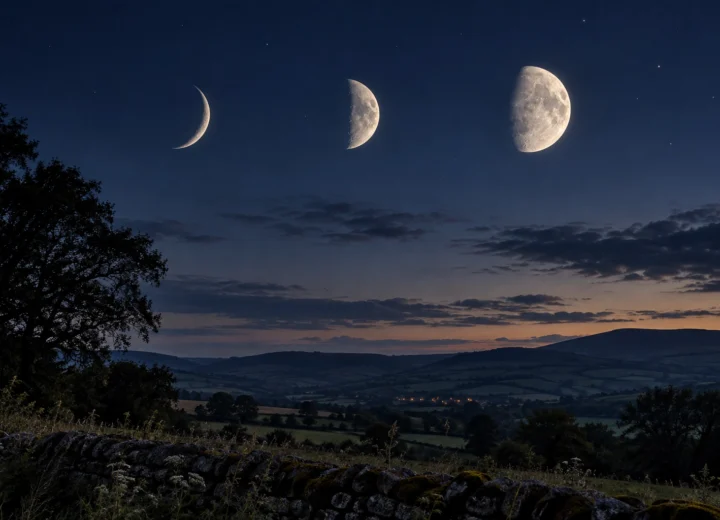
The NASA guide to lunar phases identifies three named stages between full Moon and new Moon. Royal Museums Greenwich uses the same sequence in its explanation of the lunar cycle.
| Phase | What you see | When it is commonly visible |
|---|---|---|
| Waning gibbous | More than half the disc appears illuminated, with the visible fraction decreasing | Later evening, overnight and into the morning |
| Last quarter | About half the disc appears illuminated | Rises around midnight and remains visible into daylight |
| Waning crescent | A narrowing curved sliver of light | Late night and, especially, before sunrise |
Cloud, local horizons and the time you look outside all affect whether you will notice a particular phase. A Moon that seems to have vanished from your usual evening view may simply be rising after you have gone to bed.
The days after full Moon are still bright
The change from full to waning gibbous is gradual. If you are learning to recognise lunar phases, observing the Moon on two or three consecutive nights is often more instructive than consulting a diagram. The reduction in the illuminated disc becomes easier to notice when you compare it with what you saw the previous night.
Waning gibbous and the aftermath of a busy period
Some modern moon-phase guides associate the waning gibbous stage with gratitude, sharing or reflection. Those meanings are not universal rules of British folklore. Still, the period after a peak offers a useful everyday comparison. After a wedding, exhibition, work deadline or family gathering, life does not return to normal the moment the event finishes. There are borrowed objects to return, messages to answer and loose ends to settle.
A person might use this stage as a reminder to acknowledge what went well before deciding what needs attention next. Sometimes the best response to a completed project is to file the notes and give yourself a quiet evening.
Last quarter and the usefulness of revision
The last-quarter Moon looks half illuminated, as the first-quarter Moon did earlier in the cycle. Its name refers to the Moon being roughly three quarters of the way through the lunation. As a personal metaphor, this stage suits editing: reviewing a plan, cutting a paragraph that repeats another one or deciding that a task no longer deserves the time allocated to it.
Revision is not necessarily rejection. It can preserve the parts of a piece of work that matter while removing material that has become cumbersome. The lunar phase offers a memorable occasion to undertake that work, although the improvements come from the decisions themselves.
Waning crescent and the quieter morning sky
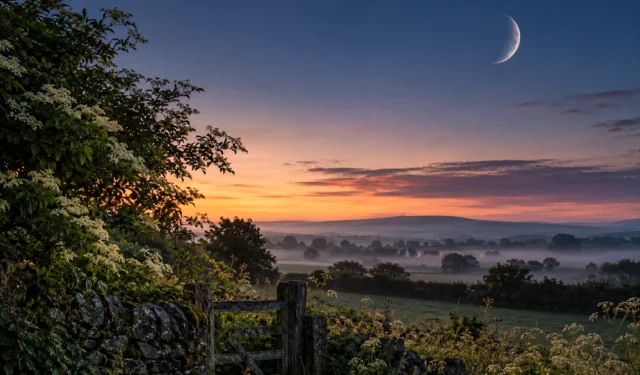
Near new Moon, the crescent becomes thin and is usually best seen low in the eastern sky before sunrise. Someone who only looks for the Moon after dinner may miss most of these final days. The change in observing time is part of the experience of following the cycle.
Modern symbolism often associates the waning crescent with rest and stillness. No astronomical condition requires anyone to become less active, but the image may provide a welcome counterweight to the belief that every spare hour should be filled with useful activity.
Does the waning moon have one traditional British meaning?
There is no good reason to describe the familiar modern equation of waning moon = banishing as a single ancient British rule. Historical communities used lunar calendars in different ways, including the timing of agricultural work, medical or astrological practices and the calculation of religious dates. Customs differed by period, region and source.
The British Library’s catalogue entry for Harley MS 2332, an illustrated early fifteenth-century almanac, describes lunar-eclipse diagrams, a zodiacal chart and tables linking the Moon with astrological and prognostic traditions. The manuscript is valuable evidence that people paid close attention to lunar calculation and the meanings assigned to celestial movements. It cannot establish that a single contemporary system of release rituals existed throughout Britain.
Current associations with letting go, removing unwanted influences or cleansing a home belong to living symbolic and ritual traditions. They may draw on older ideas, but each claim of historical continuity needs evidence of its own. A modern practice can be meaningful to its participants without requiring a fabricated ancient pedigree.
What could release mean in ordinary life?
Release is an attractive word because it suggests relief. It is also imprecise. Writing “I release stress” in a notebook may express an intention, but it cannot by itself solve a difficult workload, an unpaid bill or a conflict with someone close to you. A practical version of the idea begins by identifying what can actually change.
During a waning moon period, you might cancel a commitment that has outlived its usefulness, unsubscribe from a mailing list you never read, return something you borrowed or finish a small task that has been occupying more mental space than it deserves. None of these actions depends on lunar influence. The phase simply provides a recurring date on which to reconsider the small burdens that accumulate.
There is room for judgement. Some obligations are inconvenient yet necessary, while others can safely be reduced. The point is to consider the difference rather than to remove things indiscriminately.
Reducing a workload without losing what matters
People who write, garden or make things know that subtraction can be part of caring for a project. A gardener prunes for the health and shape of a plant. An editor cuts a repetitive passage so that the useful observation can be read without interruption. A household clears an overloaded shelf because the objects on it deserve to be accessible.
That is a helpful way to approach waning moon symbolism. A modest reduction might improve something already worth keeping. It need not become an elaborate exercise in declaring what is “negative” or imagining that a ritual has erased an underlying difficulty.
Choose something small enough to finish. The drawer where receipts accumulate, an overcomplicated schedule or a draft with several unnecessary paragraphs is a more manageable beginning than a demand to transform your entire life before the next new Moon.
Rest, grief and the limits of letting go
Some experiences cannot be tidied away. Grief, long-term illness, trauma and complicated family relationships do not become manageable simply because a calendar invites a person to release them. Applying the language of decluttering to emotional pain can add pressure to an already difficult situation.
For someone going through a hard period, a quiet personal ritual might mean leaving the problem alone for one evening, keeping a brief journal or allowing a memory to exist without trying to correct the feeling that accompanies it. Other people may prefer no ritual at all. There is no deadline set by the lunar month.
Rest needs no certificate of completion. A person can finish the working day while several jobs remain unfinished. The waning moon provides a gentle image of decrease, but the permission to rest is a decision that can be made on any date.
A ten-minute waning moon reset
If you like small, repeatable practices, a ten-minute reset is enough. Use a desk, kitchen counter, bag or inbox. Choose a place that is within your control, and resist the temptation to turn a brief exercise into a full household overhaul.
- Look at the chosen space and identify what is genuinely out of place.
- Remove rubbish and return items that already have a proper home.
- Choose one unnecessary object, pending task or duplicated item that can be dealt with safely.
- Stop after ten minutes, even if there is more you could do.
The stopping point is part of the practice. It prevents the idea of release from becoming another demand for productivity. You may have cleared very little, but the change is real and visible.
A short journal page
Some people prefer words to physical tidying. An ordinary notebook works perfectly well. Consider what has finished, what still needs a final action, what you can stop carrying and what deserves to remain. One paragraph is plenty if you have no appetite for a longer session.
Looking back over several months may reveal the tasks you repeatedly postpone or the commitments you habitually accept without checking your capacity. That observation is useful because it concerns your own behaviour, not because the Moon has diagnosed a hidden problem.
Habits and difficult decisions need more than symbolism
Waning-Moon guides often recommend the phase for breaking habits. A regular monthly reminder can be useful for a modest change, such as reducing an unwanted subscription or putting your telephone away earlier in the evening. More serious problems require a different level of care.
Dependence on alcohol or nicotine, eating disorders, self-harm and other health concerns should not be treated through lunar rituals in place of appropriate professional help. Someone may choose a symbolic act alongside an evidence-based plan, but the symbolism is not the treatment.
Relationships require similar caution. Writing someone’s name on paper or imagining that an influence has been “banished” does not communicate a boundary or resolve a dispute. Sometimes the necessary work is a difficult conversation, a practical arrangement or advice from someone qualified to help with a legal or safeguarding problem.
Clearing the house without smoke or ceremony
Modern ritual culture frequently links the waning moon with household cleansing. The ordinary version of that practice can be straightforward: change the bedding, clean a neglected surface, empty a bin, return borrowed things or put away objects that have drifted onto the dining table.
Incense and burning herbs are optional, not a requirement for a room to feel different. Smoke can irritate airways, disturb pets, trigger alarms and create a fire risk. An open window, where conditions allow, and a little cleaning can be more comfortable than filling a small room with scented smoke.
Afterwards, the room may feel calmer because the environment has changed and the task is complete. There is no need to make an additional claim about invisible substances being removed.
The value of spending less
There is a pleasantly practical use for the idea of reduction. When the lunar cycle enters its waning half, you might review an automatic payment, wait before buying something on impulse or repair an object you already own. This is particularly useful if buying symbolic or ritual objects has begun to feel like another obligation.
It would be contradictory to treat a month dedicated to simplification as a reason to purchase an entire collection of specialised supplies. A notebook, a cleared table or a short walk costs little, and none of them is necessary to enjoy the sky.
How to observe the waning moon
The simplest way to become familiar with the phase is to look at it. After full Moon, try going outside later in the evening and notice where the Moon is rising. Around last quarter, you may see it during the morning. In the final crescent days, an unobstructed eastern horizon before sunrise can be helpful.
NASA’s Moon Phase and Libration, 2026 gives visual examples and the usual observing periods for each phase. You can compare its diagrams with what you see from your own window or garden, allowing for clouds and the changing geometry of your local sky.
Observation is valuable in itself. It is easy to lose track of a phase when its most convenient viewing hours shift. Following that change makes the lunar cycle feel less like a row of decorative icons and more like an event happening above an ordinary neighbourhood.
The waning moon in contemporary witchcraft
In present-day witchcraft and other personal symbolic practices, waning phases are often associated with protection, banishing, reduction, ending patterns and cleansing. These correspondences form part of modern practice, although practitioners may interpret them differently.
Historical British lunar beliefs are more varied than the neat diagrams found in many recent guides. A tradition does not become invalid merely because some of its present form is recent; it does, however, deserve an accurate description. When we call an association modern, we leave room to investigate older sources without assuming that every century followed the same rules.
Someone may mark the waning moon with a few minutes of reflection and find the exercise personally meaningful. Someone else may appreciate the changing crescent for its appearance alone. Neither response needs to be defended through claims about supernatural results.
What should go, and what deserves to stay?
Reduction works best when it is selective. There is little benefit in throwing away something useful simply to satisfy the theme of a lunar phase. Nor is there any need to break a valued habit because a chart says the time has come to end something.
One practical pair of questions is enough: what no longer deserves this space or attention, and what would I like to protect? The answers can be surprisingly modest. A spare evening may be worth keeping. A duplicate appointment may be worth cancelling. A half-finished letter may deserve completion rather than disposal.
That balance helps prevent “letting go” from becoming a fashionable term for avoiding responsibility. Good editing requires care for the material left on the page.
A Hawthorn & Key approach to the waning moon
At Hawthorn & Key, the waning Moon is most interesting when its astronomy and its symbolism are allowed to sit comfortably beside one another. The illuminated disc becomes smaller from our viewpoint as the cycle moves towards new Moon. People can use that familiar pattern as a reminder to finish a task, simplify a room or spend an evening resting.
The image offers a different rhythm from constant expansion. It does not demand a dramatic farewell or a ceremony every month. Sometimes it is enough to look at the shrinking crescent, put away what you have finished and leave tomorrow’s work for tomorrow.
Sources & Further Reading
- NASA Science, Moon Phases, for the physical sequence and visibility of lunar phases.
- NASA Scientific Visualization Studio, Moon Phase and Libration, 2026, for the observing times and appearance of each phase.
- Royal Museums Greenwich, What are the names of full moons throughout the year?, including an explanation of the eight lunar phases.
- British Library, Harley MS 2332: Illustrated Almanac, an early fifteenth-century manuscript containing lunar and astronomical material.
- Steve Roud, The Penguin Guide to the Superstitions of Britain and Ireland, for historical British folk-belief context.