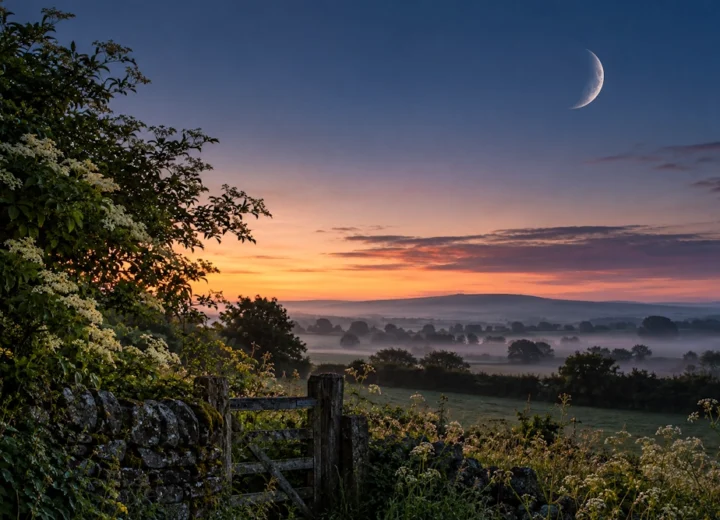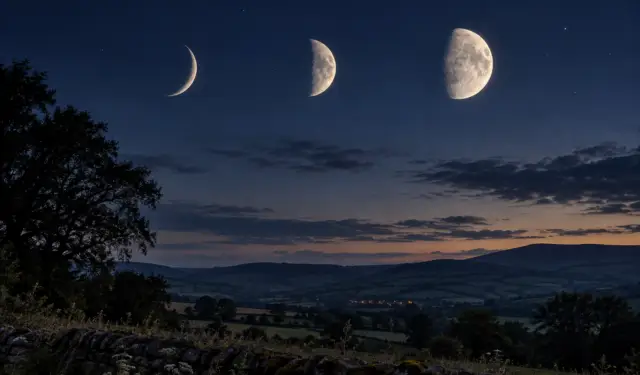
After new Moon, the illuminated portion visible from Earth gradually increases. A thin crescent becomes a half-lit first-quarter Moon, then a broad waxing gibbous disc, and eventually a full Moon. The process takes roughly half of the 29.5-day lunation.
Because the visible light appears to grow night by night, modern symbolic practice often associates the waxing Moon with growth, effort, building and momentum. This is the most common waxing Moon meaning in contemporary practice. What deserves more care is the leap from metaphor to promise.
The Moon can provide a useful picture of gradual development. It does not guarantee that a project, relationship or bank balance will grow simply because the illuminated lunar disc is doing so.
The useful part of waxing symbolism is the image of gradual change, not a promise that the Moon will produce the result for us.
What does waxing mean?
In astronomy, waxing means that the visible illuminated portion of the Moon is increasing. Any discussion of waxing Moon meaning is clearer when that physical definition comes first.
The term covers several familiar phases:
- waxing crescent;
- first quarter;
- waxing gibbous.
The sequence ends at full Moon.
| Waxing stage | What you see | Grounded symbolic use |
|---|---|---|
| Waxing crescent | A thin illuminated crescent growing after new Moon | Beginning, first visible action, early commitment |
| First quarter | Half of the visible lunar disc appears illuminated | Effort, friction, adjustment and practical obstacles |
| Waxing gibbous | More than half appears illuminated as full Moon approaches | Refinement, checking, editing and preparation |
NASA and Royal Museums Greenwich describe the changing appearance as the result of the Moon’s orbit and our changing view of its sunlit half. Nothing is being added to the Moon itself. We are seeing more of the illuminated hemisphere.
The waxing Moon begins after new Moon
At astronomical new Moon, the Moon is normally invisible because its illuminated side faces mostly away from Earth and the Moon lies in roughly the same direction as the Sun.
As it moves eastward in its orbit, a slim crescent becomes visible in the evening sky. Over successive nights, that crescent thickens.
Our article on new-Moon symbolism and simple rituals treats the new Moon as a possible moment for deciding what deserves attention. The waxing period is the natural place to ask what happens after the decision.
Waxing Moon meaning and the idea of gradual growth
Popular spiritual content often presents the waxing Moon as an energetic upward arrow: start, attract, expand, manifest.
The actual pace of the lunar cycle is slower.
A waxing crescent does not become full overnight. The visible change from one evening to the next is modest. Weather may hide it. Buildings may block the view. Some nights the progress is easier to notice by comparing photographs than by relying on memory.
That makes waxing Moon meaning more convincing as a metaphor for accumulation than for sudden transformation.
The thin crescent: a beginning that has become visible
The first crescent after new Moon is delicate. It can disappear into cloud or twilight, but it is unmistakably there when conditions are right.
Symbolically, this suits the stage when an intention has become an action.
A person who wants to read more has opened the book. Someone who wants to improve a garden has cleared one bed. A business idea has become a page of notes. A difficult conversation has been scheduled.
None of these actions guarantees completion. They simply make the beginning visible.
First quarter: when effort becomes obvious
At first quarter, the Moon appears half illuminated from Earth, even though the name refers to the Moon being roughly one quarter of the way through its phase cycle.
This point is often given dramatic symbolic language about obstacles or decisive action.
A quieter interpretation is practical: after a week or so, the easy excitement of beginning may be wearing off. The work has acquired friction.
That makes first quarter a good moment to ask what is actually blocking progress.
Waxing gibbous is not simply almost done
As the Moon moves beyond first quarter, more than half of its visible face is illuminated. This is the waxing gibbous phase.
The shape can look close to full, but several days remain before full Moon.
As a metaphor, that is useful. A project can look nearly finished while still needing careful work. The final portion may involve editing, testing, cleaning, checking facts or asking another person to review what has been done.
Growth can also involve correction, editing and removal.
There is no single ancient British waxing-Moon ritual
Medieval and early modern people in Britain paid close attention to lunar timing. British Library almanacs contain tables for lunar age, conjunctions, eclipses and other calculations, sometimes alongside astrological, agricultural and medical material.
That historical evidence should not be flattened into a claim that people across Britain followed the same modern formula of “waxing Moon for attraction and abundance”.
Different periods used different systems, and the boundary between astronomy and astrology was not drawn where it is today.
Modern waxing Moon meaning is clearer when it is allowed to be modern rather than given an invented ancient pedigree.
Why growth became the obvious modern metaphor
The modern waxing Moon meaning of growth does not require a secret tradition.
The illuminated Moon is visibly increasing.
Human beings regularly turn visible natural processes into metaphor. Spring becomes renewal. A seed becomes potential. A doorway becomes transition. A rising tide becomes momentum.
The waxing Moon belongs to the same imaginative habit.
Its power as a symbol comes from recognisable change, not from proof that the phase causes growth in unrelated parts of life.
A practical way to use waxing Moon meaning
If you use waxing Moon meaning as a reflective framework, choose something that can be observed rather than vaguely wished for.
For example:
- write 300 words;
- walk for twenty minutes;
- save a fixed amount;
- send one application;
- repair one object;
- practise an instrument for fifteen minutes;
- clear one drawer;
- read one chapter.
These actions are small enough to happen without the Moon doing any work on your behalf.
Do not turn growth into constant expansion
There is a commercial version of lunar symbolism in which every waxing phase becomes a reason to acquire more: more money, more clients, more possessions, more followers, more products, more “energy”.
Growth does not have to mean enlargement.
A skill can grow while a schedule becomes simpler. Confidence can grow while spending decreases. A garden can mature because fewer plants are crowded into it. A friendship can deepen without becoming more public.
Waxing Moon meaning becomes more useful when growth means development rather than simple accumulation.
Growth includes maintenance
Plants do not grow because they are repeatedly told to grow. They grow within conditions: light, water, soil, temperature, genetics and time.
Human projects also depend on conditions.
A waxing-Moon journal entry might therefore ask not “How can I attract success?” but “What conditions would make this easier to continue?”
The answer might be sleep, a quieter workspace, a realistic budget, fewer commitments, better information or help from someone with more experience.
Momentum can be gentle
The word momentum often sounds like speed.
The waxing Moon meaning explored here offers another image: steady change that does not hurry.
The lunar disc follows its cycle whether anyone is watching. The change continues whether anyone notices it or not, and a small difference from one evening to the next is normal.
For people tired of productivity language, this may be the most useful aspect of waxing symbolism.
Three check-ins across the waxing Moon
Waxing crescent
When the first crescent is visible, ask three questions:
- What did I say I wanted to begin?
- What is the smallest visible sign that I have begun it?
- What is the next action?
If the answer to the second question is “nothing yet”, that is information rather than a spiritual failure.
You can begin now, revise the intention or let it go.
First quarter
Near first quarter, the questions can change:
- What is harder than I expected?
- Is the obstacle practical, emotional or simply lack of time?
- What can be simplified?
- Do I still want the original goal?
The last question matters.
Not every abandoned plan needs to be rescued. Persistence is not automatically wisdom.
Waxing gibbous
As the Moon approaches full, turn from starting to refining:
- What needs checking?
- What can be edited?
- Who should see this before it is finished?
- What am I pretending is complete because I am tired of it?
This version of “growth” includes quality.
You do not have to track every night
A lunar journal can become strangely demanding if every change in illumination requires a new page, card pull or ritual.
For most people, three observations across the waxing half of the cycle are more sustainable than daily performance.
There is no need to turn the phase into a daily obligation. Notice it when it is useful or simply when the sky draws your attention.
Clouds do not interrupt the phase
British weather quickly exposes the limits of any lunar practice that depends on perfect visibility.
A week of cloud can hide much of the waxing sequence. The Moon continues through its orbit anyway.
If a symbolic practice depends on perfect visibility every evening, it will quickly become frustrating in much of Britain.
Use an astronomy calendar when needed, and treat direct observation as a pleasure rather than a requirement.
Waxing Moon meaning in modern magic and divination
In modern witchcraft, waxing Moon meaning often includes attraction, increase, confidence, prosperity and constructive spellwork.
These correspondences are real as contemporary practice. They are not evidence that the phase guarantees those outcomes.
The distinction matters particularly where money, health or relationships are involved. A symbolic ritual may accompany practical action, but it should not replace it.
As our article on historical and modern witchcraft notes, contemporary systems often combine older fragments with newer structures.
Waxing Moon and divination
Some people use Tarot or other divinatory tools during the waxing period to ask what should be developed.
A grounded approach treats the result as material for thought rather than an instruction that cannot be questioned. Here, waxing Moon meaning provides a theme for reflection, not an external command.
Britain’s long history of divinatory practice is much broader than the modern Moon-Tarot pairing, as explored in our guide to divination before the modern Tarot boom.
Historical depth and modern personal use can coexist without being confused.
The waxing Moon cannot choose the right goal for you
Growth is not automatically good.
An unhealthy workload can grow. Debt can grow. Resentment can grow. An invasive plant can grow beautifully.
So the symbolic question should never be only “What do I want more of?”
A better question is “What is worth developing?”
One practical waxing-Moon journal page
If you want a single reusable journal format, try this:
- What is growing? Describe the current situation.
- What is helping? Name the conditions that support it.
- What is getting in the way? Be concrete.
- What is the next small action? Choose one.
- What does not need to grow? Leave something out.
The final question prevents the exercise from becoming a demand for constant expansion.
A Hawthorn & Key approach to waxing Moon meaning
At Hawthorn & Key, waxing Moon meaning is less interesting as a promise of abundance than as a visible lesson in gradual change.
The astronomy is simple: more of the sunlit lunar face becomes visible as the Moon moves from new towards full. The symbolic possibilities are human: beginning, effort, adjustment, refinement and patient growth.
Used calmly, the waxing cycle can mark the difference between wanting something and giving it conditions in which to develop.
That is meaningful enough without asking the Moon to guarantee the result.
Sources & Further Reading
- NASA Science, “Moon Phases”, for the sequence and physical explanation of waxing phases.
- Royal Museums Greenwich, Royal Observatory material on lunar phases.
- NASA Jet Propulsion Laboratory Education, “Look at the Moon! Journaling Project”.
- British Library, Harley MS 2332, an illustrated medieval almanac containing lunar eclipse diagrams, calendrical material and lunar-zodiacal correspondences.