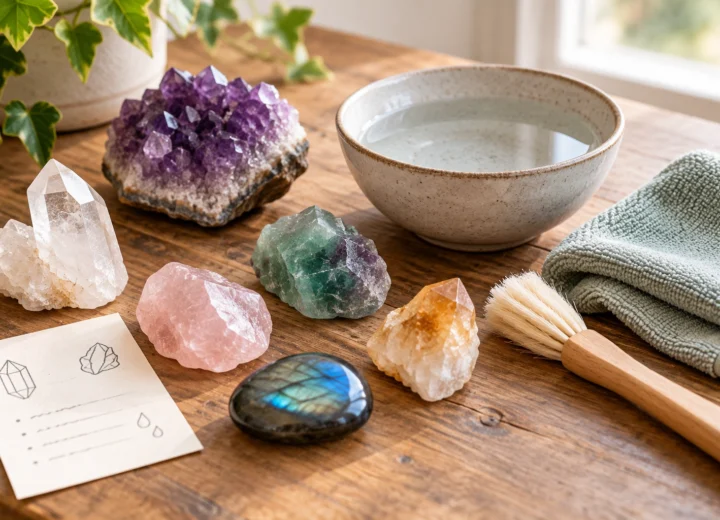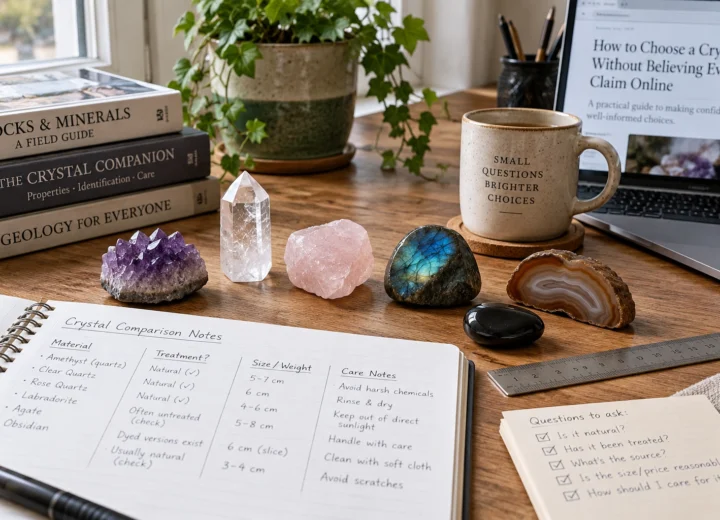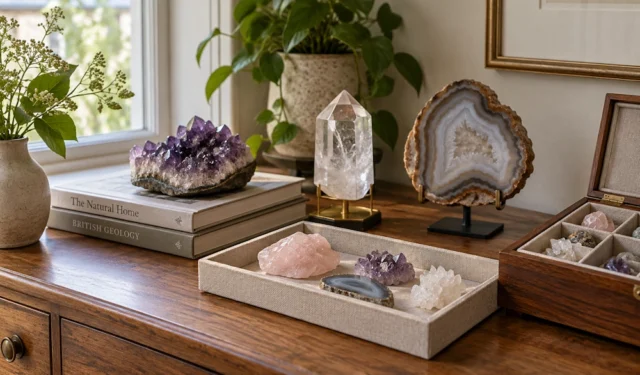
Good storage does not require a dedicated altar, a special compass direction or a room organised around invisible energy lines. It requires a secure place, suitable light, sensible spacing and enough knowledge to recognise when one specimen needs different treatment from another.
The display can still have atmosphere. It simply works better when the arrangement respects the objects instead of sacrificing them to the photograph.
The best rule for how to store crystals is simple: organise the collection around the physical needs of the objects first, then decide how you want the shelf to look.
How to store crystals starts with what the collection is for
Before buying stands and trays, decide what role the stones actually have in your home.
They may be:
- mineral specimens you want to study;
- small symbolic objects;
- jewellery;
- souvenirs from places;
- decorative pieces;
- objects used in journalling or reflection;
- or simply things you find beautiful.
Those uses lead to different storage choices. Deciding how to store crystals is easier once you know whether you are protecting specimens, jewellery, keepsakes or objects used regularly.
A mineral specimen benefits from a label. Jewellery benefits from soft separated storage. A small stone used beside a notebook should be easy to reach. A fragile cluster may be better in a closed cabinet than on the edge of a bedside table.
There is no advantage in forcing every object into the same display system.
Store crystals according to the material, not the idea of stone
Minerals can survive geological time and still be surprisingly sensitive in a house.
The Natural History Museum notes that some mineral specimens are sensitive to ultraviolet and blue light, unsuitable relative humidity or temperature changes. The Canadian Conservation Institute makes the same broader point: although many inorganic specimens are stable, a minority of minerals are highly sensitive to light or humidity.
A stone can be geologically ancient and still react poorly to the conditions of a bathroom windowsill.
Home collections rarely need museum-level environmental control, but museum conservation offers a useful principle for how to store crystals: identify unusually sensitive objects and avoid unnecessary exposure to light, heat or moisture.
Light is part of the display
Natural light makes crystals look beautiful.
It can also be the reason some materials change over time.
GIA notes that prolonged intense light can fade some amethyst and citrine. Its general jewellery-care guidance also identifies several other coloured materials as vulnerable to excessive light or heat, while amber can darken with too much light.
That does not mean crystals must be hidden in drawers.
It means direct sunlight is a deliberate exposure, not the default best display position. Light is one of the first things to consider when deciding how to store crystals for long-term display.
For colour-sensitive pieces:
- prefer indirect daylight;
- avoid a south-facing windowsill receiving hours of strong sun;
- do not use powerful hot display lamps close to specimens;
- rotate particularly valued pieces out of bright display if necessary;
- and check material-specific guidance rather than assuming every purple, yellow or pink stone behaves the same way.
If you bought a stone because you love its colour, preserving that colour is a reasonable priority.
| Storage issue | Practical response | Main reason |
|---|---|---|
| Strong direct light | Prefer indirect daylight for light-sensitive pieces | Some colours and materials can change with prolonged intense exposure |
| Heat source | Keep distance from radiators, fireplaces and hot lamps | Heat can affect colour, treatments, adhesives and fracture risk |
| Pieces touching | Use spacing, lined trays or separate compartments | Harder or sharp-edged pieces can scratch softer surfaces |
| Heavy or rounded specimen | Use a stable low shelf, stand or retaining edge | Weight, rolling and tipping are physical hazards |
| Fragile or dusty specimen | Consider a cabinet, display box or supported mount | Less handling usually means less opportunity for damage |
Heat matters too
A shelf above a radiator, beside a fireplace or immediately under a hot lamp may create more risk than an ordinary bookcase.
Some gems can fracture under rapid temperature changes. Heat may also affect colour, treatments, adhesives or composite objects.
Keep valuable or sensitive pieces away from:
- radiators and heaters;
- open fires;
- the hottest part of a sunny enclosed window;
- steam-heavy areas;
- and display lighting that noticeably warms the object.
A candle beside a stone may look atmospheric, but distance is useful. Fire safety and material stability are more important than the photograph, especially when you are working out how to store crystals near heat sources.
Humidity is usually ordinary until it is not
Most common polished stones do not require a climate-controlled cabinet.
But a mixed mineral collection can contain exceptions.
The Canadian Conservation Institute identifies pyrite as particularly vulnerable at relative humidity above 50%, where oxidation can lead to damaging iron sulphate products and eventual deterioration. Some hydrated minerals also respond badly to inappropriate humidity.
This is why bathrooms, damp cellars and humid windows are poor universal locations for mineral specimens.
If your collection includes raw, unusual or scientifically labelled minerals rather than only common tumbled stones, research the storage requirements of the exact species. That is more reliable than using one universal rule for how to store crystals.
A small hygrometer may be useful for a serious specimen cabinet. It is probably unnecessary for three pieces of quartz on a bookshelf.
The level of care should remain proportionate to the collection you actually own.
How to store crystals without scratches, chips or broken points
Storage damage often comes from the collection itself.
A hard gem can scratch a softer one when both are dropped into the same bowl, drawer or jewellery box. Faceted edges can also mark polished surfaces.
GIA recommends separated or padded storage for jewellery rather than allowing pieces to rub together. Separation is one of the simplest answers to how to store crystals without creating avoidable surface damage.
For loose stones and small polished objects, use:
- separate compartments;
- small fabric pouches for suitable pieces;
- lined trays;
- individual boxes for delicate specimens;
- or enough space on the shelf that objects are not touching.
Do not assume that wrapping everything tightly is always best. Fragile clusters can snag on fabric, and some specimens are better supported in a small box or mount.
Hardness is not the same as toughness
A stone may resist scratching but still chip or split when dropped.
This distinction matters when deciding whether a specimen belongs on an open high shelf, in a shallow dish or inside a cabinet.
Feldspars, for example, can have cleavage that makes them more vulnerable to impact than a hardness number alone suggests. Some crystals grow in thin blades, points or clusters that are physically delicate regardless of the underlying mineral’s hardness.
When deciding how to store crystals, store the object you actually have rather than an abstract hardness number from a chart.
Heavy specimens need stable furniture
Large mineral specimens can be much heavier than they look in photographs.
A secure display should have:
- a stable shelf rated for the load;
- a level surface;
- no overhang;
- heavy pieces placed low rather than above head height;
- and enough clearance that an object is not knocked when books, curtains or doors move.
For tall points, spheres and polished towers, consider a proper stand or shallow retaining edge if rolling or tipping is possible. Stability matters more than visual drama when deciding how to store crystals on open shelving.
Crystal spheres make the issue obvious because an attractive display object can still roll like any other heavy ball.
Think about children and pets
Small stones can be swallowed. Sharp specimens can cut. Heavy pieces can fall. Some raw mineral specimens may contain substances that should not be handled casually, licked or powdered.
That does not require treating every mineral cabinet as hazardous material storage.
It does mean that a household with young children or curious animals should favour closed cabinets, high secure shelves and larger stable display pieces.
Do not place loose stones in a pet’s water bowl, food area or bedding as a symbolic practice.
Keep the collection separate from pet food, water and bedding rather than involving animals in symbolic arrangements.
Raw specimens need more caution than polished décor
A polished quartz palm stone and an unidentified raw mineral specimen are not equivalent objects, so how to store crystals safely changes with the type of specimen you own.
Natural History Museum conservation work includes minerals that are chemically sensitive or potentially hazardous when handled incorrectly. Raw specimens may also produce dust, shed fragments or have extremely sharp crystal edges.
If you own an unusual specimen:
- keep its label;
- do not grind, drill or polish it casually;
- wash hands after handling if the mineral warrants it;
- avoid allowing children or pets to handle it;
- and research the exact species through a reputable mineralogical source.
For ordinary home décor, unusual chemical properties should be treated as a handling consideration rather than as an attraction in themselves.
Keep simple labels and provenance notes
Even a small collection benefits from basic records. Labels are especially useful when how to store crystals depends on treatment, provenance or an unusual mineral species.
A discreet note can include:
- mineral or material name;
- where you bought or found it;
- country or locality if genuinely known;
- whether it is treated, dyed or synthetic;
- date acquired;
- and any personal association you want to remember.
The label does not need to sit visibly beside every stone.
A notebook, spreadsheet or small card kept under the object is enough.
This becomes particularly useful several years later when “that green one from somewhere” is no longer a satisfying provenance record.
Display choices should make cleaning easier
Open shelves look lighter and more informal.
They also collect dust.
If a specimen has deep crevices, fragile crystal points or a rough matrix, repeated cleaning creates more handling and therefore more opportunities for damage.
A glass-fronted cabinet can reduce dust without hiding the collection. Small clear display boxes work well for delicate specimens. Simple domes can suit individual pieces, provided heat and humidity are not trapped in an unsuitable way. These are practical options when deciding how to store crystals that are awkward to clean repeatedly.
For robust polished stones, an open tray is easier.
Choose the display according to how annoying the object will be to clean, not only how it looks on the first day.
Do not overcrowd the shelf
Meaningful objects become visual wallpaper when there are too many of them competing for attention.
A useful display often has:
- one larger anchor object;
- a few smaller pieces;
- negative space;
- one practical element such as a book or box;
- and enough room to remove an object without knocking three others over.
You can rotate the rest through storage.
Rotating part of a collection can make the display calmer and reduce crowding without diminishing the collection itself.
Use ordinary furniture before buying special display furniture
You probably already own suitable display surfaces.
Bookshelves, glazed cabinets, small wall shelves, printer’s trays, jewellery boxes, wooden trays and shallow dishes can all work depending on the objects.
Special crystal stands are useful when they solve a physical problem: supporting a sphere, keeping a point upright or holding a specimen at a useful angle.
They are less useful when they merely add another object to an already crowded arrangement.
Symbolic arrangements still have to obey material care
If symbolism helps you organise a collection, use it.
You might keep a stone associated with attention near a desk, a family keepsake beside photographs, or a piece connected with travel near a map.
The association is personal and spatial rather than a claim that the stone changes the room through an invisible mechanism.
Physical requirements still come first. Symbolic placement can influence how to store crystals, but it should not override light, heat, weight or fragility.
If your “sun stone” fades in strong sun, symbolism does not require you to sacrifice the object to the metaphor.
A simple plan for how to store crystals at home
For a small collection, try this:
- Choose a stable shelf away from prolonged direct sun and direct heat.
- Place the heaviest object low and securely.
- Give delicate pieces individual stands, boxes or enough space around them.
- Separate jewellery and stones that may scratch one another.
- Keep one short record of names, treatments and provenance.
- Leave empty space.
- Rotate pieces rather than expanding the display indefinitely.
That is enough for most homes and gives a workable answer to how to store crystals without turning the collection into a specialist conservation project.
When a closed box is better than a display
Not every meaningful object needs to become décor.
A stone connected with grief, a private relationship, a difficult period or a personal practice may feel better stored in a small box or drawer.
Protection from light and dust is an additional benefit.
A meaningful object does not have to remain on permanent display.
A Hawthorn & Key approach to how to store crystals
At Hawthorn & Key, how to store crystals is primarily a question of care, scale and good interior judgement. A crystal shelf works best when it looks like part of a home rather than evidence that a mineral shop exploded quietly in the corner.
We favour a few well-understood objects, enough space to notice them and practical care that respects what the materials really are.
Symbolism can influence where an object belongs, but weight, fragility and material behaviour still determine whether that location is sensible.
Sources & Further Reading
- Natural History Museum – Minerals: Sparkling, Sensitive and Toxic.
- Canadian Conservation Institute – Caring for Natural History Collections.
- Gemological Institute of America – Tips on Caring for Jewelry.
- Gemological Institute of America – Amethyst Care and Cleaning Guide.
- Gemological Institute of America – Citrine Care and Cleaning.
- Gemological Institute of America – How Should I Care for My Pearls?.