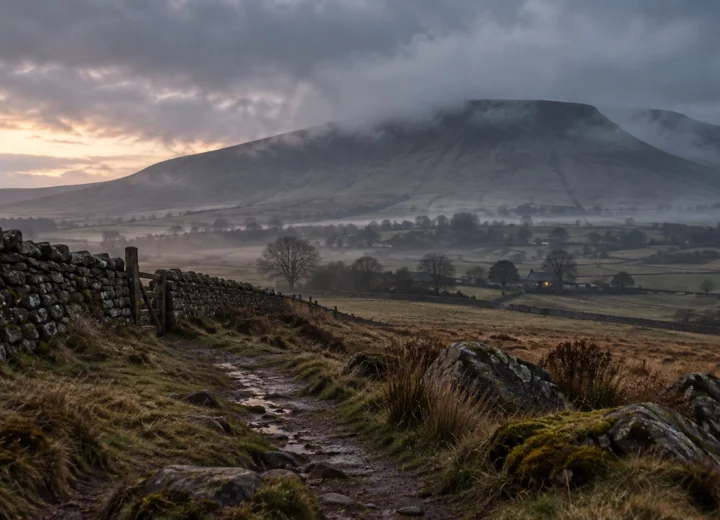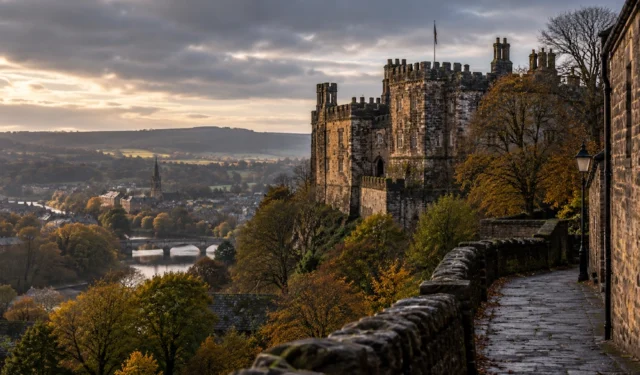
These cases did not form a continuous hunt for an organised group of witches. They involved different witnesses, households and legal decisions. Looking at them together makes it possible to ask how a rumour became an accusation, why some allegations survived examination and others collapsed, and how memories of one prosecution could influence the next.
The Lancashire witches were never one single case
The best-known account of the 1612 proceedings is Thomas Potts’s The Wonderfull Discoverie of Witches in the Countie of Lancaster, published in 1613 at the direction of the judges. Its long title encompasses trials at Lancaster and the separate prosecution of Jennet Preston at York. Potts gives historians a rare, detailed account of what the authorities wanted to record, though his writing should not be mistaken for a neutral transcript. He was involved in the court’s work and presented the proceedings in terms favourable to the judicial establishment.
Most later retellings concentrate on Pendle. Yet the same assize also dealt with allegations from Samlesbury, where an accusation built around a young witness ended in acquittal. The contrast matters because it prevents the Lancashire witches from being remembered as an undifferentiated group of people who all met the same fate.
| Case | What happened | What the surviving record shows |
|---|---|---|
| Jennet Preston, July 1612 | Tried at York and executed | A related prosecution took place outside Lancaster |
| Samlesbury, August 1612 | Three women tried and acquitted | The court rejected the central accusation after questioning the witness |
| Pendle and other defendants, August 1612 | Ten people executed following the Lancaster assizes | Convictions were possible on evidence that would not satisfy modern standards |
| Lancashire investigations, 1633-34 | Convictions prompted further official scrutiny | Examinations and a recantation exposed serious weaknesses in the allegations |
Samlesbury: an accusation that failed in court
On 18 August 1612, Jane Southworth and two women from the Brierley family stood trial at Lancaster. Historical accounts give variant spellings of the Brierley names. Their principal accuser was Grace Sowerbutts, a girl of about fourteen who was related to two of the defendants. Her allegations involved an elaborate account of nocturnal meetings and acts attributed to witchcraft.
The women challenged the story and asked the judge to establish who had persuaded Grace to speak against them. According to Potts, questioning led Grace to withdraw her accusations and name Christopher Southworth, a Catholic priest, as the person who had coached her. The three defendants were acquitted.
What the acquittal can and cannot tell us
The Samlesbury outcome shows that accusations of witchcraft could be challenged and rejected, even within a legal system that regarded harmful witchcraft as a genuine offence. It does not mean the courts applied modern standards of evidence. The Pendle defendants were being prosecuted in the same judicial setting, with consequences that were much more severe.
There is another complication. Potts enthusiastically described the collapse of the case as the exposure of a Catholic plot. The Southworth family had been divided by religious allegiance, and Protestant authorities had political reasons to cast a priest in a sinister role. Lancaster Castle’s historical account notes that the circumstances remain open to interpretation. We can describe the accusation and the acquittal, but should be cautious about treating Potts’s explanation of the supposed conspiracy as an independently established fact.
Jennet Preston: part of the history, tried at York
The geographical boundary of the familiar Pendle story is also less tidy than it appears. Jennet Preston was associated with the wider allegations, but her prosecution took place at York on 27 July 1612. She was accused of causing the death of Thomas Lister by witchcraft, convicted and executed. Potts included her case in his account of the northern proceedings.
Preston is often grouped with the Lancashire witches in popular accounts, but the distinction between her trial and the Lancaster assizes is worth preserving. The judges could deal with connected accusations across different sittings, while later regional histories tended to bring those events together under a convenient label. That label helps readers find the subject; it should not conceal where and when the individual cases were heard.
Who was accused, and why?
The familiar picture of an accused witch is an isolated elderly woman, often poor and suspected of unusual knowledge. Some of the Lancashire defendants did live in severe poverty or carried reputations connected with harmful magic. Others do not fit that description. Men were prosecuted, and Alice Nutter appears to have occupied a different social position from some of the poorer Pendle defendants. Family disputes and religious tensions feature in the Samlesbury record.
It is also misleading to assume that everyone accused had previously worked as a healer. A person consulted for charms or the recovery of stolen property could occupy a very different place in the community from someone blamed for an illness or a death. These categories sometimes overlapped, but the evidence does not support turning every accused person into a practitioner of benevolent folk medicine.
Our account of wise women and cunning men examines that distinction more closely. It offers useful context for the Lancashire witches without projecting a single occupation or religious identity onto people whose surviving biographies are often incomplete.
Two decades later, the earlier trials were still being discussed
In 1633-34, a boy named Edmund Robinson claimed to have witnessed a gathering of witches at Horestones in Pendle Forest. His story drew numerous people into a new Lancashire investigation. Some were convicted at the assizes, but concern about the reliability of the allegations led the judge to refer the matter to the Privy Council in London.
The events were a separate prosecution, rather than the continuation of a coven supposedly discovered in 1612. What connected the two cases was local memory. The records preserved by The National Archives show that the earlier trials had become part of the stories people told one another, and those stories could affect what later witnesses claimed to have seen.
The Bishop of Chester examines the accused
In June 1634, John Bridgeman, Bishop of Chester, examined three women who had been convicted: Margaret Johnson, Mary Spencer and Frances Dickenson. Johnson continued to make statements about witchcraft, but the bishop found her confused and unreliable. Spencer and Dickenson rejected the accusations. A covering letter described the circumstances of the examination and the bishop’s attempts to obtain confessions.
That document does not show that the authorities had abandoned belief in witchcraft. They were still working within the religious and legal assumptions of the period. It shows, however, that officials could suspect a particular prosecution had gone wrong and seek further testimony before allowing its consequences to stand unquestioned.
Surgeons, midwives and the search for marks
The investigation also produced a striking medical record. On 2 July 1634, surgeons and midwives in London inspected four women brought from Lancashire for signs that contemporaries associated with witchcraft. The certificate reports no unnatural marks on Jennet Hargreaves, Frances Dickenson or Mary Spencer. On Margaret Johnson, the examiners described two features but discussed ordinary bodily explanations for them.
The examination itself was invasive, and the underlying belief that a bodily mark could reveal supernatural guilt was unfounded. Its historical value lies in the fact that the expected evidence was not simply declared present. The investigators recorded what they saw, including findings that undermined the accusations. A reader should recognise the scrutiny without mistaking its methods for valid modern medicine.
Edmund Robinson admits inventing the witch feast
The most revealing record was made on 16 July 1634. Re-examined before a justice of the peace, Edmund Robinson admitted that he had invented central parts of his story. The document explains that he had listened to neighbours discussing a witch feast held about twenty years earlier at a place he called Mocking Tower, an apparent recollection of the 1612 Malkin Tower story. He then associated the tale with people already suspected locally of witchcraft.
Here the surviving archive gives us something more precise than a general argument about rumour. Robinson described hearing an older narrative and using it to create a new accusation. The earlier history of the Lancashire witches had become material from which a later witness constructed an account that helped place other people in danger.
His admission does not tell us everything about the pressure placed on him or the full motives of the adults around him. It does establish that the celebrated witch feast in his story could not be treated as an observed event. The National Archives publishes a transcript of this re-examination alongside the bishop’s letter and the medical certificate, making it possible to compare the stages of the investigation rather than relying on a later retelling.
Children, adults and the making of testimony
Children were prominent in both the Samlesbury case and the later Lancashire investigation. Their involvement is disturbing partly because adults created the circumstances in which their words became legal evidence. Neighbours supplied reputations and rumours. Examiners determined the questions. Courts decided which statements carried weight. A young witness’s account could acquire authority through the process of being repeated before people who had the power to imprison and punish.
Blaming Grace Sowerbutts or Edmund Robinson alone would flatten a complicated history. Grace’s story collapsed under questioning, while Robinson’s later account of invention makes clear that he had drawn upon talk already circulating in the community. Their actions mattered, but so did the officials and neighbours who turned statements into accusations.
These episodes are among the strongest reasons to read the Lancashire witches as a history of evidence and institutions, as well as of fear. They show how power could move through ordinary conversation before it reached a courtroom.
Religion and local quarrels belonged to the same landscape
Early seventeenth-century Lancashire contained communities divided by religious allegiance. Catholic recusancy attracted scrutiny, especially under Protestant authorities, and Potts’s presentation of the Samlesbury acquittals was coloured by those divisions. Yet it would be equally misleading to explain every Lancashire witchcraft accusation as a disguised religious prosecution.
Disputes over begging, livestock, illness, inheritance or relations between neighbours could shape local suspicion. Legal and religious authorities then interpreted those disputes within a culture that regarded harmful witchcraft as possible. The details differed from household to household. That is why the documentary record deserves closer attention than broad claims about a county uniformly possessed by witch fever.
John Webster and the limits of seventeenth-century belief
One later Lancashire-associated voice offers a different perspective. John Webster, linked with Clitheroe, published The Displaying of Supposed Witchcraft in 1677. He questioned claims that people entered into bodily compacts with the Devil and challenged several familiar assertions about witchcraft. His writing arose within the intellectual and religious world of his century; it should not be presented as a straightforward modern scientific account.
Webster is useful because disagreement over witchcraft belonged to the period itself. Some writers defended prosecutions, others criticised evidence, and some rejected particular supernatural explanations. There was no single position held by everyone who lived in early modern England.
Modern scholarship also calls for care with the printed record. Robert Poole’s edited volume The Lancashire Witches: Histories and Stories includes James Sharpe’s chapter on the historical context alongside studies of Potts, politics and later representation. These are distinct contributions, and the volume should be credited to its editor rather than attributed to Sharpe alone.
When court history becomes a local legend
By the nineteenth century, the Lancashire witches had become part of the county’s collected folklore. John Harland and Thomas Turner Wilkinson’s Lancashire Folk-Lore (1867) preserved accounts circulating long after the original trials. Such collections are important records of what later readers and storytellers remembered, although they cannot automatically establish what people believed or said in 1612.
Places acquired associations with named defendants. Some survived through local history, others through guidebooks, postcards and repeated anecdotes. The temptation to connect an attractive old building or gravestone to a famous witch trial is understandable, but the connection must be supported by records rather than by atmosphere alone.
The Alice Nutter gravestone mistake
Lancashire County Council’s Red Rose Collections gives a particularly clear correction. A Nutter family gravestone at St Mary’s Church in Newchurch in Pendle has encouraged the belief that Alice Nutter lies beneath it. The collection identifies that belief as false. The matching surname and the macabre appearance of the stone were not enough to establish a burial.
This kind of correction belongs in the history rather than being treated as an inconvenient detail. The people accused in 1612 were real individuals. Their memory is better served by identifying what the records support than by adding dramatic certainty where none exists.
Reading the Lancashire witches beyond Pendle
The familiar Pendle account remains central to the county’s witch-trial history. It records prosecution, conviction and execution on a scale that deserves remembrance. But the Samlesbury acquittals, Jennet Preston’s separate York trial and the surviving 1634 examinations make the wider picture considerably more demanding.
We can see an accuser questioned, defendants acquitted and condemned people subjected to additional investigation. We can read the medical assumptions of officials who were searching for signs that did not exist. Most strikingly, we can read a boy’s admission that the story behind a new prosecution had been assembled from the remembered language of an older one.
At Hawthorn & Key, the Lancashire witches are worth approaching through those individual records. The later folklore tells us how the events were remembered. The court documents reveal how accusations were made and challenged, sometimes too late to protect the people caught within them.
Sources & Further Reading
- Thomas Potts, The Wonderfull Discoverie of Witches in the Countie of Lancaster (1613), in the Chetham Society’s annotated reprint of 1845. This is a contemporary account presented by the prosecution side and must be read critically.
- Christine Goodier, “The Samlesbury Witches”, Lancaster Castle. Includes the acquittals and the disputed religious context.
- Lancaster Castle, “Lancashire Witch Trials”. Summary of the 1612 trials and defendants.
- The National Archives, “Early Modern Witch Trials: Accusation and Trial”. Includes the 1634 examinations, the medical certificate and Edmund Robinson’s re-examination.
- The National Archives, “The Physical Examination of Accused Witches”. Context and transcript of the July 1634 certificate.
- Lancashire County Council, Red Rose Collections, Nutter family tomb at Newchurch. Corrects the mistaken association with Alice Nutter’s burial.
- Robert Poole (ed.), The Lancashire Witches: Histories and Stories (Manchester University Press, 2002), including James Sharpe’s chapter on historical context. Folger Shakespeare Library catalogue.
- John Webster, The Displaying of Supposed Witchcraft (1677), Wellcome Collection.
- John Harland and T. T. Wilkinson, Lancashire Folk-Lore (1867), a later collection of regional traditions.