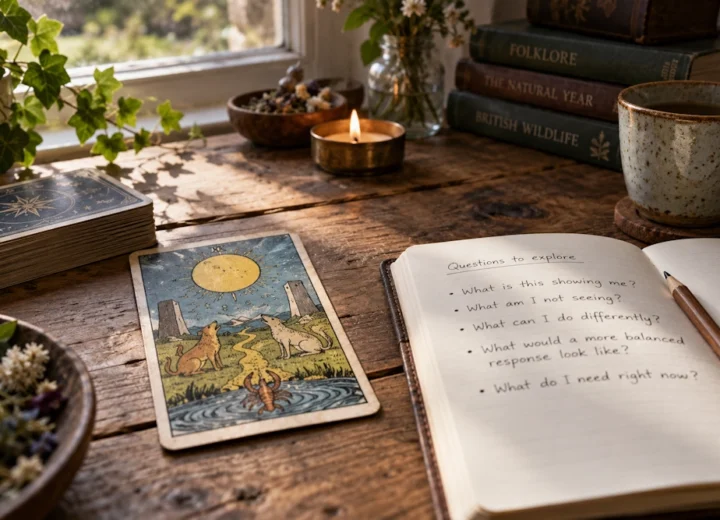
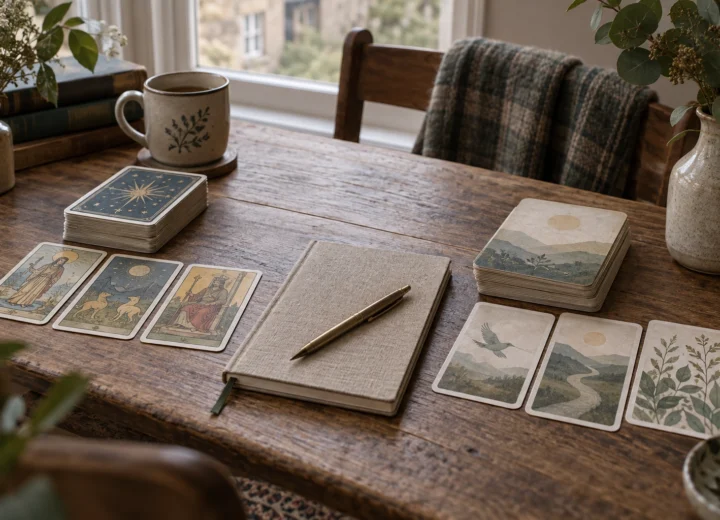
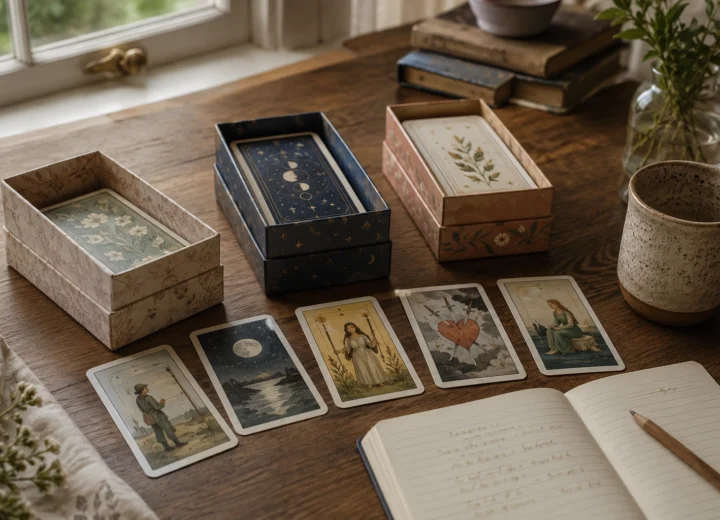
Three cards are enough.
That can be surprisingly difficult to believe when tarot books and social media are full of elaborate spreads covering an entire table.
A beginner does not need twelve positions, several clarifiers and a second deck for confirmation. Three cards can already create contrast, movement and a small narrative. More importantly, three cards are few enough that you can actually look at them.
A useful first spread is not designed to predict every detail of the future.
It is designed to help you notice what is happening, what deserves attention and what you can do next.
Why three cards work so well
One card gives you a single image.
Two cards create comparison.
Three cards create relationship and movement.
The first can establish a situation, the second can complicate it and the third can point towards a response.
That is enough structure for a meaningful reading without overwhelming a beginner with too many competing symbols.
Three-card spreads are a reading format, not an ancient sacred law
Tarot itself developed from European playing-card traditions, with the earliest documented tarot cards appearing in fifteenth-century Italy.
Divinatory systems and formal layouts developed later.
Arthur Edward Waite’s early twentieth-century Pictorial Key to the Tarot, for example, describes divinatory meanings and spreads associated with the Rider–Waite–Smith tradition.
The modern three-card spread is best treated as a simple practical format rather than a secret layout preserved unchanged from antiquity.
Begin with a question you can actually explore
A good spread starts before the cards are shuffled.
Instead of asking:
“What exactly will happen to me?”
try:
“What should I understand about this situation, what am I overlooking and what can I do next?”
The second question gives each card a job while keeping responsibility with the reader.
The simplest grounded three-card spread
- What is happening?
- What deserves more attention?
- What can I do next?
This is a flexible spread for work, relationships, creative projects, habits, difficult conversations and periods of uncertainty.
It does not require the cards to reveal hidden facts or guarantee an outcome.
Card one: What is happening?
The first card is not a supernatural diagnosis.
It is a lens on the situation.
Look at the image and ask what part of your current experience it resembles.
If the Four of Pentacles appears, you might notice themes of holding on, protection, control or fear of loss.
Then compare those themes with what you actually know.
Card two: What deserves more attention?
This card introduces complexity.
It may show something you are minimising, a tension between two needs or a perspective you have not considered.
If the Page of Swords appears, perhaps curiosity, communication, vigilance or premature conclusions deserve examination.
Do not assume it represents a literal young person unless the context strongly supports that reading.
Card three: What can I do next?
The final position should ideally return you to agency.
If Strength appears, the practical question might be:
“Where would calm persistence work better than force?”
If the Eight of Pentacles appears, perhaps the next step involves practice, repetition or improving a skill.
The card suggests a direction for reflection, not a command.
Lay the cards from left to right
There is no need for ritual complexity.
Place the first card on the left, the second in the centre and the third on the right.
The visual sequence helps the eye read movement across the spread.
If another arrangement feels more natural, use it.
The geometry does not make the reading more accurate.
Decide the positions before drawing
If you assign meanings after seeing the cards, it becomes easy to redesign the spread around the answer you hoped to receive.
Write the three positions first.
Then shuffle and draw.
This small discipline gives the reading a stable frame.
Shuffle in whatever way is physically comfortable
You can overhand shuffle, divide the deck into piles, gently mix cards on a table or use another method that does not damage the cards.
You do not need a perfect riffle shuffle.
You also do not need to shuffle until a card “jumps” from the deck.
Choose a simple stopping point and draw three cards.
You do not need to cleanse the deck first
Some modern readers use smoke, crystals, moonlight, knocking, bells or visualisation before a reading.
These can be personal rituals if they help establish attention.
They are not required to make cardboard safe or functional.
For a beginner, putting the phone aside and clearing enough table space is usually preparation enough.
Look at all three cards before opening the guidebook
Spend a minute simply observing.
Do the cards look active or still?
Are people facing towards one another or away?
Do colours repeat?
Are there several cards from one suit?
Is the spread dominated by Major Arcana or ordinary daily-life cards?
These relationships often disappear when each card is read separately from a book.
Describe before interpreting
For each card, write one sentence describing what is visibly present.
For example:
“A figure stands between two other people.”
“A person looks back at cups while two remain standing.”
“Someone is working repeatedly on a pentacle.”
Description slows down the urge to jump immediately to a fixed keyword.
Then add the traditional card meaning
Once you have looked, consult the deck’s guidebook or a reliable tarot reference.
Traditional meanings provide a shared vocabulary.
They are especially helpful when an image feels unfamiliar.
But the guidebook should join your observation rather than replace it.
Finally connect the meaning to the position
The same card changes emphasis depending on its job in the spread.
The Hermit in “What is happening?” might reflect withdrawal or deliberate solitude.
In “What deserves attention?” it might ask whether you need more private reflection.
In “What can I do next?” it might suggest stepping away from noise before deciding.
Position creates context.
Read the transitions between cards
Do not treat the spread as three unrelated dictionary entries.
Ask how card one becomes card two, and how card two relates to card three.
Perhaps the spread moves from confusion to structure.
Perhaps it moves from confidence to caution.
Perhaps the third card challenges both of the first two.
A spread is a relationship.
Example one: a work decision
Question:
“What should I understand about taking on this new project?”
Imagine drawing:
- Two of Pentacles — what is happening;
- Ten of Wands — what deserves attention;
- Queen of Swords — what can I do next.
A grounded reading might notice existing juggling, a risk of overload and a need for clear boundaries or terms.
It does not need to predict whether the project will succeed.
Turn that reading into ordinary action
The practical next steps might be:
- check the actual workload;
- ask what can be delegated;
- clarify deadlines;
- put the fee and scope in writing.
The cards helped organise questions.
The decision still depends on real information.
Example two: a difficult conversation
Imagine:
- Five of Swords;
- The Moon;
- Temperance.
You might read this as conflict or defensiveness, incomplete information or uncertainty, followed by a need for moderation and careful combination.
That does not prove the other person is lying.
It may simply remind you that the situation contains tension and that not everything is clear.
Example three: creative blockage
Imagine:
- Eight of Swords;
- The Fool;
- Three of Pentacles.
A useful interpretation might move from feeling restricted, through experimentation, towards collaboration or practical craft.
The next action could be to make a deliberately imperfect first version and ask someone trustworthy for feedback.
No prophecy is required.
Past / present / future is popular, but it is not the only three-card spread
Many beginners encounter “past / present / future” first.
It is easy to remember.
But the future position can encourage deterministic reading.
If you use it, treat “future” as a possible direction under current conditions rather than a fixed event already waiting for you.
A more grounded version is context / present / direction
- Context: What has shaped this situation?
- Present: What matters most now?
- Direction: Where may current choices be leading?
This keeps the narrative flow while leaving room for change.
Another useful spread: keep / change / begin
- Keep: What is already working?
- Change: What pattern needs adjustment?
- Begin: What small experiment could I start?
This spread works well at the beginning of a month, project or season.
It is deliberately practical.
For conflict: mine / theirs / conversation
This layout requires caution.
Do not use the second card to claim access to another person’s private thoughts.
Instead define the positions as:
- Mine: What am I bringing to the situation?
- Theirs: What perspective might I need to allow for?
- Conversation: What would help us communicate?
The second card generates empathy, not mind-reading.
For a decision: value / risk / next information
- Value: What matters most to me here?
- Risk: What should I not minimise?
- Next information: What do I need to learn before deciding?
This is more responsible than asking the cards to choose Option A or Option B for you.
It creates questions that can be answered with evidence.
Do not add clarifiers automatically
A clarifying card is useful only when something specific is unclear.
If you draw a fourth card every time you dislike the third, you are no longer clarifying.
You are extending the reading until it changes tone.
Try writing two possible interpretations of the difficult card before drawing anything else.
Leave reversals out at first if they create confusion
Tarot reversals are optional.
Many experienced readers use them; many experienced readers do not.
A beginner already has 78 cards and three spread positions to combine.
If upside-down meanings double the mental load, turn all cards upright while learning.
Pay attention to repeated suits
Three cards from the same suit can create a strong thematic concentration.
Several Cups may keep attention on emotional relationships or imagination.
Several Swords may emphasise thinking, communication or conflict.
Several Pentacles may point towards resources, work or material concerns.
Several Wands may emphasise action, drive or creative movement.
These are interpretive patterns, not fixed laws.
Major Arcana do not automatically mean fate
If two or three Major Arcana appear, the reading may feel weightier because those cards use broad symbolic themes.
That does not mean the universe has issued a binding decree.
It may simply mean the images invite you to think at a larger level: authority, change, hope, choice, uncertainty or completion.
Write down the reading before changing it
A short record protects against retrospective reinterpretation.
Write:
- date;
- question;
- three cards;
- one sentence for each position;
- one practical next step.
That is enough for a useful tarot journal.
Return after you have acted
The best review question is not “Did the cards predict correctly?”
Ask:
“Did the spread help me notice something useful?”
Perhaps the cards prompted a conversation, showed that you were avoiding a fact or made an overloaded plan visible.
Those are meaningful outcomes even if no prediction was made.
Stop if the reading increases panic
If you find yourself repeatedly drawing cards about illness, betrayal, death, financial disaster or another fear, put the deck away.
Tarot should not become a mechanism for compulsive reassurance-seeking.
Return to ordinary evidence and, if needed, appropriate professional support.
A three-card spread should make the question clearer
When the reading is finished, you should ideally have fewer useful questions, not more frightening possibilities.
If every card creates another mystery that requires another card, simplify.
The spread is a tool.
You do not owe it an endless conversation.
A Hawthorn & Key approach to a three-card spread
At Hawthorn & Key, three cards are enough because the aim is not to overwhelm uncertainty with symbolism.
Use one card to look at the situation, one to complicate your first impression and one to return attention to what you can do.
Read slowly. Keep facts separate from associations. Stop before clarification becomes repetition.
A small spread can hold plenty of meaning when you give the cards room to speak without asking them to become a timetable for the future.
Sources & Further Reading
- Victoria and Albert Museum, A History of Tarot Cards, for tarot’s development from card game to later divinatory use.
- The Metropolitan Museum of Art, Before Fortune-Telling: The History and Structure of Tarot Cards.
- Arthur Edward Waite, The Pictorial Key to the Tarot, as a primary source for early twentieth-century Rider–Waite–Smith divinatory practice.
- Helen Farley, A Cultural History of Tarot.