Many beginners assume that tarot should tell them exactly what will happen, when it will happen and what another person will think or do. That expectation creates pressure on both the cards and the reader, and it encourages confident statements that the cards cannot verify.
A calmer approach uses tarot for reflection. The cards can help you notice patterns, name tensions, compare possibilities and ask better questions without pretending to remove uncertainty from the situation.
A useful tarot reading does not need to predict an outcome. It can help you see the question, your assumptions and your options more clearly.
Why you can read tarot without predicting the future
The earliest documented tarot cards were made for games in fifteenth-century Italy.
The Metropolitan Museum of Art describes tarot as a trick-taking card tradition with trump cards added to the ordinary suits.
The Victoria and Albert Museum notes that divinatory use developed much later, becoming established from the late eighteenth century onwards.
This history matters because it reminds us that prediction is a later use of the cards, not their only possible purpose. That makes it historically reasonable to read tarot without predicting the future.
Prediction and reflection are different reading styles
A predictive question asks:
“What exactly will happen?”
A reflective question asks:
“What should I notice about this situation?”
The first treats the card as information arriving from outside ordinary knowledge.
The second treats the image as a structured prompt for thinking.
You can read tarot without predicting the future and still take the images, traditions and personal associations seriously.
Start with what you actually know
Before drawing a card, write down the facts.
What has happened?
What do you know directly?
What are you assuming?
What decision, uncertainty or feeling has brought you to the cards?
This simple step is central when you read tarot without predicting the future, because it stops symbolism from replacing the facts of the situation.
Separate facts from interpretations
Suppose a colleague has not replied to a message for three days.
The fact is that there has been no reply. “They are angry with me” is an interpretation, while “They are secretly planning to leave the project” adds another layer of speculation.
Tarot should not turn unverified guesses into facts merely because a card appears to fit them.
Ask about your side of the situation first
Questions centred on your own choices usually produce the most useful readings.
Try:
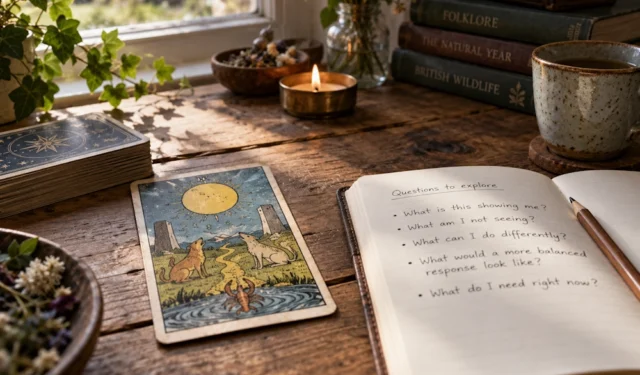
- What am I overlooking?
- What assumption am I making?
- What part of this is within my control?
- What would a more balanced response look like?
- What do I need before making a decision?
These questions leave room for action, which is one reason they work well when you read tarot without predicting the future.
Keep the reading inside the limits of what tarot can verify
“What does she secretly think of me?” is tempting because it promises certainty where ordinary communication is uncertain.
The problem is that the reading cannot verify another person’s private thoughts.
A more grounded question is:
“What am I assuming about this relationship, and what could I clarify directly?”
That keeps interpretation attached to information you can eventually test and gives you a practical way to read tarot without predicting the future.
Do not demand exact dates from symbolic images
Tarot traditions contain many systems for timing.
Readers may associate suits, numbers, astrological correspondences or card positions with days, weeks, months or seasons.
These systems vary substantially.
A card does not become a reliable calendar entry simply because one timing scheme assigns it a date.
Turn when-will-it-happen into a better question
Instead of asking for a date, ask:
- What conditions would make progress more likely?
- What is currently slowing this down?
- What would tell me the situation is changing?
- What can I prepare while I wait?
These questions turn timing anxiety into observable conditions. They are especially useful if you want to read tarot without predicting the future or forcing symbolic cards into exact dates.
Read the image before reaching for a keyword
Look at the card for a few moments.
Who or what appears in the scene?
Where is movement happening?
Where is it blocked?
What seems protected, exposed, divided or connected?
Visual description gives you a foundation before memorised meanings begin to shape the reading.
Keywords are useful but incomplete
A beginner may learn that The Hermit means introspection, The Tower means disruption and The Lovers means relationship or choice.
Those words are useful starting points, but they are not fixed sentences that dictate one reading.
The question, card position and surrounding images all affect which part of a card becomes relevant.
Use several possible interpretations before choosing one
If you draw The Tower, do not immediately decide that disaster is coming.
Write three possible readings.
It might suggest:
- a structure that is no longer stable;
- a belief being challenged;
- an uncomfortable truth becoming visible.
Only then ask which interpretation best fits the actual situation. This is a useful discipline when you read tarot without predicting the future.
Difficult cards do not require catastrophic predictions
Death does not have to predict literal death.
The Devil does not require an evil external force.
The Tower does not guarantee disaster.
The Moon does not prove deception.
These cards can be read as symbolic language for endings, attachment, instability, uncertainty and other human experiences.
Positive cards do not guarantee positive outcomes either
The Sun does not promise success in every context.
The Star does not guarantee that hope will be fulfilled.
Ten of Cups does not certify a perfect relationship.
A reflective approach avoids both fear and wishful certainty, which is essential if you want to read tarot without predicting the future.
The card opens a theme. It does not issue a contract.
Context matters more than isolated card reputation
The same card can raise different questions in a job decision, relationship discussion or creative project.
Justice in one situation may make you think about fairness.
In another, it may draw attention to consequences, documentation or the need to distinguish evidence from preference.
A reading becomes useful when symbolism meets a specific context.
Use card positions as questions rather than verdicts
A spread position such as “obstacle” does not mean the card itself is bad.
It means you are looking at the card through one question.
If The Empress appears as an obstacle, perhaps care has become overextension. If The Emperor appears as support, structure may help. If The Fool appears as advice, experimentation may be worth considering.
Spread positions provide a lens through which the same card can be considered differently.
Keep the reading small enough to stay useful
Pulling more cards can feel like gathering more evidence.
Often it only produces more material to interpret.
When you are anxious, a large spread makes it easy to search until you find the answer you hoped for or feared.
One to three cards are usually enough for a reflective question. Smaller spreads often make it easier to read tarot without predicting the future because there is less material to force into a single narrative.
Do not keep drawing clarifiers until the answer changes
If you dislike the first card and immediately draw five more, the reading can become negotiation.
Set the number of cards before beginning.
If the result feels unclear, write down what is unclear and return later.
An unclear reading does not necessarily mean that more cards will improve it.
Use a three-part reading structure
A simple reflective method is:
- Observe: What do I actually see in the card?
- Connect: What part of the situation does this image remind me of?
- Question: What useful question follows from that connection?
This method slows interpretation enough to keep imagination visible and helps you read tarot without predicting the future while still allowing intuitive associations.
Three examples of reflective tarot reading
Eight of Cups
In Rider-Waite-Smith imagery, a figure walks away from arranged cups.
A predictive reading might declare:
“You will leave the relationship.”
A reflective reading might ask:
“What am I emotionally invested in even though it no longer feels sufficient?”
The second question creates room for thought without pretending the decision has already been made.
Two of Swords
The familiar image presents a seated figure holding crossed swords.
Rather than predicting stalemate, ask:
- What information am I avoiding?
- What would make this choice easier to examine?
- Am I treating two imperfect options as if one must secretly be perfect?
The symbolism becomes a framework for decision-making rather than an answer key, which is exactly the aim when you read tarot without predicting the future.
The Star
The Star often carries associations of hope, renewal and openness.
Instead of “Everything will work out,” try:
“What would hope look like if it had to become a practical action?”
This keeps the positive symbolism while avoiding a guarantee the card cannot provide.
Techniques are optional, not laws
Read reversals only if they help
Some readers interpret upside-down cards as blocked, internalised, delayed or opposite expressions of the upright meaning.
Others do not use reversals at all.
Neither approach is required, and beginners do not need to use every available technique at once.
If reversals create more nuance, use them. If they only double the amount you feel obliged to memorise, leave them aside while learning.
Tarot traditions disagree more than beginners are often told
Different readers assign different meanings, correspondences and techniques.
Rider-Waite-Smith, Marseille and Thoth traditions do not approach every card in the same way.
Modern authors also vary.
This diversity is another reason to avoid speaking as though one card has one objective prediction attached to it.
Use a journal to test your interpretations
Record the question, cards, first impressions and what you eventually did.
Return to the reading later.
Which interpretations were useful?
Which were projection?
What information did you lack at the time?
This review teaches more than trying to prove that the cards were right. It is one of the most useful habits for anyone learning to read tarot without predicting the future.
Do not rewrite events to make a reading accurate
After something happens, it is easy to reinterpret an old card so that it seems to have predicted the outcome perfectly.
Keep your original notes.
If you originally read a card as “new job” and nothing of the kind happened, do not later claim it obviously meant “new mindset”.
Honest records protect you from retrospective certainty.
Notice confirmation bias without turning the reading into a psychology lecture
People naturally notice information that fits an existing expectation more easily than information that challenges it.
Tarot can amplify this because its imagery is rich and flexible.
The solution is simple:
Write down at least one interpretation you do not immediately prefer.
Then compare them against the situation.
Use tarot to generate options, not remove them
If you are deciding whether to accept a new project, a reading might help you consider workload, ambition, money, boundaries and uncertainty.
It should not reduce the decision to “The cards said yes.”
The final choice still belongs to you. That personal agency is part of what it means to read tarot without predicting the future.
That is not a limitation of reflective tarot; keeping the decision with the reader is part of the method.
High-stakes decisions need ordinary evidence
Do not rely on tarot to diagnose illness, choose medication, assess legal liability, determine whether an investment is safe or decide whether urgent professional help is required.
Cards can help you articulate fears or questions around a difficult situation.
They cannot replace appropriate medical, legal or financial expertise.
Relationship readings need the same boundary
A tarot reading cannot verify whether someone is faithful, secretly in love, lying or planning to leave.
If the relationship question involves facts that matter, look for communication and evidence.
The cards may help you ask:
“What do I need to discuss?”
They cannot tell you what another person has privately decided.
Repeated readings can increase confusion
If you ask the same question every day, small changes in cards can become new sources of anxiety.
Decide in advance when you will revisit the issue.
Perhaps after new information arrives, after you take an action or after a reasonable period has passed.
Give reality time to contribute.
End with one practical step
After interpreting the cards, write one action that does not depend on believing the reading is prophetic.
The action might be sending an email, making a budget, asking a question, resting for an evening or gathering more information.
A practical step prevents symbolism from becoming endless contemplation.
Better questions for reading tarot without prediction
When you read tarot without predicting the future, a small change in wording can make the question more useful. Compare these pairs:
| Predictive question | Reflective alternative |
|---|---|
| Will I get the job? | What should I consider as I prepare for this opportunity? |
| When will I meet someone? | What do I want to understand about partnership before pursuing one? |
| Is my friend lying? | What is making trust difficult here, and what can I clarify directly? |
| Will the business succeed? | What strengths, risks and blind spots deserve attention? |
| What will happen next month? | What themes should I approach deliberately next month? |
Reflective tarot still leaves room for imagination
A grounded reading can still leave plenty of room for imagination.
You can respond intuitively to colour, posture, landscape, number and story.
You can notice an association that no guidebook mentions.
The difference is that you recognise it as your interpretation rather than an objective message delivered by the universe.
Symbolism can be meaningful without being literal
A lighthouse in a dream can matter without predicting a lighthouse.
A road in a painting can suggest choice without physically determining your route.
Tarot works in a similar symbolic space.
An image can help organise thought because humans think through metaphor as well as fact.
Meaning does not require supernatural certainty. You can read tarot without predicting the future and still find the symbolic language useful.
Card history can improve the reading
The Rider-Waite-Smith deck was created in early twentieth-century Britain by Arthur Edward Waite and Pamela Colman Smith within a particular esoteric and artistic context.
Earlier tarot traditions often looked different, especially in the Minor Arcana.
Knowing this prevents modern interpretations from masquerading as eternal card meanings.
Use guidebooks as conversations, not authorities
Read the creator’s notes.
Read a reliable tarot history.
Compare several interpretations.
Then return to the image and the actual question.
A guidebook can teach vocabulary without needing to dictate the one true meaning of the card.
A simple five-minute reading without prediction
- Write one open question.
- Draw one card.
- Describe what you see without interpreting it.
- Write two possible meanings relevant to the question.
- Choose one practical action or further question.
Then stop. There is no need to draw another card simply to certify the first one.
If you are still choosing a deck
If you have not yet settled on a deck, our guide to choosing your first tarot deck explains the practical differences between Rider-Waite-Smith, Marseille, Thoth and more experimental systems.
A readable deck makes reflective practice much easier.
A Hawthorn & Key approach to reading tarot without prediction
At Hawthorn & Key, learning to read tarot without predicting the future is most interesting when the cards create better attention rather than louder certainty.
A card can interrupt a familiar story, reveal an assumption, give language to an uncomfortable feeling or suggest a question you had not considered.
That kind of attention is useful in its own right.
You do not need the cards to predict every conversation, date or outcome.
The aim is not to make the future certain, but to approach the present with more care.
Sources & Further Reading
- Victoria and Albert Museum, A History of Tarot Cards.
- The Metropolitan Museum of Art, Before Fortune-Telling: The History and Structure of Tarot Cards.
- Arthur Edward Waite, The Pictorial Key to the Tarot, read as an early twentieth-century primary source.
- Helen Farley, A Cultural History of Tarot.
- British Museum collections, for tarot and European playing-card material.