August 14, 2026
What Was Folk Magic in Britain?
There is something misleadingly tidy about the phrase folk magic. It sounds as though it ought to describe a single tradition: a body of old rules, perhaps handed down from one generation to another, with a recognisable set of tools and beliefs. The historical evidence is much less orderly.
To understand folk magic in Britain, it helps to begin with the surviving evidence rather than with the modern fantasy of one hidden, unified magical system.
Across Britain, people used charms, spoken formulas, written prayers, household objects, plants, stones and small acts of ritual for very practical reasons. They wanted a sick child to recover. They wanted a stolen animal returned, a troublesome neighbour kept at a distance, a journey made safely, a house protected, a marriage made fortunate, or a run of inexplicable bad luck brought to an end. Sometimes they consulted a specialist. Sometimes they did something themselves because it was what a parent, neighbour or local custom recommended.
Modern historians use terms such as popular magic, cunning magic and folk magic to make sense of this broad territory. When discussing folk magic in Britain, those terms are useful, but they should not be mistaken for the language ordinary people always used about themselves. The surviving record is regional, uneven and often filtered through courts, collectors, clergy and later folklorists.
Folk magic in Britain is clearest when it is read as practical history, not as a single secret doctrine.
Folk magic in Britain was usually practical before it was philosophical
One of the clearest features of folk magic in Britain is its practical character. Court records from early modern England contain references to men and women consulted to find lost or stolen property, identify supposed thieves, treat illness, counter suspected witchcraft and solve problems that could not easily be resolved through ordinary means.
These practitioners might be called wise men, wise women, cunning men, cunning women, charmers, soothsayers, fortune-tellers, conjurors or, in some regions, white witches or pellars. None of these labels was perfectly fixed. A person known for finding stolen goods in one village might also prepare charms, tell fortunes or advise on suspected bewitchment.
This is an important distinction from the modern image of magic as primarily a spiritual identity. Historical clients often approached a practitioner because something had gone wrong and they wanted a result. They were looking for a service.
Research based on northern English court depositions has even suggested that practical magic can be studied as a form of labour. People paid or rewarded specialists for work: finding, curing, diagnosing, divining or counteracting. That does not mean every claim was believed, successful or lawful. It does mean that magical services occupied a recognisable place within ordinary social and economic life.
Common concerns in folk magic in Britain
Because the evidence is scattered, it helps to group the subject by the kinds of problems people were trying to manage rather than by a single magical system.
| Concern | Typical evidence or practice | Grounded reading |
|---|---|---|
| Illness or suspected bewitchment | Charms, prayers, counter-measures, advice from cunning folk | Evidence of fear, care and attempted help; not proof of medical efficacy |
| Lost or stolen property | Divination, astrology, books, keys, sieves or interpreted movement | A practical response to uncertainty before modern investigation tools |
| Household protection | Horseshoes, concealed shoes, witch bottles, marked timbers and threshold objects | Material evidence that homes were imagined as vulnerable boundaries |
| Love, luck and social pressure | Charms, spoken formulas, personal objects and reputation-based practices | Culturally revealing, but not always harmless or ethically simple |
| Modern revival or reconstruction | Books, museums, Pagan practice, local heritage and internet retelling | A later layer of meaning, not automatically an unchanged survival |
It did not form a separate religion
It is tempting to imagine folk magic as the surviving underground religion of pre-Christian Britain. That picture has had a long cultural life, but it is much too simple for the evidence.
Many charms and magical procedures existed inside a thoroughly Christian world. Practitioners could use prayers, biblical names, crosses, saints, holy words and church materials alongside astrology, divination, herbal knowledge or other techniques that clergy might regard as improper. A charm might look religious in one context and magical in another.
Historical categories were therefore contested. The same person might see a spoken prayer as legitimate devotion, while a minister or magistrate saw the circumstances in which it was used as superstitious. A healer might understand a written formula as a blessing; an opponent might call it sorcery.
This is one reason the phrase folk magic is best treated as a modern analytical tool rather than the name of an organised historical faith.
That broader distinction is also useful in our introductory guide to British folklore, where recorded belief, local custom and historical evidence are kept in separate view.
Cunning folk were not simply the opposite of witches
Modern retellings often divide the old magical world neatly into bad witches and good cunning folk. In folk magic in Britain, the historical relationship was more complicated.
Cunning practitioners were frequently consulted by people who believed they had been bewitched. They might identify a supposed culprit, recommend a charm or construct a countermeasure intended to force the harmful influence back upon its source. In that sense, they could appear as enemies of witchcraft.
But authorities did not always accept the distinction. A practitioner claiming to use magic for healing or protection could still attract suspicion, accusations of fraud or religious criticism. The methods used to counter a witch might themselves look uncomfortably magical.
Nor did every community divide practitioners by the same labels. A person called a wise woman by one neighbour could be called a witch by another. Reputation mattered.
That ambiguity is worth keeping in mind when reading later stories about the Fair Folk and older supernatural beliefs. Historical communities did not organise their unseen world according to the neat categories familiar from modern fantasy.
Charms could be spoken, written, worn or hidden
Folk magic did not require a dramatic ritual space. Many of its surviving traces are small.
The Pitt Rivers Museum holds thousands of amulets and charms from many cultures, including English material. Its collections show how broad the idea of a charm can be: something worn, carried, placed in a building or used in a ritual because people believed it might protect, heal or influence events.
Written charms were especially portable. A short text might be folded into a small bag and worn close to the body. The words could be religious, magical or difficult for a modern reader to place comfortably in either category.
Other protective objects were architectural rather than personal. Houses have yielded concealed shoes, dried animals, marked timbers, horseshoes, witch bottles and objects placed in walls, roofs, hearths and thresholds.
The Ashmolean Museum’s Spellbound exhibition drew attention to how many such objects have been recovered from historic buildings. Whatever we make of the beliefs behind them, their physical presence demonstrates that protective actions were not merely literary inventions.
The house was one of the most important landscapes of folk magic in Britain
A threshold is an ordinary piece of architecture, but in folk belief it could also be a vulnerable boundary. Doors, windows, chimneys and hearths connected the protected interior of a household with the uncertain world outside. This is one reason folk magic in Britain so often returns to the doorway, the hearth and the wall.
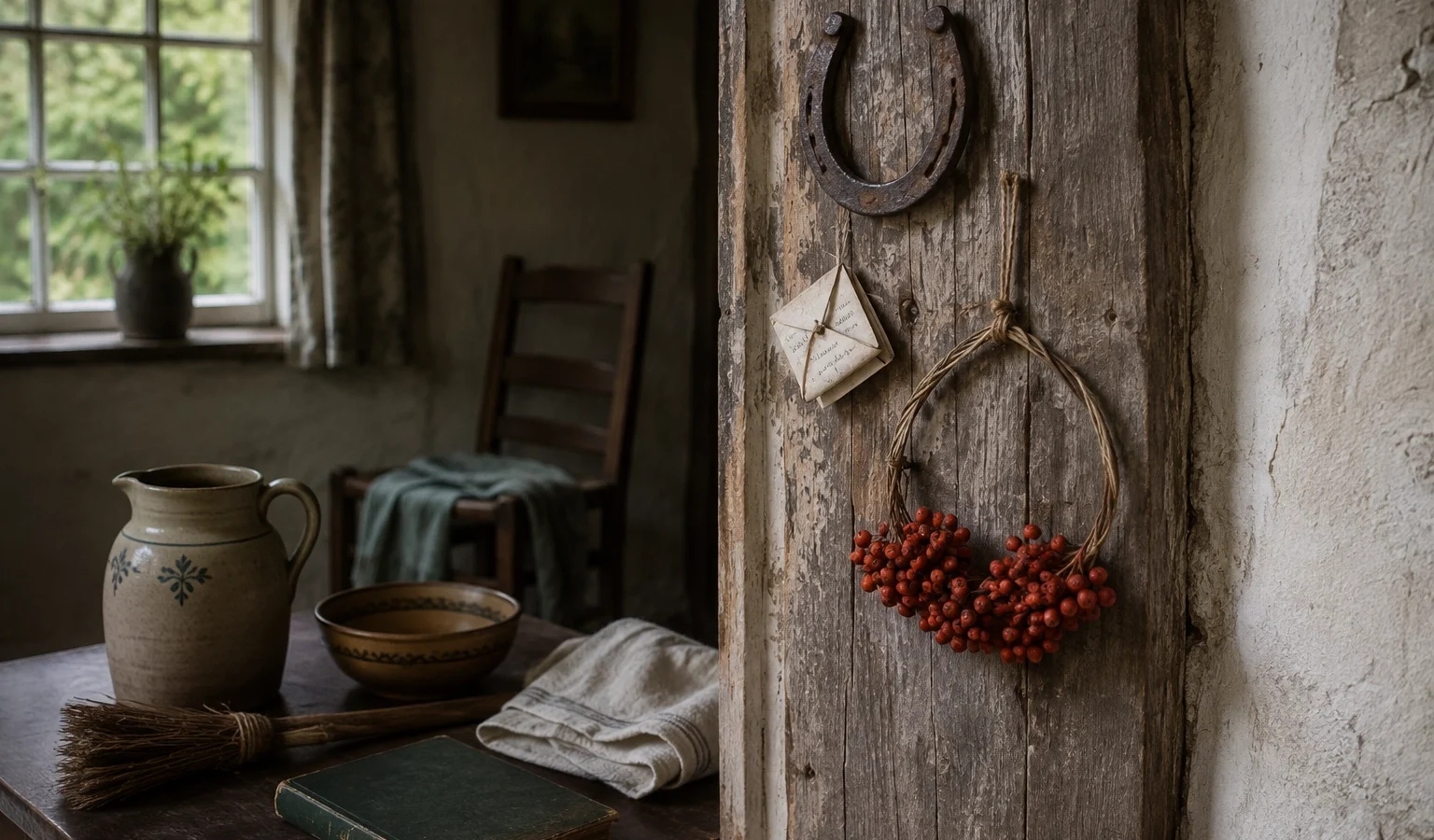
That helps explain why protective objects are so often found at entrances and structural openings. A horseshoe above a door, a bottle beneath a hearth or an object concealed within a wall makes sense within a worldview in which misfortune might travel, enter, cling or be redirected.
The symbolism was not necessarily consistent. Iron might be thought troublesome to witches in one body of tradition and troublesome to fairies in another. Rowan could be carried, hung at a doorway or fashioned into crosses and loops. Salt, bells, pins and knots accumulated different meanings in different regions and periods.
There was no national handbook dictating the correct material for each danger.
This same attention to boundaries appears elsewhere in British folklore. Old stories repeatedly give significance to wells, crossroads, doors and other places where one condition becomes another. Our guide to crossroads in British folklore explores one version of that wider pattern.
Healing was central to folk magic in Britain, but categories overlap awkwardly
Healing is one of the areas where modern categories become particularly unstable.
A historical remedy might combine a plant with a prayer, a practical treatment with a symbolic number, or a physical action with a spoken charm. Some ingredients had genuine medicinal properties. Others were used because of resemblance, inherited custom, religious association or magical belief. Often several explanations could coexist.
It would be misleading to describe every traditional remedy as magic. It would be equally misleading to strip the symbolic elements away simply because they do not fit modern medicine.
The safe historical position is to ask what the source actually tells us: what was used, who recommended it, what people believed it was for, and how later collectors interpreted it.
None of this is evidence that an old charm can diagnose or treat illness today. Historical interest and medical effectiveness are separate questions.
Finding stolen goods could be as important as healing
Lost property and theft recur so often in records of cunning practice that they deserve more attention than they usually receive. Any grounded account of folk magic in Britain needs to include finding, tracing and identifying as well as healing and protection.
In a world without modern policing, insurance databases, electronic payments or rapid communication, the disappearance of a horse, tool, purse or household object could threaten a family’s security. A specialist who claimed to identify a thief or locate missing property therefore offered something socially valuable, even if the method involved divination rather than evidence we would accept today.
Techniques varied. Some practitioners used astrology. Others used scrying, books, keys, sieves, written calculations or objects whose movement was interpreted as meaningful.
The point is not that these methods reliably found thieves. The historical importance lies in the demand for them. People were trying to manage uncertainty with the resources available to them.
Love, luck and protection were not always harmless subjects
Modern presentations of folk magic sometimes soften the past into a collection of pleasant household rituals. The surviving material is not always so comfortable.
Love charms could involve attempts to influence another person’s choice. Counter-witchcraft could escalate suspicion against a neighbour. Divination could reinforce accusations. Protective rituals could be tied to intense fear that someone nearby intended harm.
Some practices involved animal remains or human bodily material. Others reflected historical attitudes towards illness, disability or social outsiders that should not be romanticised.
A thoughtful account of folk magic therefore has to hold two ideas at once. These practices can be culturally fascinating and emotionally understandable, while also belonging to societies in which fear of witchcraft sometimes produced real cruelty.
Why so much evidence comes from courts and collectors
Ordinary household acts are difficult to recover historically precisely because they were ordinary. People rarely wrote down every charm taught by a grandmother or every object placed above a doorway.
We often meet popular magic when something went wrong: a neighbour complained, a client accused a practitioner of fraud, a church court investigated superstition, or a witchcraft accusation reached the authorities.
Later folklorists created another kind of record. During the nineteenth and early twentieth centuries, collectors wrote down beliefs, purchased amulets and asked people about old customs. Their work preserved material that might otherwise have disappeared, but their categories and assumptions also shaped what they collected.
The Pitt Rivers Museum’s famous so-called witch’s ladder is a useful warning. A string threaded with feathers, found in a Somerset attic in the nineteenth century, quickly attracted magical explanations. Yet even the early scholarly discussion admitted that the evidence for its supposed function was uncertain. Modern witchcraft later gave the object a much clearer ritual identity than the original evidence supports.
Objects do not interpret themselves.
A concealed shoe, a folded charm or a horseshoe above a door is evidence of human concern before it is evidence of supernatural power.
How folk magic in Britain survived modernity in uneven ways
It is misleading to imagine that practical magic simply vanished when Britain became industrial and urban.
Folklorist Edward Lovett collected charms and amulets from working people in late Victorian and Edwardian London. Protective and lucky objects remained part of modern life even in the capital.
At the same time, older practices changed meaning. A horseshoe could become a decorative emblem of luck. A folkloric charm could enter a museum. A once-local custom might be revived through books. Twentieth-century occult and Pagan movements borrowed from historical material while also creating new rituals of their own.
That later history matters because it is easy to mistake a modern reconstruction for an unchanged survival.
Folk magic in Britain, folklore and modern witchcraft
Folk magic overlaps with folklore because beliefs and practices travel through stories, custom and memory. It overlaps with historical witchcraft because people used magical explanations to understand harm and misfortune. It overlaps with later occultism and modern witchcraft because those movements have drawn upon older charms, plants, symbols and texts.
But overlap is not identity.
A nineteenth-century Yorkshire rowan loop, an early modern cunning man’s written charm and a twenty-first-century ritual inspired by folklore may all involve the idea of protection. They belong to different historical settings and should be described accordingly. That distinction keeps folk magic in Britain historically useful rather than merely decorative.
A grounded way to approach the subject
At Hawthorn & Key, the most interesting part of folk magic is not the promise that an old object still possesses a guaranteed power. It is the way ordinary people used objects, words and inherited habits to make uncertainty feel manageable.
A naturally holed stone nailed to a cottage door, a folded charm carried in a pocket or a rowan loop hung near an entrance can tell us something about fear, hope, memory and the desire to protect a home. That history is rich enough without pretending that every custom formed part of a secret ancient system.
Folk magic in Britain is best understood as a changing field of practical beliefs: local, improvised, often Christian, sometimes commercial, occasionally harmful, frequently intimate and deeply connected to ordinary life.
Read carefully, folk magic in Britain becomes less a collection of spells than a record of how ordinary households, neighbours and specialists responded to uncertainty.
Sources & Further Reading
- Owen Davies, Popular Magic: Cunning-folk in English History.
- Tabitha Stanmore, Cunning Folk: Life in the Era of Practical Magic.
- Keith Thomas, Religion and the Decline of Magic.
- University of Exeter, Forms of Labour project: “The Magiconomy of Early Modern England”.
- Ashmolean Museum: Spellbound: Magic, Ritual & Witchcraft exhibition material.
- Pitt Rivers Museum: Small Blessings: Amulets and Charms and England: The Other Within collection research.
- Museum of Witchcraft and Magic: written charm amulet and related collections concerning cunning folk, charms and protective objects.